

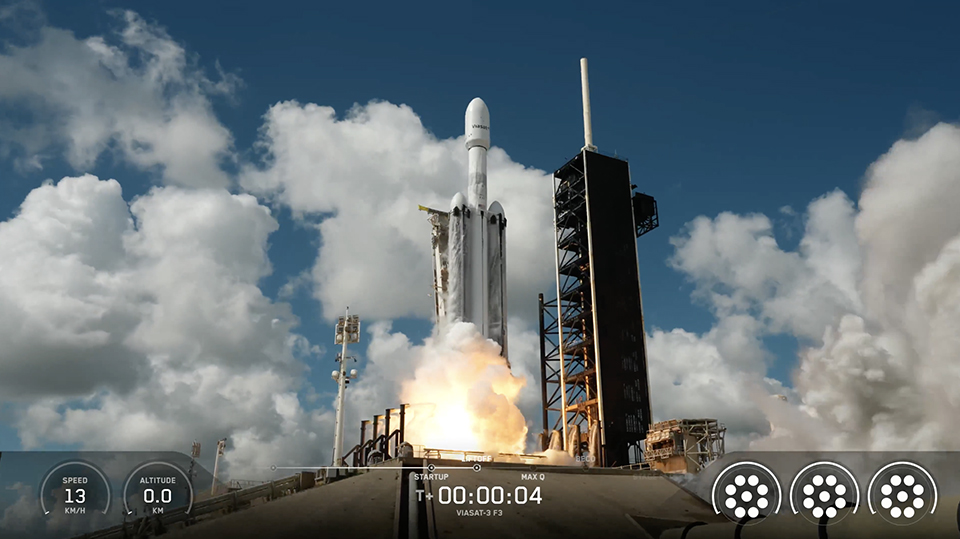
Viasat, Inc. announced the successful launch and initial signal acquisition of its ViaSat-3 Flight 3 (F3) satellite on Wednesday, April 29. The mission, which lifted off at 10:13 a.m. EDT aboard a SpaceX Falcon Heavy rocket from Kennedy Space Center, marks the completion of the company’s next-generation global constellation. Initial telemetry confirmed the satellite is healthy and has begun its journey to geostationary orbit, where it will undergo several months of in-orbit testing before entering commercial service later this year.
Scaling Global Network Capacity
The ViaSat-3 F3 satellite is specifically designed to provide high-speed connectivity across the Asia-Pacific (APAC) region. As the final piece of the three-satellite constellation, F3 joins Flight 1 (Americas) and Flight 2 (EMEA) to provide a unified global network. Each satellite in the class is designed to deliver more than 1 Terabit per second (Tbps) of total throughput, representing a massive expansion in Viasat’s available capacity for commercial aviation, maritime, and defense customers.
Technical Specifications and Beam-Forming Capabilities
Viasat-3 satellites utilize advanced dynamic beam-forming technology to optimize spectral efficiency in real-time. Unlike traditional wide-beam satellites, this architecture allows Viasat to concentrate bandwidth where demand is highest, such as over busy flight corridors or active military operations. The Flight 3 satellite features a high-capacity Ka-band payload and an ultra-large deployable reflector. Following the deployment anomalies experienced by Flight 1, Viasat has implemented refined operational constraints and monitoring protocols to ensure the successful blooming of the F3 antenna system.
Strategic Transition and Leadership Focus
The launch coincides with a significant senior leadership reorganization at Viasat. With the successful integration of Inmarsat concluded, Guru Gowrappan stepped down as President this month, with Chairman and CEO Mark Dankberg assuming direct oversight of the streamlined executive team. Dankberg emphasized that the completion of the ViaSat-3 constellation is a cornerstone of the company’s multi-orbit strategy. “ViaSat-3 F3 will substantially increase capacity that is secure, reliable, and highly flexible for customers operating in APAC while delivering greater bandwidth economics,” Dankberg stated.
Financial Outlook and Capital Intensity Reductions
With the final satellite of the constellation now in orbit, Viasat expects a sustained reduction in capital intensity. The company’s long-term roadmap focuses on transitioning toward a common, lower-mass multi-orbit satellite architecture. This shift is intended to improve free cash flow and strengthen Viasat’s balance sheet as it navigates the competitive “debt wall” facing many major operators. Commercial service for the F3 satellite is expected to begin in late summer 2026, following the completion of bus and payload commissioning.
