

On May 19, 2026, orbital sustainability leader Astroscale Holdings Inc. and satellite communications giant SKY Perfect JSAT Corporation announced a strategic capital and business alliance. As part of a broader 30.6 billion yen growth financing round executed by Astroscale, SKY Perfect JSAT will invest 800 million yen via a third-party allotment of common shares.
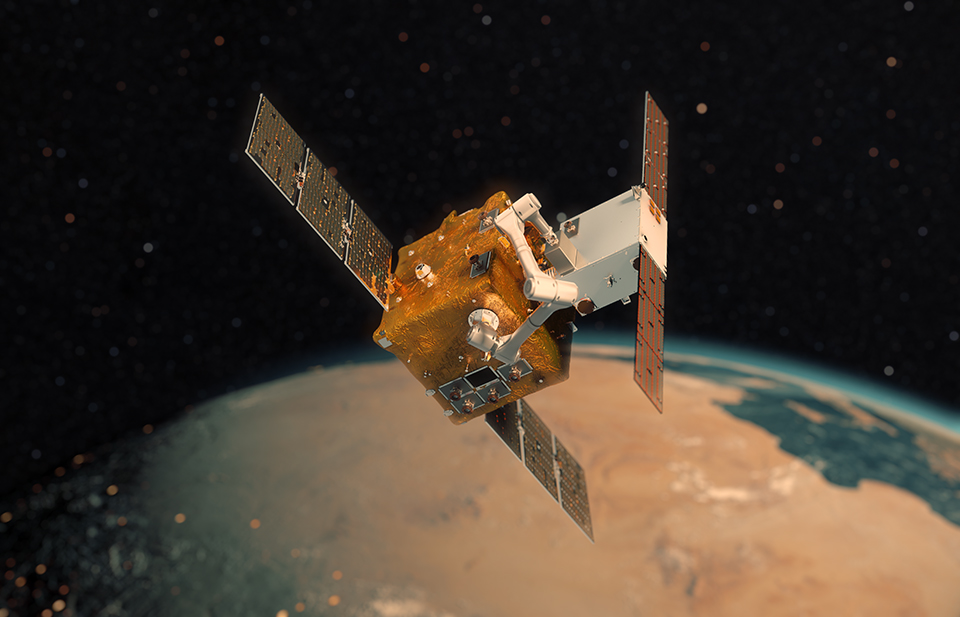
This partnership aims to shift the regional space economy from an era of disposable spacecraft toward an infrastructure ecosystem based on life extension, inspection, and repair.
Strategic Capital Integration and Corporate Motives
The transaction joins Astroscale’s expertise in rendezvous and proximity operations (RPO) with SKY Perfect JSAT’s footprint as Asia’s largest satellite communications operator, currently managing 17 geostationary (GEO) spacecraft.
The investment model relies on an estimated third-party share allotment of 469,483 common shares at an issue price of 1,704 yen per share. The settlement date is scheduled for June 5, 2026. Astroscale intends to use the capital influx to fund facility expansions and mature its technical systems to capture long-term servicing contracts. Simultaneously, SKY Perfect JSAT positions itself to structurally optimize its capital expenditure requirements, extending the operational and revenue-generating lifespans of its massive broadcasting and telecommunications assets without launching costly replacement platforms.
Targeting the Geostationary Life Extension Market
The alliance is specifically optimized to unlock commercial value within the high-revenue geostationary orbital arc. GEO satellites cost hundreds of millions of dollars to build and launch, yet their operational lifespan is structurally limited by the volume of onboard fuel required for station-keeping. Once that fuel is exhausted, an otherwise perfectly functional satellite must be retired to a graveyard orbit.
Astroscale’s on-orbit servicing vehicles address this limitation by providing dynamic fleet maintenance alternatives:
- Precision In-Orbit Inspection: Deploying close-range optical imaging to assess structural degradation or solar array deployment anomalies.
- In-Situ Mechanical Repair: Providing robotic servicing interventions to correct localized equipment failures.
- Propellant Refueling and Lifespan Extension: Docking with fuel-depleted satellites to take over station-keeping propulsion, effectively adding years of operational utility to established fleets.
Synergies with Multi-Orbit Inspection Manifests
The joint development framework expands upon Astroscale’s existing orbital operational portfolio. In April 2026, the firm unveiled its ISSA-J1 mission, a commercial multi-orbit satellite inspection initiative scheduled for a 2027 launch. This mission will see a 650-kilogram servicer approach and inspect two retired Japanese spacecraft, ALOS and ADEOS-II, in distinct orbits using a single flight profile.
By combining the operational data from these low-Earth orbit (LEO) pilot missions with SKY Perfect JSAT’s deep ground infrastructure, teleports, and regional global networks, the partners intend to normalize in-orbit servicing as a standard, predictable business segment. This commercial pipeline is designed to sit alongside traditional satellite broadcasting and Earth observation, building a resilient commercial framework capable of supporting high-density cislunar logistics, defense space domain awareness, and active debris removal.
Industrial Rationale and Changing Space Paradigms
Executive leadership from both firms highlighted that the alliance reflects a changing philosophy toward orbital asset management. Nobu Okada, Founder and CEO of Astroscale, noted that services like refueling offer immediate avenues to maximize fleet efficiency and flexibility, accelerating the delivery of commercially viable solutions.
Eiichi Yonekura, President and CEO of SKY Perfect JSAT, echoed this view, stating that the global space industry is fundamentally moving beyond the historical launch-and-abandon paradigm. He emphasized that on-orbit servicing is the core technology required to sustain this structural transformation, transforming satellites into assets that can be actively maintained, enhanced, and extended in space over the medium to long term.
