

On Sunday, April 19, 2026, Blue Origin reached a significant milestone in orbital reusability with the successful launch and recovery of a previously flown New Glenn first-stage booster.
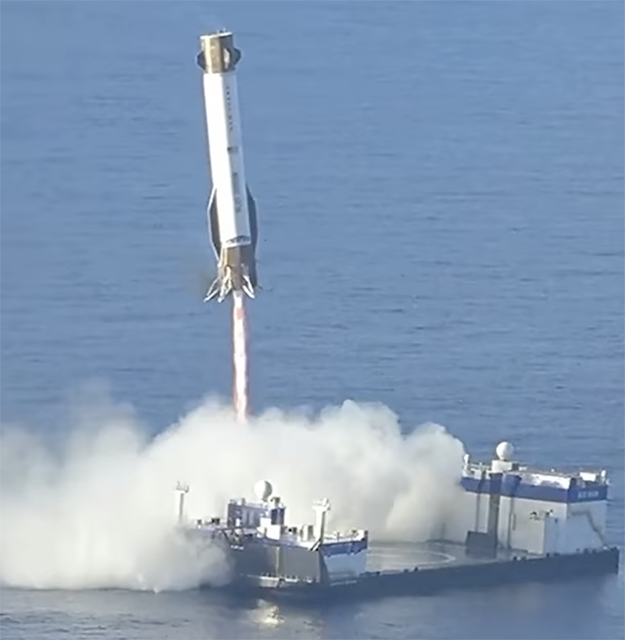
The mission, designated NG-3, lifted off from Launch Complex 36 at Cape Canaveral Space Force Station at 7:25 a.m. EDT. While the 29-story booster, nicknamed “Never Tell Me The Odds,” successfully touched down for the second time on the droneship Jacklyn, the mission faced a partial setback when the primary payload, AST SpaceMobile’s BlueBird 7, was placed into an off-nominal orbit.
Blue Origin confirmed via social media approximately two hours after liftoff that while the satellite had powered on and separated from the second stage, it was not in its intended trajectory. Both companies are currently assessing the health of the spacecraft and determining if onboard propulsion can salvage the mission.
Milestones in Heavy-Lift Reusability
The NG-3 flight serves as the first operational demonstration of New Glenn’s refurbishment and reuse capabilities. The booster used in this mission previously flew on the NG-2 mission in November 2025, which sent NASA’s ESCAPADE probes toward Mars. By successfully landing the same hardware a second time, Blue Origin has joined SpaceX as the only other entity capable of vertically recovering orbital-class boosters at sea.
The achievement is a critical component of Blue Origin’s strategy to increase launch cadence. CEO Dave Limp recently indicated that the company aims to conduct eight to twelve New Glenn flights in 2026, a significant increase from the two launches completed in 2025. This cadence is necessary to meet the massive backlog for customers like Amazon’s Project Kuiper and various national security payloads.
BlueBird 7 Technical Specifications
BlueBird 7 is the second “Block 2” satellite in AST SpaceMobile’s planned direct-to-cellphone internet constellation. Its predecessor, BlueBird 6, was launched on an Indian LVM3 rocket in December 2025. Key technical features of the BlueBird 7 include:
- Massive Aperture: An antenna array spanning roughly 2,400 square feet (223 square meters), one of the largest in low Earth orbit (LEO).
- Connectivity: Designed to deliver cellular broadband (4G/5G) directly to standard, unmodified smartphones.
- Block 2 Upgrades: Enhanced processing power and throughput capacity compared to the earlier BlueWalker 3 demonstrator.
Rationale: Challenging the Launch Monopoly
The success of the booster recovery is a strategic victory for Blue Origin in its pursuit of the heavy-lift market. For years, SpaceX’s Falcon 9 has maintained a near-monopoly on cost-effective, high-frequency launches due to its proven reusability. The ability to recycle New Glenn boosters is the primary mechanism through which Blue Origin intends to offer competitive pricing and reliable scheduling to satellite operators.
The shift toward reusable heavy-lift vehicles is particularly urgent as the industry moves toward mega-constellation deployments. Operators like AST SpaceMobile, which aims to have up to 60 satellites in orbit by the end of 2026, require a stable and affordable launch market to achieve commercial viability.
Outlook for AST SpaceMobile and New Glenn
The off-nominal orbit of BlueBird 7 introduces uncertainty into AST SpaceMobile’s 2026 service rollout. The company has over $1.2 billion in contracted revenue commitments and had intended for this launch to anchor its initial commercial capacity. If the satellite cannot be moved into its target orbit, AST may need to accelerate its upcoming launch manifest to maintain its timeline for nationwide cellular broadband coverage.
For Blue Origin, the focus now shifts to diagnosing the second-stage performance issue that led to the orbital discrepancy. Despite the payload error, the data gathered from the booster’s second flight and landing will inform the refurbishment process for future missions. The company still expects to launch its Mark 1 lunar lander later this year as part of its commitments to the NASA Artemis program, provided the New Glenn upper stage is cleared for flight.
