

Thales Alenia Space, a joint venture between Thales (67%) and Leonardo (33%), announced on Tuesday, May 5, the signing of a €26.1 million Phase 1 contract with the European Space Agency (ESA) for the development of the telescopes for the LISA (Laser Interferometer Space Antenna) mission.
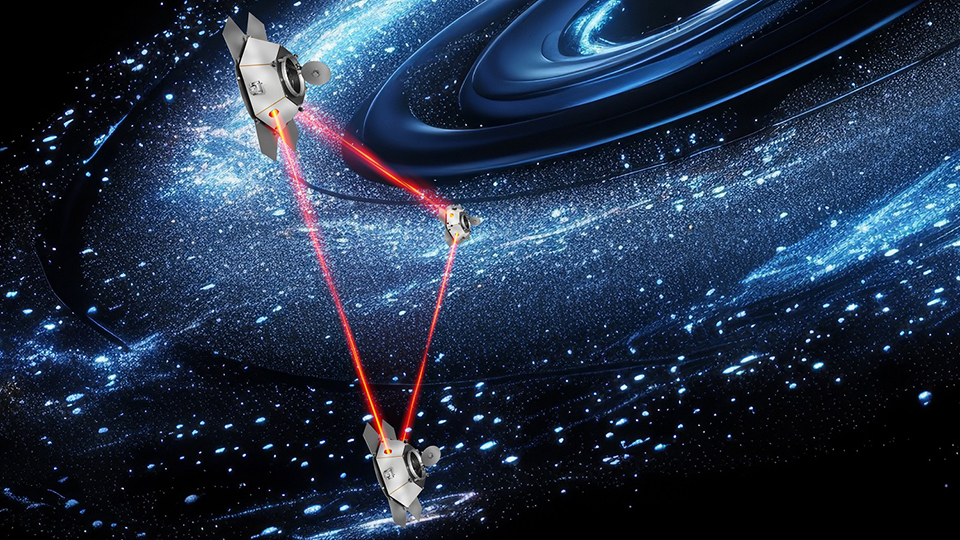
As the first European space-based observatory designed to detect gravitational waves, LISA will observe ripples in spacetime caused by massive cosmic events. This contract marks a major milestone in the realization of the mission, which consists of a three-satellite constellation forming a massive interferometer in space.
Telescope Specifications and Picometer Stability
The Phase 1 contract involves the design, development, assembly, and testing of six ultra-stable telescopes—two for each of the three satellites. These instruments are a primary technical challenge, as they must maintain picometer-level stability while exchanging laser beams over a distance of 2.5 million kilometers. To achieve this, the telescopes will be manufactured entirely from Zerodur®, a glass-ceramic material with extremely low thermal sensitivity.
Thales Alenia Space will collaborate with Thales SESO®, an expert in lightweight Zerodur® mirrors, to ensure the optical precision required to detect distortions in spacetime smaller than the diameter of an atom.
Integration of Critical Spacecraft Subsystems
This latest agreement follows several other major contract wins for Thales Alenia Space on the LISA project. In June 2025, the company was selected by prime contractor OHB System AG to provide the spacecraft avionics, control software, and the Drag-Free and Attitude Control System (DFACS).
More recently, in January 2026, the company signed a €16.5 million contract to provide the mission’s propulsion subsystem. The DFACS is particularly critical, as it must compensate for non-gravitational forces—such as solar radiation pressure—to ensure the satellites follow a purely geodesic path, a requirement for accurate gravitational wave measurement.
Collaborative Science and Strategic Leadership
“LISA represents a pioneering initiative in astrophysics and space exploration that has not previously been attempted,” stated Massimo Claudio Comparini, Deputy CEO of Thales Alenia Space. He emphasized that the company’s capability to produce high-performance optical instruments in series is a significant asset for the mission’s success.
Thales Alenia Space Italia, serving as a member of the LISA Core Team, is leveraging design solutions inherited from a five-year study phase where it acted as the industrial lead, ensuring continuity in the mission’s technical evolution.
Timeline for Global Interferometry
With the Phase 1 development now underway, the LISA mission is advancing toward its scheduled launch in 2035 aboard an Ariane 6 rocket. Following launch, the three spacecraft will enter a heliocentric orbit trailing Earth, forming an equilateral triangle to begin their nominal 4.5-year science phase.
By measuring the differential changes in the length of its arms via laser interferometry, LISA will provide a new perspective on the early universe, black hole mergers, and the fundamental nature of gravity itself.
