

On May 18, 2026, the European Space Agency (ESA) and the Greek Ministry of Digital Governance announced the successful development and commissioning of the Holomondas Optical Ground Station (OGS) in Greece.
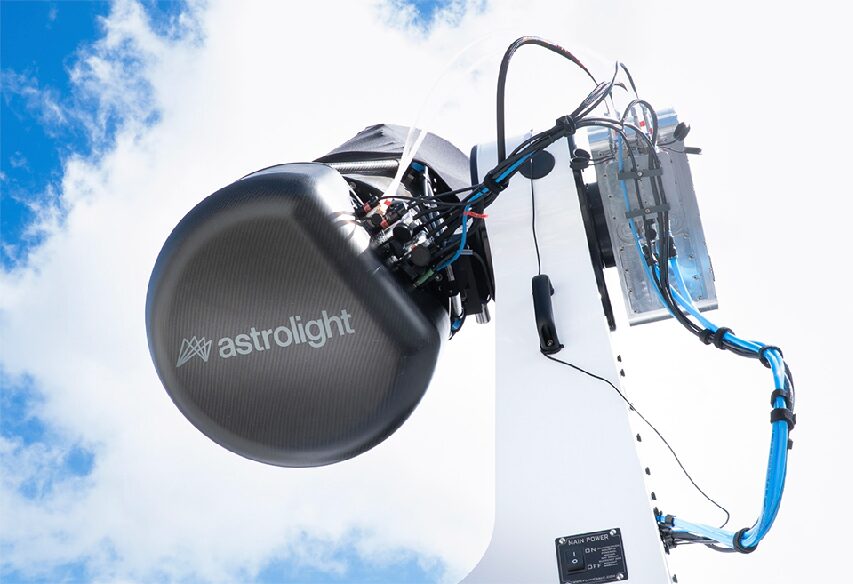
Implemented by Lithuanian space and defense technology company Astrolight in collaboration with the Aristotle University of Thessaloniki, the facility is officially operational. It is now positioned to anchor Europe’s next-generation secure communication network by testing ultra-high-speed satellite-to-Earth laser links.
The Holomondas Upgrade and End-to-End Infrastructure
The milestone represents the transition of the historic Holomondas astronomical observatory into a high-capacity optical communications hub. Astrolight equipped the site with a proprietary optical core, an advanced 808-nanometer laser beacon, and a C-band optical receiver designed to achieve precise beam alignment and data reception speeds of up to 2.5 Gbps under varying atmospheric conditions.
The ground station activation directly coincides with the in-orbit testing phase of two Greek CubeSats, PeakSat and ERMIS-3. Both spacecraft successfully reached low Earth orbit on March 30, 2026, as part of SpaceX’s Transporter-16 rideshare campaign. Astrolight vertically integrated both sides of the mission profile, manufacturing the ground segment systems as well as the compact ATLAS-1 laser communication terminals operating onboard the satellites. This end-to-end configuration streamlines tracking and synchronization, reducing the physical size and cost of the required ground hardware.
Overcoming Spectrum Scarcity and Signal Jamming
The deployment of the Holomondas OGS addresses critical capacity and security bottlenecks inherent to traditional satellite communications. By shifting data transport from radio frequencies to narrow, focused beams of invisible infrared light, optical links bypass the strict licensing and congestion issues currently plaguing the commercial RF spectrum.
Furthermore, laser-based data transfer delivers structural protection against electronic warfare tactics. Because a laser link relies on a highly directional, pencil-thin beam of light, it is nearly impossible for an adversary to intercept or jam the transmission without physically standing directly in the line of sight between the satellite and the ground telescope. This anti-jam capability is a vital strategic asset for the Baltic region and wider European defense sectors, which have faced escalating levels of terrestrial radio and GPS signal interference originating from cross-border electronic counters.
Rationale and the Greek Connectivity Initiative
The PeakSat and ERMIS-3 projects are components of the broader Greek Connectivity Programme, an initiative managed by ESA on behalf of the Hellenic Ministry of Digital Governance and funded via the EU’s Recovery and Resilience Facility. The strategy aims to position Greece as an international data relay center while building out European technological sovereignty.
By validating that low-power, miniaturized terminals like the ATLAS-1 can reliably downlink massive Earth observation datasets to smaller, cost-effective telescopes, the partnership seeks to lay the groundwork for a global broadband network. This architecture will mimic terrestrial fiber-optic cables, linking space-based cloud servers, data centers, and orbital constellations into a single, unjammable communications mesh.
Future Expansion and Regional Optical Networks
Following the completion of the initial Holomondas verification phase, the Greek Connectivity Programme plans to scale its optical footprint across the Mediterranean. The master infrastructure roadmap involves upgrading two additional Greek astronomical facilities—the Helmos and Skinakas observatories—into active optical ground stations.
These sites will be integrated with European quantum key distribution (QKD) initiatives, including compatibility testing with the upcoming EAGLE-1 and SAGA secure architectures. The resulting multi-site network will provide redundant, weather-resilient downlinks, ensuring that if cloud cover blocks the laser path over one observatory, data can be instantaneously rerouted to a clear ground station elsewhere in the region.
