

By Nick David, Editorial Lead, SatNews
Updated Aug. 27, 2026: This article has been updated to add ICEYE Netherlands and ICEYE Korea, both announced after publication, to correct details of the German SPOCK 1 budget submission, the Panzerbrigade 45 timeline, and the Space42 joint venture’s 2025 activity, and to clarify ICEYE’s existing corporate presence in the UAE.
The Bottom Line
- Synthetic aperture radar operator ICEYE has established national entities in Germany, Portugal, India, the Netherlands and Korea inside 49 days and named a country chief executive for the UAE in the same window, a cadence it has not shown before, on a model that has been running since 2025.
- CEO Rafal Modrzewski told SatNews the structure answers governments moving from buying imagery to buying industrial capability: “sovereignty increasingly goes beyond owning or operating a satellite.”
- Poland went from contract signature to a four-satellite constellation its own military operators fly in under 12 months, while France’s first sovereign radar demonstrator does not enter service until early 2029.
Germany on July 8. Portugal on July 9. Abu Dhabi on Aug. 3. Then New Delhi, Amsterdam and Seoul, on three consecutive days this week.
Forty-nine days separate the first of those announcements from the last, and the last three landed inside 72 hours. Five are national entities. Abu Dhabi was a chief executive appointment over a footprint ICEYE already had: the company’s 2024 sustainability report lists three UAE-registered group companies, and the Aug. 3 release announced no new one, describing instead a “long-standing presence.” ICEYE India came with a commitment to build engineering and manufacturing capability inside the country and no named chief executive. ICEYE Netherlands, on Tuesday, paired an Amsterdam entity with a technology hub inside the Dutch defense industrial base under Joost Elstak. ICEYE Korea, on Wednesday, named Eric Rhee head rather than chief executive and disclosed that the entity had been established back in June. No competitor has publicly announced a comparable run of sovereign SAR entity launches in that window.
When SatNews covered the ICEYE UAE appointment three weeks ago, we wrote that we had requested interviews with ICEYE leadership. The company answered in writing on Aug. 18, at length and on the record, through Modrzewski and through Christos Kolimenakis, the former JPMorgan managing director now running ICEYE UAE. Six days later, India landed.
The Groundwork Started in 2025
Bunched together, it reads as a decision someone took in June, but the record starts a year earlier. ICEYE opened a research and manufacturing center in Valencia on May 7, 2025, under Gonzalo García-Muñoz, who holds the ICEYE Spain chief executive title alongside a group role as senior vice president of global operations. Vasilis Chaloulakos became head of ICEYE Greece nine days after that, and Yasuhiro Tsukahara took the Japan chief executive job on Sept. 5, 2025. Ten months of that groundwork preceded this summer’s six announcements.
“The country-leadership model has been a deliberate response to how our business is evolving,” Modrzewski told SatNews. “As more countries move from buying access to intelligence toward owning and operating sovereign space capabilities, the relationship becomes much deeper than a traditional supplier-customer model.”

He named the qualifying test: “We establish that kind of presence where there is both sustained customer demand and a clear case for building meaningful local capability.” And on what comes next: “And yes, we are looking at additional markets.” That was written six days before New Delhi.
Each appointment carries a different mandate. Philipp Herkelmann walks into a business Germany has already built for him: the Rheinmetall joint venture at Neuss, and the €1.7 billion SPOCK 1 award the two companies booked from the Bundeswehr in December. A confidential finance ministry submission to the Bundestag budget committee, reported in February, puts the originally planned value at €1.76 billion, with up to €579.5 million more for the operator contract and a ceiling above €2.7 billion through 2033 if every option is exercised. The ministry argued the funding was urgent because Panzerbrigade 45 takes up its duties in Lithuania on Oct. 1, 2026, and a delayed start would put the units there at risk.
Rui Costa comes out of deep tech and AI, and gets a Lisbon center of excellence to build from scratch. Kolimenakis spent 15 years at JPMorgan, latterly a managing director in its UAE office running Innovation Economy coverage across EMEA. Modrzewski said the differences are deliberate: “There is no single template because the mandate is not identical from one country to another.”
Poland in Ten Months, France in 2029
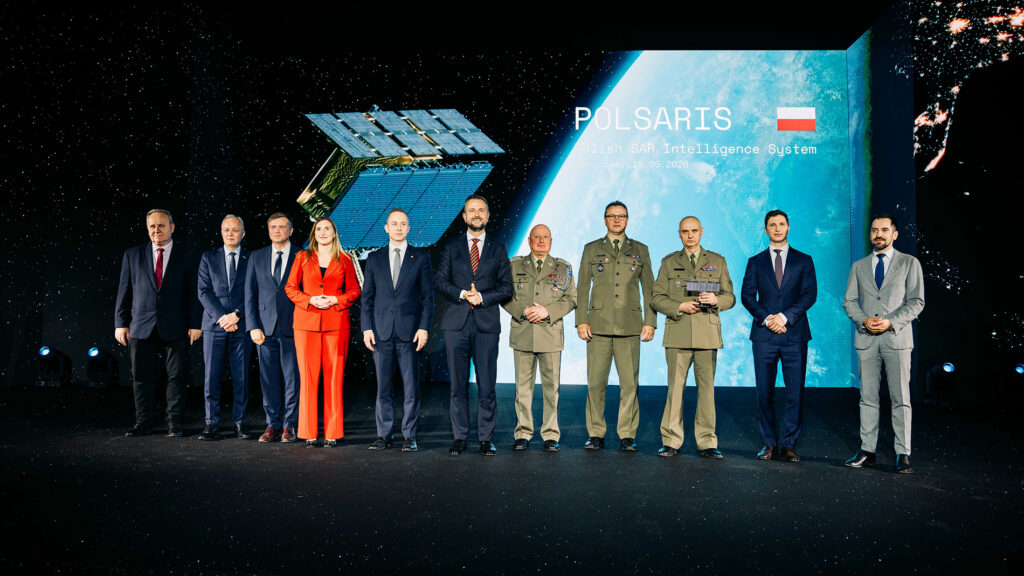
Poland is where the model has already been tested. “We delivered the baseline three-satellite scope within 10 months of signing and had the full four-satellite system operational, with Polish operators trained to run it independently, in less than a year,” Modrzewski wrote. The roughly €200 million MikroSAR contract was signed with the Ministry of National Defence on May 14, 2025, and handover came on May 15 this year. Polish military operators fly the POLSARIS constellation under the oversight of ARGUS, the country’s Geospatial Reconnaissance and Satellite Services Agency. ICEYE does not.
France committed roughly €50 million to DESIR, its first sovereign radar demonstrator, through CNES acting on behalf of the defense procurement agency DGA, for one satellite entering service in early 2029. Loft Orbital is prime, Thales Alenia Space supplies the radar payload and TEKEVER the active antenna.
The two procurements answer different questions. Poland bought slots on a production line that already existed, while France is standing up a national value chain and a new payload alongside it and will wait until 2029 for a single satellite. Both are defensible industrial choices, but only one puts imagery over a commander’s desk this year.
Modrzewski’s own account of what transfers leaves the technology out. “What is repeatable is the combination of a standardized constellation, high-rate production, integrated ground systems and training, and close work with the customer from procurement through operational handover.”
ITAR-Free Travels East
ICEYE’s ITAR-free positioning was built as a European argument, and the Gulf and Indian entities test whether it survives translation.
“For Gulf customers, the value of an ITAR-free system is not that it replaces relationships with U.S. suppliers,” Modrzewski wrote. “It is that it gives governments greater strategic optionality over how a sovereign capability is owned, operated, integrated, and developed over time. Every customer will make those choices differently, and ITAR-free does not mean export control-free.”
The label has limits on the American side as well. ICEYE US holds National Reconnaissance Office radar contracts alongside Capella and Umbra, so ITAR-free describes the European-built systems and not the whole company.
On Monday, the same day ICEYE announced New Delhi, Kongsberg NanoAvionics scaled its own ITAR-free defense bus line up to a 500 kg platform. The term now describes a category of supplier, which puts the weight back on a delivery record.
One Company, Several Industrial Bases
SatNews raised the structural question in May: a customer can be sovereign in day-to-day tasking and still depend on a foreign supplier for sustainment, software and follow-on launches.
Modrzewski answers it directly. Country chief executives get “meaningful autonomy” over local engagement and capability-building, but: “Core technology development, product architecture, manufacturing standards, and major delivery capabilities are coordinated globally… The model is therefore not about creating separate national versions of ICEYE.”

India has spent two decades testing what localization commitments from foreign suppliers are worth. The Comptroller and Auditor General reported in September 2020 on ₹66,427 crore of offset contracts signed between 2005 and March 2018. The ministry had accepted ₹5,457 crore as genuinely discharged, 8% of the total, against the ₹11,396 crore vendors themselves claimed. “Audit did not find a single case where the foreign vendor had transferred high technology to the Indian industry.” India’s Defence Acquisition Procedure 2020, issued days later, wrote offsets out of every ab-initio single-vendor purchase, including procurements based on inter-governmental agreements and Foreign Military Sales, and the country started asking for factories instead. ICEYE arrives in New Delhi offering the factory.
The Balance Sheet
Whether it can mean that depends on what ICEYE can fund. The company reported more than €250 million in 2025 revenue on more than €100 million of EBITDA, against a €1.5 billion order backlog, and CFO Magdalena Bartos told Bloomberg in March that it expects to pass €1 billion in revenue in 2027. Those are company figures, unaudited, with no accounting framework specified.
Almost nobody else in sovereign SAR generates that kind of operating cash. Japan’s two listed radar operators lose money at the operating line, with QPS Holdings posting a ¥833 million operating loss for the year to May 2026 and Synspective guiding to a ¥5.5 billion operating loss for 2026, and both reliant on non-operating subsidy income for any net profit. Capella has been an IonQ subsidiary since July 2025, and Umbra discloses no financials at all. Airbus Defence and Space earned €798 million on its own EBIT Adjusted measure from €13.4 billion of 2025 revenue, but owns no new commercial radar constellation and resells Synspective data to fill the gap.
Distributed assembly and test is a fixed-cost commitment, and the primes generally take it on against a customer’s budget as an offset line. On the figures it reports, ICEYE could carry that cost without one.
The test now is how fast an entity turns into a building with people in it. Kolimenakis describes the UAE build-out as “progressively expanding the work carried out locally across satellite assembly, integration and testing,” and gives a window: “an exciting 12-18 months ahead of us.” No headcount, floor space or facility date is attached to it, though the work builds on the Space42 manufacturing joint venture. Announced in December 2024, that venture ran its first assembly, integration and test campaign in Abu Dhabi during 2025, on satellites produced in Finland. India got the entity and the manufacturing commitment together but has no country chief executive and no facility date, three months after Modrzewski told Indian press a plant was six to 12 months away.
Two dates set the near-term test. German production is scheduled to begin at Neuss in Q3 2026, inside the next 34 days, with Panzerbrigade 45 taking up its duties in Lithuania on Oct. 1. India’s own six-to-12-month clock runs out somewhere between November and next May.
About the Author
A storyteller at heart, Nick David covers space policy, satellite markets, defense, and the technologies reshaping how humanity operates beyond Earth. With a background in creative direction, brand strategy, and editorial storytelling, he brings a modern lens to complex subjects and a relentless curiosity about what comes next.
