

On Wednesday, September 9, 2026, satellite operator Eutelsat Group and French NewSpace ground station provider Skynopy signed a strategic partnership agreement at the International Space Summit in Paris.
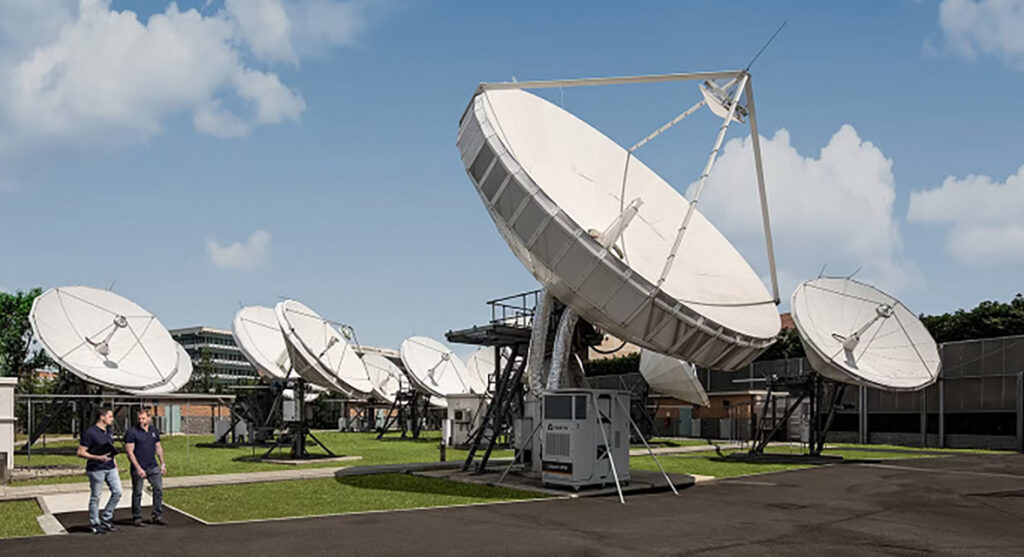
The initiative establishes “Global AKAR,” a software-defined global ground network designed to provide low-latency, high-throughput ground station services for low Earth orbit (LEO) satellite operators.
Ground Segment Integration Context and Market History
The agreement connects Eutelsat’s international teleport footprint with Skynopy’s software-defined modem technology and cloud orchestration framework. Historically, ground segment infrastructure has been fragmented, requiring constellation operators to build proprietary antenna networks or manage disparate ground contracts.
Global AKAR scales Skynopy’s virtualized ground network architecture, which previously demonstrated rapid deployment capability across commercial Earth observation and in-orbit hosting missions. The initiative expands on Skynopy’s ground station connectivity partnership with in-orbit hosting provider SpaceLocker, alongside commercial integrations providing virtualized ground services for Earth observation primes such as Airbus Defence and Space for Pléiades Neo constellation support.
Technical Network Specifications and Software Orchestration
Global AKAR converts Eutelsat’s teleports into an on-demand, virtualized gateway infrastructure across S-, X-, and Ka-band frequencies. The software architecture allows third-party constellation operators to access Eutelsat ground assets via a unified interface.
Key performance specifications of the Global AKAR network include:
- Latency Reduction: Targets data downlink latency of less than 3 minutes from satellite pass to cloud delivery, replacing legacy ground delivery averages of approximately one hour.
- Throughput Expansion: Delivers data transfer speeds up to 10 Gbps via software-defined RF processing, expanding upon standard ground link throughputs of 1 to 2 Gbps.
- Proprietary Cloud Orchestration: Utilizes Skynopy’s cloud-native orchestration software and virtualized modems to dynamically allocate antenna resources and automate pass scheduling.
- Tri-Band Support: Provides simultaneous tracking and reception in S-band (telemetry and command), X-band (payload data downlink), and Ka-band (high-volume payload transmission).
Commercial Market Rationale and Sensitive Payload Security
By opening selected Eutelsat ground facilities to external satellite operators, the partnership creates a shared data backbone for Earth observation constellations, orbital data centers, and in-orbit servicing spacecraft. Customers gain distributed global coverage without incurring the capital expenditure required to design, site, build, and maintain independent ground stations.
Furthermore, the network’s virtualized architecture features encrypted interfaces engineered to meet stringent defense, security, and institutional data handling standards. This enables government space agencies and commercial defense providers to route classified or time-sensitive intelligence data directly through secure ground gateways.
Executive Leadership Viewpoints
“Eutelsat’s global ground station network is a significant asset supporting our satellite operations and customers worldwide,” stated Jean-François Fallacher, Chief Executive Officer of Eutelsat. “Global AKAR will extend the value of that infrastructure, opening it to new customers and applications while continuing to support our own requirements. By combining Eutelsat’s global footprint and operational expertise with Skynopy’s technology, we are creating a new commercial offering to meet growing demand across the LEO market.”
“Global AKAR is the alliance of a European champion, Eutelsat, and one of France’s most promising start-ups, Skynopy, working hand in hand to offer the best service on the missing element of the space economy: the ground segment,” stated Pierre Bertrand, Chief Executive Officer and Co-Founder of Skynopy.
Operational Deployment Horizon Through 2029
The partnership will deploy more than 100 operational software-defined antennas across designated Eutelsat teleport sites globally by the end of 2029. Initial software integration and site retrofits will commence across European and international teleports through late 2026, establishing early-capacity LEO data downlinks ahead of full network scaling.
