

On Sept. 13, 2007 (Sept. 14 at 10:31 a.m. local time at the launch site), Japan successfully launched the Kaguya spacecraft from the Tanegashima Space Center aboard an H-IIA launch vehicle.
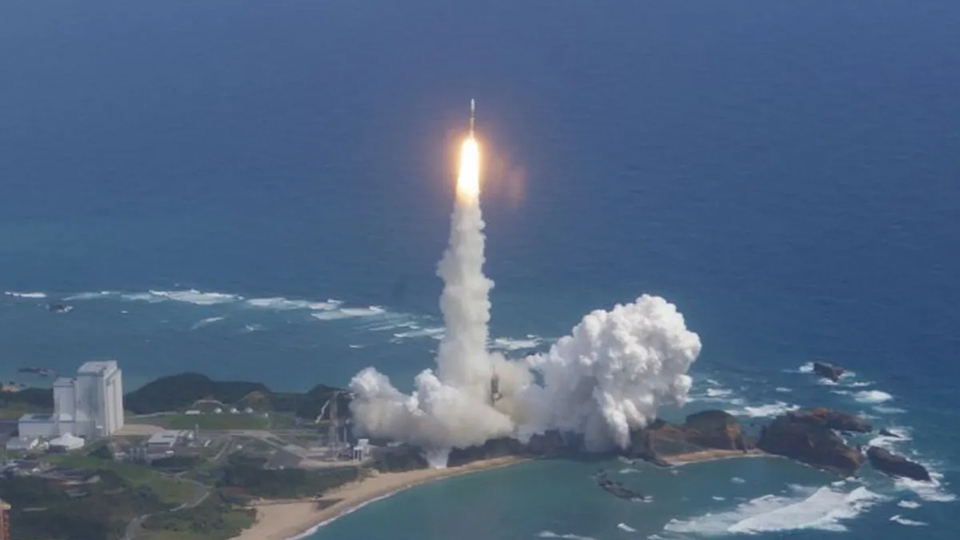
Officially designated as the SELenological and ENgineering Explorer (SELENE), the spacecraft represented Japan’s second lunar mission and its first probe to enter a dedicated operational orbit around the Moon.
Why it mattered
The Kaguya moon mission was actually the second lunar probe launched by Japan, but it was the country’s first spacecraft to actually orbit the moon. (Japan’s Hiten spacecraft launched in 1990, but it flew in a highly elliptical orbit around Earth that allowed it to make 10 flybys of the moon before crashing into the lunar surface in 1993. It also released a small probe called Hagoromo near the moon.)
But while the Hiten and Hagoromo missions were designed to test technology for a future moon mission, Kaguya put all that tech into practice. The probe was renamed after the moon princess Kaguya-hime from a Japanese folktale shortly after launch as a result of a public poll. The two small satellites it carried were named Okina (a relay satellite) and Ouna (a radio source experiment).
Kaguya translated those initial engineering validation tests into a fully realized operational orbital survey. Shortly after launch, the probe was named Kaguya after a lunar princess from traditional Japanese folklore following a nationwide public poll.
The mission architecture comprised three distinct spacecraft operating in tandem: a main orbiter, a small communications relay satellite named Okina, and a radio source experiment microsatellite named Ouna dedicated to mapping lunar gravity fields. After completing two preliminary Earth loops, Kaguya executed a 20-day transit to the Moon to begin its primary scientific observational survey.
Equipped with 14 scientific instruments alongside dual high-definition optical cameras, Kaguya delivered unprecedented spatial and topographical data. The spacecraft captured the first high-definition video and imagery of the lunar landscape, including iconic sequences of Earthrise over the lunar horizon that had not been documented since NASA’s Apollo program. Beyond visual data, the satellite generated a complete global topographical map of the Moon, mapped gravitational anomalies across both the near and far sides, and acquired the first optical observations of the permanently shadowed interior of Shackleton Crater near the lunar south pole.
Following the successful completion of its primary observation mission in October 2008, Japan Aerospace Exploration Agency mission planners intended to extend operations into early 2009. However, a malfunction in a reaction wheel forced controllers to bring the extended flight to an early close. Engineers subsequently directed Kaguya into a controlled, planned crash landing on the lunar surface near Gill Crater, concluding the mission.
