

Between Aug. 31 and Sept. 1, 2026, the European Space Agency (ESA) completed the operational lifecycle of its Cluster II magnetospheric observation mission as the final two identical spacecraft, Samba (Cluster 3) and Tango (Cluster 4), executed targeted atmospheric reentries over a remote sector of the South Pacific. Samba entered the atmosphere on Aug. 31 at 23:39:38 CEST, followed approximately 24 hours later by Tango on Sept. 1 at 23:30:31 CEST.
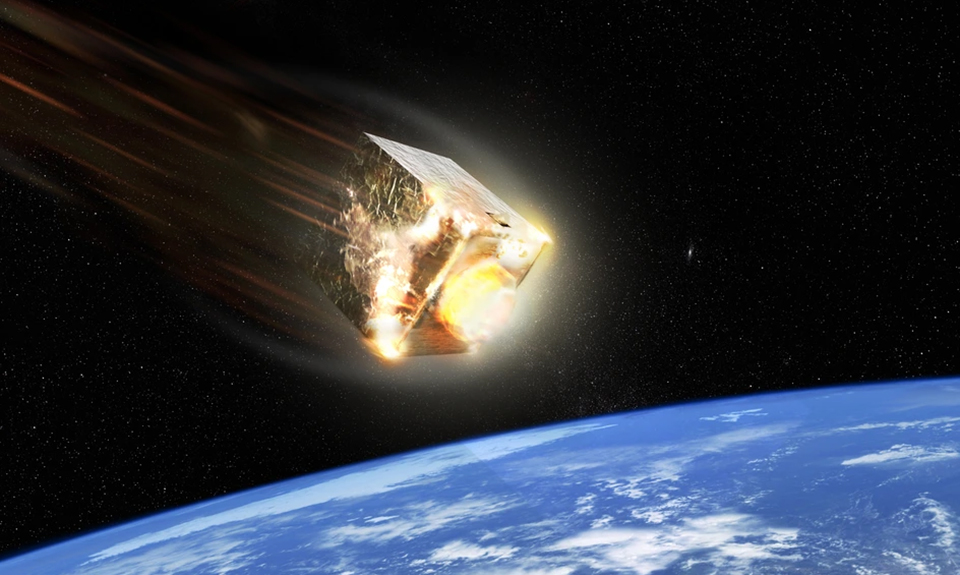
An international scientific team conducted an airborne observation campaign designated ROSIE (Re-entry Observation Setup and International Execution) to monitor the breakup sequence. Flying from Tonga aboard a specialized Dassault Falcon 900 research aircraft, scientists gathered empirical optical, infrared, and spectroscopic data to measure satellite fragmentation and metallic vapor composition during reentry.
Operational Context and Targeted Disposal Strategy
Originally launched in 2000 to study Earth’s magnetosphere, the four Cluster satellites predated modern international orbital debris mitigation mandates. Because their highly elliptical orbits rendered conventional powered reentries unfeasible, ESA flight dynamics controllers at the European Space Operations Centre (ESOC) implemented a targeted natural decay strategy. Operators conducted orbital trim maneuvers several months in advance, allowing solar and lunar gravitational perturbations to gradually lower each spacecraft’s perigee into the dense atmosphere above uninhabited ocean waters.
The reentries of Samba and Tango concluded a multi-year disposal campaign that previously saw sister spacecraft Salsa enter the atmosphere on Sept. 8, 2024, and Rumba reenter on Oct. 22, 2025. The identical structural mass and composition of the four satellites provided researchers with a rare control baseline to test atmospheric demise models across varying entry speeds, angles, and atmospheric conditions.
ROSIE Instrumentation and Data Collection Operations
The ROSIE observation mission—led by the University of Stuttgart’s Institute for Space Systems (IRS) alongside project management lead Astros Solutions, Comenius University, Hypersonic Technology Göttingen, and Zafiro Systems—deployed a payload array designed to evaluate high-temperature structural breakdown.
- Observation Platform: Modified Dassault Falcon 900 aircraft operating at localized high altitude
- Payload Sensor Suite: 30 scientific instruments arranged across six dedicated observation stations
- Instrument Distribution: High-speed visual imaging cameras, broad-spectrum infrared sensors, and specialized spectrometers
- Observational Yield: 29 of 30 onboard instruments successfully recorded Samba’s 50-second fragmentation sequence, while aircraft positioning maneuvers during Tango’s entry allowed extended tracking of luminous debris trails
Atmospheric Impact Modeling for LEO Constellations
The spectroscopic measurement signatures gathered during the ROSIE campaign aim to isolate atomic lines emitted as aluminum alloys and onboard components melt and vaporize in the upper atmosphere. These measurements provide critical empirical data regarding the release of aluminum oxide particulates into the stratosphere, an environmental metric gaining scrutiny as high-density Low Earth Orbit (LEO) broadband constellations increase the frequency of satellite decommissionings and atmospheric disposals.
Data Processing Timeline
Participating research institutions have begun processing the high-speed optical and spectral data files recovered from the Falcon 900 flight. The compiled datasets will be integrated into international space debris and aerothermodynamic reentry models over the coming months to refine predictive software for future satellite design and controlled disposal requirements.
