TOKYO, JAPAN — On Tuesday, July 7, 2026, Japanese small satellite manufacturer Seiren Co., Ltd. finalized a tripartite satellite communications contract alongside global space services provider SSC Space and cloud-based ground station operator Infostellar Inc.
The agreement establishes an international, automated Ground-Segment-as-a-Service (GSaaS) pipeline to support telemetry, tracking, and control (TT&C) operations for Seiren’s upcoming FUSION-1 technology demonstration mission.
The commercial collaboration highlights a structural maturation within Japan’s commercial aerospace ecosystem. It transitions prominent, century-old industrial manufacturing conglomerates away from single-source reliance on legacy domestic state-run ground tracking infrastructure and positions them toward flexible, software-defined global antenna networks.
Virtualizing the SmallSat Downlink Pipeline
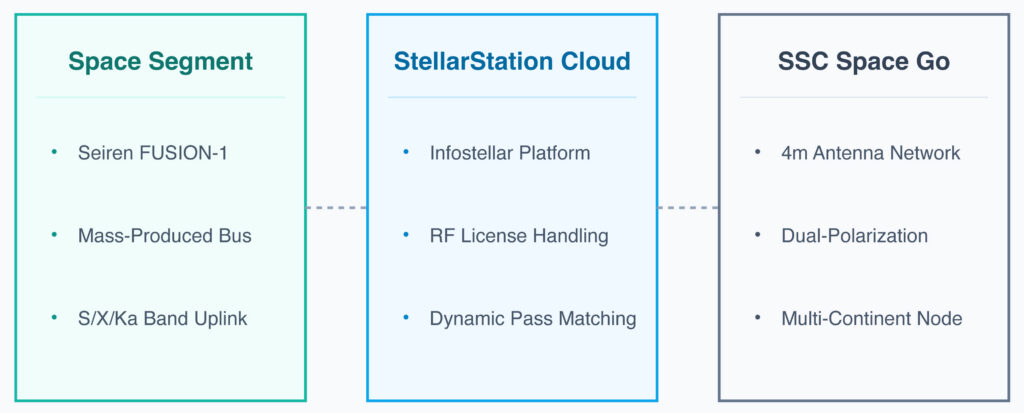
The telemetry and payload tracking matrix for the FUSION-1 campaign integrates hardware assets from SSC Space with the cloud-virtualization software engine managed by Infostellar:
- StellarStation Software Integration: Infostellar’s proprietary cloud-virtualization platform, StellarStation, functions as the central software interface for the mission. The platform ingests orbital pass profiles and dynamically matches FUSION-1 tracking windows with geographically optimal ground antennas, handling radio frequency (RF) licensing acquisition and regulatory frequency coordination on a single unified console.
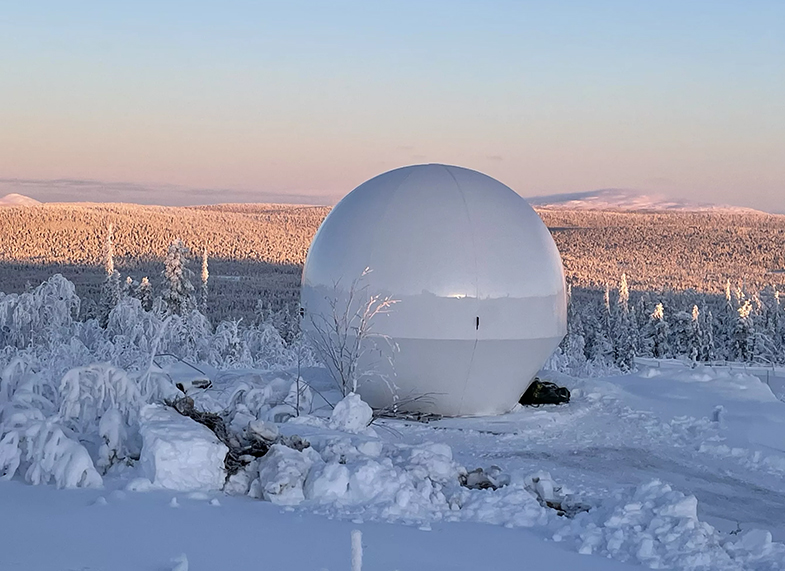
- SSC Space Go Network Ingestion: The automated scheduling loops map directly onto SSC Space Go, the recently deployed, specialized small-satellite ground network layer operated by SSC Space (formerly the Swedish Space Corporation). The service provides the FUSION-1 mission with priority access to a globally distributed ring of compact, 4-meter-class antennas capable of execution across S-, X-, and Ka-band frequencies. The architecture includes simultaneous dual-polarization payload downlinks routed through highly secure, multi-tenant ground installations situated at Esrange Space Center in northern Sweden, Inuvik in northern Canada, and Punta Arenas in southern Chile.
Upgrading Textile Giants Into SmallSat Providers
The FUSION-1 mission marks a major operational expansion for Seiren Co., Ltd., a legacy Japanese enterprise founded in 1889 as a comprehensive textile and industrial materials manufacturer. Over the past decade, Seiren has systematically leveraged its core precision weaving, automated assembly, and high-durability polymer technologies to capture market share within the aerospace hardware sector.
The company initially validated its satellite manufacturing capabilities by leading the structural development of the Fukui Prefectural Citizens’ Satellite Project, which successfully launched the RWASAT-1 CubeSat in 2021. Backed by strategic subsidy allocations from the Fukui Prefecture designed to incubate a self-sustaining regional space business cluster, Seiren has established an active, full-scale mass production pipeline for small satellite buses and Synthetic Aperture Radar (SAR) antenna arrays in a technical collaboration with radar imaging specialist Synspective. The FUSION-1 campaign serves as the company’s pathfinder foray into end-to-end mission control operations, laying the groundwork to export commercial Japanese-built satellite constellations to international operators.
Regional Market Drivers and Cloudification
The integration of Seiren’s hardware with international ground networks aligns with a broader trend of ground segment cloudification sweeping through the Asia-Pacific aerospace market. As the demand for persistent Earth observation data and low-latency internet of things (IoT) applications accelerates throughout Japan, satellite operators face severe bottlenecks if they rely exclusively on localized, fixed-antenna arrays subject to regional terrain blockages and meteorological interference.
By utilizing virtualized ground architectures, Japanese space ventures can bypass the capital-intensive process of constructing dedicated ground terminal infrastructure. This reduces operational overhead, guarantees high link availability through automated global path diversity, and accelerates the time-to-market for sovereign commercial constellations looking to deploy multi-satellite configurations across diverse orbital planes.
Global Ground Routing Framework