

The rapid deployment of automated guided vehicles (AGVs) and autonomous mobile robots (AMRs) has fundamentally transformed modern factories and distribution centers.
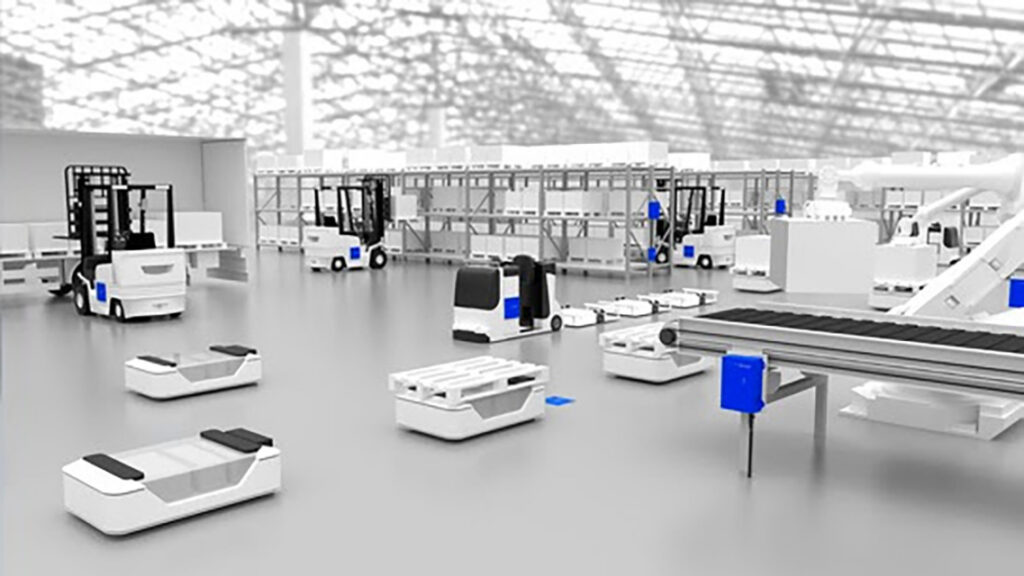
Yet, while fleet management software, navigation algorithms, and hardware interoperability (such as the VDA 5050 standard) receive meticulous strategic planning, one critical element is routinely left to chance: the power supply.
Historically treated as isolated procurement items, fragmented charging systems have quickly evolved into severe cost drivers. Transitioning from individual vehicle charging sockets to a harmonized, operator-controlled energy architecture has become an operational necessity.
The Cost of Fragmentation: Isolated Charging “Islands”
In typical automotive plants or fulfillment centers, automation projects are scaled incrementally—one vendor supplies the assembly line tuggers, another manages goods-inward transport, and a third handles order picking. When left to individual vendors, each brings proprietary charging hardware, registers independent rated connection capacities with the local grid, and dictates its own floor placement.
This piecemeal approach introduces significant facility inefficiencies:
- Redundant Capital Expenditures: Running five separate AGV projects frequently results in five independent, vendor-locked charging setups, multiplying material and contractor installation costs.
- Inflated Grid Connection Demands: Proprietary “island” infrastructures require utility connection capacities calculated for a theoretical worst-case scenario where every vehicle charges simultaneously at peak power.
- Lost Operational Real Estate: Every square meter allocated to a single-vendor charging bay is high-value floor space removed from core, value-generating material throughput.
“The fragmentation of the charging infrastructure is a relic from a time when automated guided vehicle projects were viewed as isolated islands,” explains Matthieu Ebert, Director of Product & Technology at Wiferion, a PULS brand. “Today, as companies seek to network and scale their fleets, this approach is becoming a bottleneck.”
Shifting Infrastructure Ownership to the Operator
Other industrial sectors have long recognized that infrastructure standardization is a prerequisite for scaling. Consumer electric vehicles utilize universal charging ports, and the manual forklift sector standardized around the Rema plug decades ago.
By taking strategic control of the charging infrastructure during initial greenfield or brownfield design phases, intralogistics operators unlock substantial economic advantages:
  TRADITIONAL ISOLATED SITES             HARMONIZED ENERGY INFRASTRUCTURE
 +----------------------------+         +--------------------------------+
 | [Vendor A] -> Charger A    |         |        [Universal Power Grid]  |
 | [Vendor B] -> Charger B    |  ---->  |                   |            |
 | [Vendor C] -> Charger C    |         |        [Unified Charging Pad]  |
 | (Over-allocated grid peak) |         |        /          |         \  |
 +----------------------------+         |    [AGV A]     [AGV B]   [AMR C]
                                        +--------------------------------+
- Grid Power Optimization: In real-world workflows, a harmonized infrastructure allows operators to utilize dynamic load balancing. Fleet vehicles rarely experience peak charging demands simultaneously, allowing facilities to drastically trim nominal utility connection thresholds and slash peak-load grid fees.
- Minimized Installation Overheads: The raw hardware cost of an industrial charger typically doubles once cabling, circuit protection, physical floor anchoring, and electrical commissioning are factored in. Consolidating the network minimizes the total number of physical nodes required.
Inductive Charging as the Interoperable Backbone
While standardizing physical plugs works well for manual machines, implementing universal mechanical connectors across a diverse fleet of automated robots introduces severe design constraints due to varying vehicle chassis heights, docking clearances, and localized contact wear.
Contactless inductive fast-charging platforms, such as Wiferion’s etaLINK series, bypass these mechanical restrictions entirely. Inductive energy transfer provides the exact hardware flexibility needed to anchor an operator-controlled, multi-vendor fleet:
| Operational Feature | Impact on Fleet Management |
| Omnidirectional Approach | Vehicles can enter a charging pad from any angle, simplifying AMR routing algorithms. |
| High Positioning Tolerance | Up to 40 mm of spatial alignment leeway accommodates diverse vehicle dimensions and docking styles. |
| Encapsulated IP65 Architecture | Zero mechanical wear parts, zero exposed contacts, and zero spark risks, making it fully compatible with cleanrooms or high-dust industrial floors. |
| Integrated CAN Bus Data | Automatic data exchange with the vehicle’s Battery Management System (BMS) initializes power transfer in under a second, maximizing brief “in-process” opportunity charges during natural routing stops. |
Designing for Long-Term Scalability
Treating the warehouse power supply as an architectural foundation rather than a vendor-supplied afterthought eliminates supplier lock-in.
As facilities continue to embrace open fleet control protocols, establishing a unified, wireless charging grid ensures that the underlying energy architecture can scale seamlessly alongside the business—powering the first pilot deployment up to a fully automated, cross-vendor industrial footprint.
