

NIGRÁN, Spain, and VILNIUS, Lithuania – August 4, 2026 – Targeting the environmental drag constraints of sustained operations in Very Low Earth Orbit (VLEO), satellite developer Kreios Space contracted small satellite manufacturer Kongsberg NanoAvionics on August 4, 2026, to provide the satellite platform for the first orbital demonstration of an air-breathing electric propulsion system.
The in-orbit demonstration will validate atmosphere-ingesting propulsion capabilities at orbital altitudes between 150 km and 300 km.
Spacecraft and Propulsion Specifications
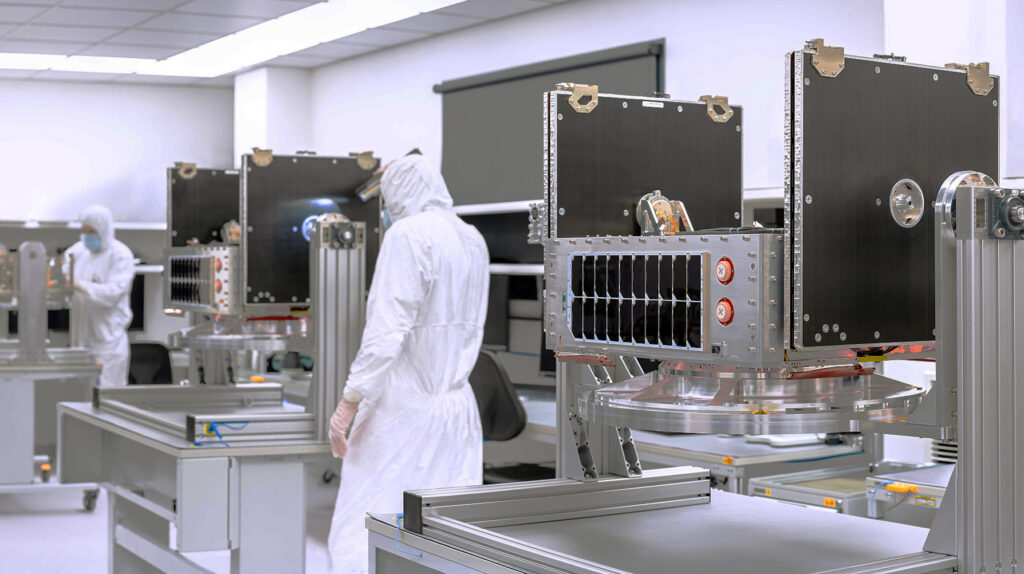
The mission centers on NanoAvionics’ flight-proven MP42 microsatellite bus, configured to an approximate wet mass of 200 kilograms in its final operational setup. The spacecraft will integrate Kreios Space’s Air-Breathing Electric Propulsion (ABEP) thruster alongside a high-resolution visible and near-infrared (VNIR) optical payload.
Rather than relying on heavy onboard chemical or noble-gas propellants, the ABEP system uses an atmospheric intake to collect residual oxygen and nitrogen molecules present in the upper thermosphere. The collected gas is ionized and accelerated through an electric thruster, counteracting atmospheric drag to enable extended operational lifetimes in low altitudes without onboard propellant mass penalties.
VLEO Market Dynamics and Platform Heritage
Operating in VLEO offers distinct physical advantages for Earth observation and satellite communications, including enhanced sensor spatial resolution, reduced signal propagation latency, and lower launch energy requirements. However, atmospheric drag historically degraded unmaintained orbits within weeks.
The contract expands the operational footprint of NanoAvionics’ MP42 platform, which is currently deployed across multiple specialized payloads including the Eycore SAR demonstrator mission.
Executive Directives on Low-Orbiting Platform Mobility
“Kreios is building the satellites that make sustained operations in Very Low Earth Orbit possible,” said Adrián Senar, CEO of Kreios Space. “By enabling satellites to fly lower, longer, and more efficiently, we are enabling higher-resolution Earth observation, much better satellite communications, more responsive and accurate missions, and a more sustainable orbital infrastructure. Partnering with NanoAvionics in our first in-orbit flight provides us with a satellite bus and market-leading experience necessary to allow us to test our new technology in confidence.”
“Kreios is tackling one of the most demanding operating environments in space, and this mission joins a very short list of European VLEO initiatives,” said Atle Wøllo, CEO of Kongsberg NanoAvionics. “This contract reflects our customers’ continued confidence in the maturity of our platforms and our ability to tailor them for demanding new mission profiles. Our engineering team has worked closely with Kreios to configure the MP42 satellite bus to the mission’s specific requirements.”
Integration and Operational Flight Timeline
Under the agreement, NanoAvionics will customize the MP42 bus, integrate the optical payload and ABEP propulsion unit, conduct full environmental testing, and execute initial in-orbit commissioning before transferring operational control to Kreios Space.
