

In a major regulatory step to expand its low-Earth orbit (LEO) satellite footprint, Amazon filed an application with the Federal Communications Commission (FCC) late Friday, July 24, 2026, requesting authorization to deploy up to 5,105 next-generation satellites designed for direct-to-device (D2D) cellular connectivity.
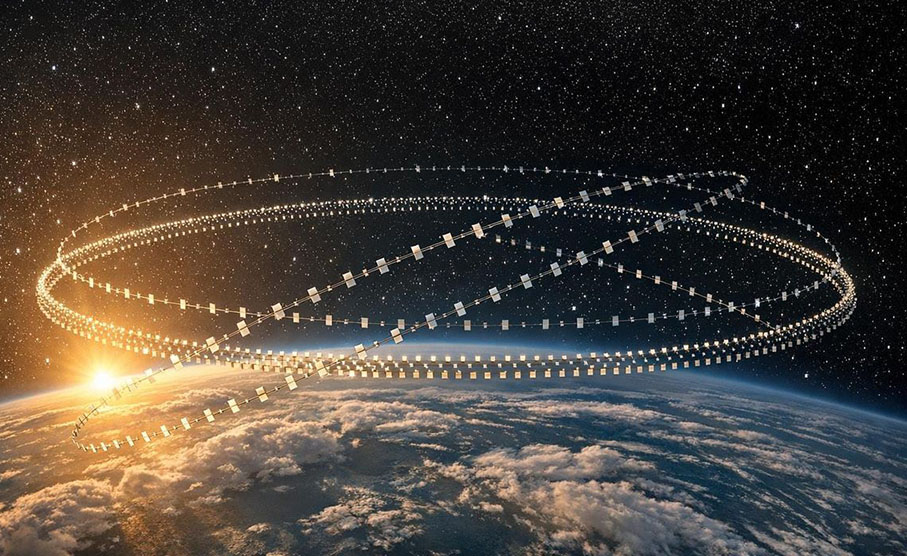
The proposed network architecture aims to provide satellite-based voice, data, and emergency communications directly to unmodified mobile smartphones, positioning the company as a direct competitor to terrestrial non-terrestrial network (NTN) providers and Starlink’s Direct-to-Cell framework.
The filing, submitted under the commercial brand Amazon Leo (formerly Project Kuiper), marks a significant evolution in the company’s space-based telecommunications strategy, transitioning from fixed broadband terminal delivery toward mass-market consumer device connectivity.
Constellation Architecture and Technical Specifications
According to the regulatory submittal, the proposed 5,105-satellite system will operate in low Earth orbit to deliver supplemental coverage from space. The spacecraft will feature advanced phased-array antennas, on-board digital processing, and optical inter-satellite links (OISLs) to route traffic dynamically across the constellation without requiring immediate ground station hops.
| Operational Parameter | Specification / Target Metric |
| Proposed Constellation Size | 5,105 Satellites |
| Primary Target Services | Voice, Data, Text, and Emergency D2D |
| In-Space Routing | Optical Inter-Satellite Links (OISLs) & On-Board Processing |
| Service Integration Horizon | Targeted Commercial Operations Starting 2028 |
The system architecture is engineered to support low-power handshakes with standard cellular handsets, expanding beyond basic SMS messaging to support real-time streaming data and voice calls.
Context of Orbital Expansion and Program Evolution
Amazon’s initial direct-to-home broadband system, originally authorized for 3,236 satellites, began operational deployments with heavy-lift launches across United Launch Alliance, Arianespace, and SpaceX rockets. To support production and launch integration for its satellite fleets, Amazon constructed a 100,000-square-foot payload processing facility at Kennedy Space Center in Florida, capable of handling multiple simultaneous launch campaigns.
The new direct-to-device application leverages spectrum assets gained through strategic commercial agreements and regional partnerships, allowing the operator to bridge gap areas where ground-based cell towers are economically or geographically unfeasible.
Strategic Market Rationale and Multi-Orbit Dynamics
The move into D2D connectivity reflects a broader satellite communications trend toward Supplemental Coverage from Space (SCS), where mobile network operators (MNOs) partner with satellite operators to eliminate global cellular dead zones. By enabling unmodified smartphones to establish satellite links, Amazon aims to integrate its orbital network directly into existing commercial telecom ecosystems and enterprise cloud architectures supported by Amazon Web Services (AWS).
In the FCC submission, Amazon regulatory counsel noted that the augmented constellation is structured to advance ubiquitous mobile access:
“The proposed satellites would support the leap from basic messaging to voice and data services, ensuring users retain critical connectivity regardless of terrestrial infrastructure availability.”
Regulatory Steps and Deployment Timeline
The FCC will review Amazon’s application under its Supplemental Coverage from Space regulatory framework, assessing potential spectrum coordination, orbital debris mitigation plans, and interference protection criteria for terrestrial wireless networks. Pending regulatory approvals and hardware qualification tests, Amazon targets initial orbital deployments for the D2D constellation to begin in 2028, expan
