

CAPE CANAVERAL, FL — At the Spacetide space commerce conference, Blue Origin Senior Vice President of Lunar Permanence John Couluris confirmed that engineering, assembly, and integration work on its Blue Moon lunar lander lines remains insulated from the launch infrastructure recovery underway in Florida.
The update follows the catastrophic May 28, 2026, launchpad explosion at Launch Complex 36 (LC-36A) that destroyed an integrated New Glenn vehicle during a pre-launch static fire test.
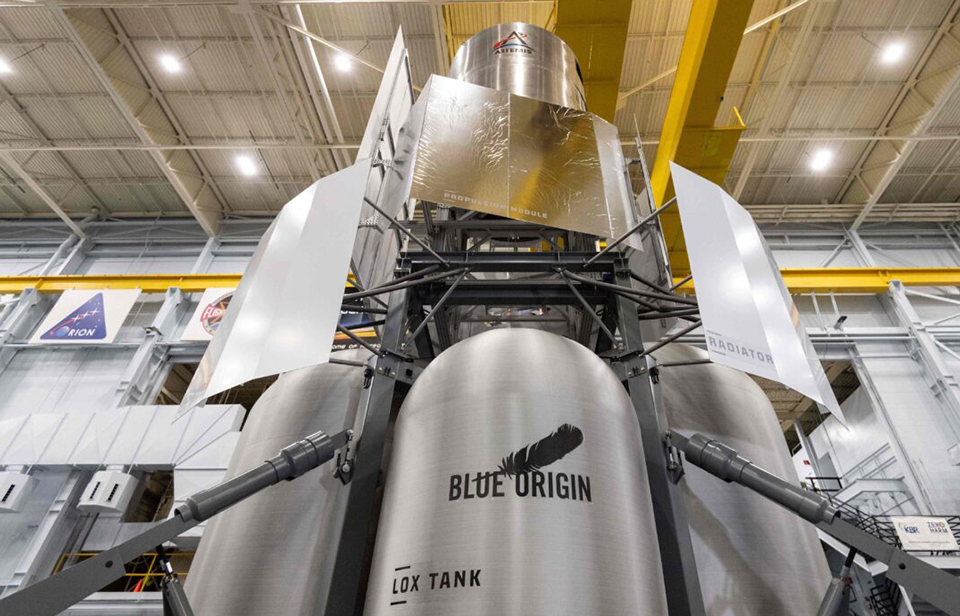
According to Couluris, Blue Origin is actively assembling seven distinct Blue Moon lunar landers at its manufacturing facilities, moving forward with its long-term cislunar delivery manifest for both NASA and commercial clients.
Launch Pad Reconstruction and a Two-Pad Strategy
The May 28 anomaly, which originated in the aft engine section of the methane-fueled New Glenn first stage, heavily damaged LC-36A, toppling a lightning tower and obliterating the heavy transporter-erector gantry. However, in an operational brief issued by CEO Dave Limp, the company confirmed that critical cryogenic propellant tank farms, the vehicle access tower, and the primary integration facility emerged intact.
Rather than rebuilding LC-36A as a single-point failure bottleneck, Blue Origin is executing an altered pad strategy. The company is using a modified launch system architecture already in development, allowing it to skip replacing the complex hydraulic cylinders lost in the blast. Under this revised timeline, LC-36A is on track to return to flight status by the end of 2026. Furthermore, to accommodate an intensive Amazon Project Kuiper and national security manifest, Blue Origin is accelerating construction on a secondary, independent pad, designated LC-36B, which is scheduled to enter active service by late 2027.
Multi-Vehicle Lander Assembly Line
The manufacturing pipeline for the Blue Moon lander portfolio consists of two separate vehicle blocks engineered to establish an active logistical pipeline to the lunar surface. The initial operational variant, the Blue Moon Mark 1 (MK1), is a single-stage, cargo-only robotic lander designed to deliver up to three metric tons of payload to any location on the lunar surface. The company is currently building three MK1 flight articles, led by the pathfinder vehicle named Endurance.
Concurrently, manufacturing teams are assembling four full-scale Blue Moon Mark 2 (MK2) architectures. The MK2 serves as the primary crewed vehicle for Blue Origin’s Human Landing System (HLS) National Team, which secured a $3.4 billion NASA development contract in 2023. This larger architecture relies on an integrated high-capacity cryogenic fluid management system to keep its liquid hydrogen and liquid oxygen propellants sub-cooled over long-duration orbital coast phases. The MK2 is tasked with transporting astronauts from the near-rectilinear halo orbit (NRHO) down to the lunar south pole starting with the Artemis V mission.
Navigating the Artemis Manifest Shifts
The delay in New Glenn’s launch availability has introduced immediate logistical variables across NASA’s near-term exploration schedules. Blue Origin was selected to launch the two primary vehicles for NASA’s Moon Base initiative—Astrolab’s FLEX rover and Lunar Outpost’s Pegasus rover—which are slated to act as the foundational Lunar Terrain Vehicles (LTV) for crewed surface exploration.
The initial MK1 Endurance pathfinder flight, originally targeted for fall 2026 under NASA’s Commercial Lunar Payload Services (CLPS) program, is experiencing manifest pressure due to the pad rebuild schedule. However, because the lander hardware assembly lines operate independently of the launch facility cleanup, NASA officials note that risk-reduction testing—including cryogenic loading simulations and BE-7 lander engine test firings at the company’s Huntsville, Alabama facilities—continues on schedule. This ensures that the spacecraft are flight-qualified the moment the rebuilt transporter-erector at LC-36A becomes operational.
Structural Landform Architectures
Blue Moon Mark 1 (MK1)
• Three flight hulls currently in assembly
• Cargo configuration: 3-metric-ton capacity
•Pathfinder Endurance targets Shackleton Ridge
Blue Moon Mark 2 (MK2)
• Four crewed HLS variants in production
• Active zero-boil-off cryogenic cooling
• Primary landing asset for Artemis V
