

LOS ANGELES, CA — Popular space commentator and astrophysicist Scott Manley recently shed light on SpaceX’s latest unannounced project: a surprise new uncrewed spacecraft named Starfall.
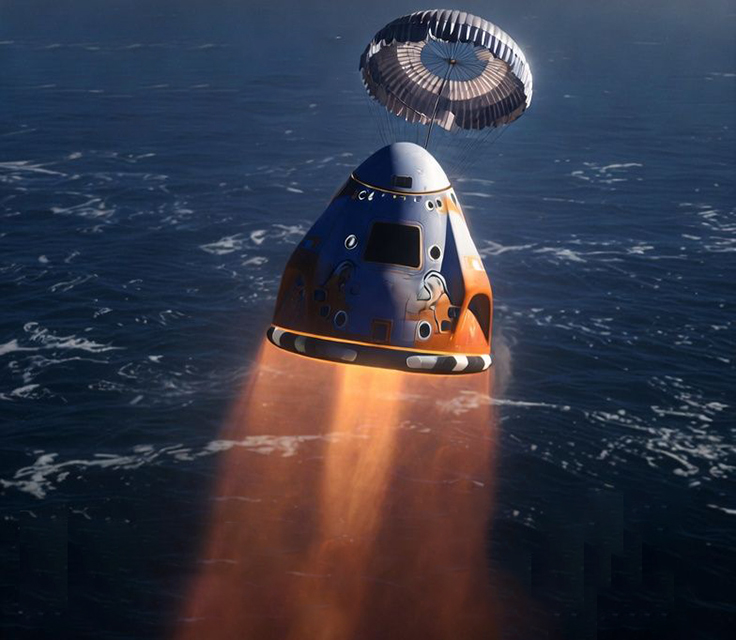
Newly released regulatory documents confirm that the Federal Aviation Administration (FAA) has officially greenlit SpaceX to conduct the first two prototype reentry test flights for the vehicle, which is poised to disrupt the burgeoning orbital manufacturing and point-to-point cargo delivery markets.
According to a Final Environmental Assessment and a Record of Decision published by the FAA, SpaceX plans to build a “mass-producible reentry vehicle” designed to autonomously transport valuable payloads safely back from space to Earth.
What is Project Starfall?
First reported quietly as a confidential internal project, Starfall diverges heavily from traditional conical spacecraft design, such as SpaceX’s own Dragon capsule. Instead, Starfall is a low-profile, flat cylindrical disk structured to maximize payload return efficiency.
According to regulatory filings, the vehicle features the following technical specifications:
- Dimensions: 3.1 meters (10.2 feet) in diameter and just 0.75 meters (2.5 feet) in height.
- Mass: A total dry weight of approximately 2,100 kilograms (4,630 pounds), split between a 1,400 kg aluminum top plate and a heavy-duty 700 kg carbon-fiber heat shield.
- Payload Capacity: An internal volume capable of returning up to 1,000 kilograms (2,205 pounds) of cargo from low-Earth orbit.
- Propulsion: Rather than using complex onboard liquid-fueled engines for deorbit maneuvers, Starfall will rely on its launch vehicle or an external kick-stage to push it back into the atmosphere. It utilizes a network of simple nitrogen cold-gas thrusters for orientation and attitude control during its descent.
The Flight Plan and Starlink Blackout Testing
The FAA has approved two initial test flights, which can be launched as secondary payloads aboard either a Falcon 9 or the massive Starship rocket. Once in space, the capsules can either loiter in orbit or execute a direct suborbital ballistic trajectory toward their targets.
The approved landing zone is located in international waters within the Pacific Ocean, approximately 1,300 kilometers (800 miles) off the coast of California and Mexico. To slow down for splashdown, Starfall will use a sequence of pilot, drogue, and a single main parachute. Crucially, the 700 kg carbon-fiber heat shield will mechanically jettison just before hitting the water, allowing recovery teams to retrieve the capsule components via boat.
Interestingly, companion Federal Communications Commission (FCC) filings indicate SpaceX will mount integrated Starlink Earth stations directly onto the prototype vehicles. SpaceX intends to use these flights to test real-time telemetry streaming through the extreme plasma blackout phase—a notorious communications barrier during atmospheric reentry.
Shaking Up the Space Economy
The operational scope of Starfall extends far beyond simple cargo delivery. The FAA documentation explicitly notes that Starfall is intended to stimulate a “self-sustaining commercial in-space manufacturing market” by offering affordable access to microgravity, vacuum environments, and safe automated return. This is viewed by industry analysts as a potential “proliferated successor” to the industrial capabilities of the aging International Space Station.
By vertically integrating both the rocket launch and the cargo return capsule, SpaceX can offer end-to-end orbital manufacturing logistics at a cost independent startups will struggle to match. Ironically, this positions Elon Musk’s firm in direct competition with some of its own recurring launch customers, such as Varda Space Industries and Inversion Space, who currently pay SpaceX to ride-share their own microgravity recovery capsules into orbit.
While the FAA documents did not outline explicit dates for the maiden flights, the regulatory approval signals that Starfall is moving rapidly toward its premier countdown.
