

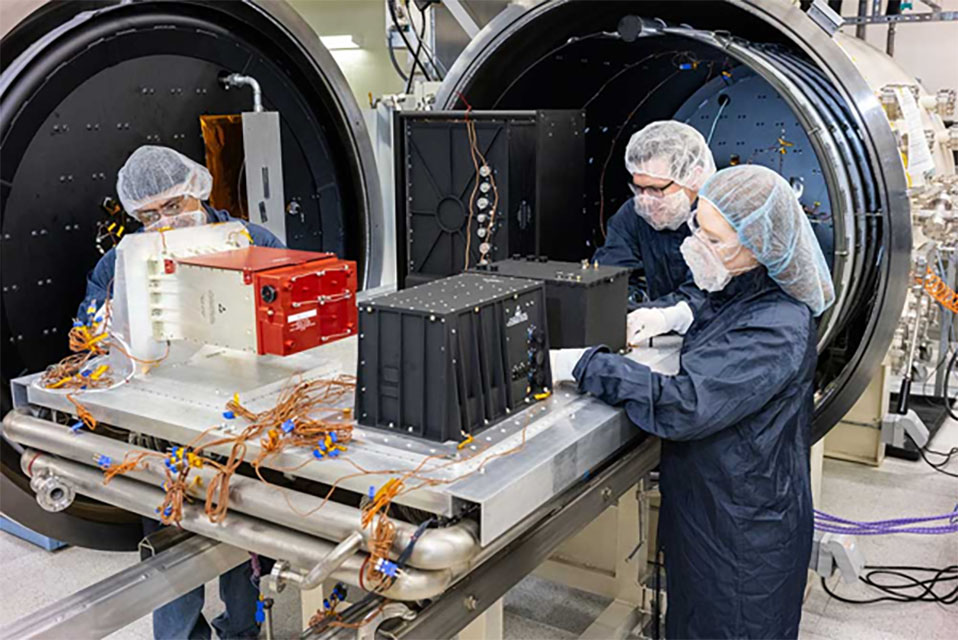
On Thursday, July 23, 2026, the National Nuclear Security Administration (NNSA) announced the delivery of its fifth next-generation Global Burst Detector (GBD) sensor payload to the U.S. Space Force. Designed for hosted integration on U.S. Global Positioning System (GPS) satellites, the space-based instrument array expands real-time, 24/7 global nuclear detonation detection capabilities from Medium Earth Orbit (MEO).
Program Heritage and Multi-Lab Interagency Framework
The GBD program serves as the space-based optical and electromagnetic sensing component of the broader U.S. Nuclear Detonation Detection System (USNDS). Developed jointly by Sandia National Laboratories and Los Alamos National Laboratory (LANL), the payload family has anchored national nuclear explosion detection capabilities for over six decades.
The delivery builds upon legacy deployment milestones, including Sandia and Los Alamos completing preliminary flight test hardware and IIIF-series qualification routines designed to survive hostile orbital and prompt-radiation environments.
Sensor Array Architecture and Subsystem Specifications
Operating from an altitude of approximately 12,550 miles above Earth, the GBD payload contains multiple specialized sensor suites built to capture and correlate atmospheric and space-based detonation signatures:
- Optical and X-Ray Detection: Integrates high-speed optical instruments, including hyper-temporal sensors capable of thousands of frames per second to discriminate valid bursts from natural phenomena.
- Electromagnetic Pulse (EMP) Sensors: Features specialized broadband radio-frequency receivers to record and timestamp transient pulse signatures.
- Host Bus Integration: Engineered as a standardized hosted payload for drop-in integration onto Lockheed Martin-built GPS III and GPS IIIF satellite buses.
Leadership Rationale on Deterrence Capabilities
“A strong nuclear deterrence posture is critical to shielding America against attack, and the delivery of this capability provides the nation with the capability to detect nuclear detonations under all conditions,” stated Matthew Napoli, NNSA’s Deputy Administrator for Defense Nuclear Nonproliferation. “Once launched, this next-gen GBD payload will join the existing satellites, ensuring monitoring capability well into the future.”
Payload Integration and Orbital Launch Schedule
Following formal delivery, the sensor payload will undergo final thermal vacuum testing and hardware integration at the Space Force satellite assembly facility. Upon completion of bus integration, the GPS satellite will ship to Cape Canaveral Space Force Station, Florida, for processing ahead of its planned launch into the operational GPS constellation.
