

• Skip to primary navigation
  • Skip to main content
  • Skip to primary sidebar
  • Skip to secondary sidebar
  • Skip to footer
  • NEWS:
  • SatNews
  • SatMagazine
  • MilSatMagazine
  • SmallSat News
  • |     EVENTS:
  • SmallSat Symposium
  • Satellite Innovation
  • MilSat Symposium
  • SmallSat Europe

SatNews

Satellite Industry Intelligence Since 1983

Subscribe
  • LATEST
  • Missions & Constellations
    • Exploration & Science Missions
    • In-Orbit Servicing & Orbital Operations
    • LEO Constellations
    • Mission Autonomy & Onboard Systems
    • Mission Deployments & Manifests
    • Navigation & PNT
    • SmallSat
    • Spacecraft & Payload Technology
    View All in Missions & Constellations →
    CAS Space Successfully Launches Kinetica-2, Aiming for Global Cost LeadershipCAS Space Successfully Launches Kinetica-2, Aiming for Global Cost Leadership
    Can SMEs Compete in Starlink-Dominated Space?Can SMEs Compete in Starlink-Dominated Space?
    Liftoff: NASA Successfully Launches Artemis II to the MoonLiftoff: NASA Successfully Launches Artemis II to the Moon
    Spire Global Successfully Deploys Satellite for NGA MagQuest Geomagnetic ChallengeSpire Global Successfully Deploys Satellite for NGA MagQuest Geomagnetic Challenge
  • Business
    • Contracts & Commercial Deals
    • Earnings & Financial Reporting
    • Events & Conferences
    • Funding & Venture Capital
    • Market Forecasts
    • Mergers & Acquisitions
    • Personnel Moves & Appointments
    View All in Business & Finance →
    L3Harris Taps Mercury Systems for High-Capacity Data Storage on SDA Tranche 3 SatellitesL3Harris Taps Mercury Systems for High-Capacity Data Storage on SDA Tranche 3 Satellites
    Antaris Secures $28M Series A to Advance AI-Powered Satellite Mission PlatformAntaris Secures $28M Series A to Advance AI-Powered Satellite Mission Platform
    Amazon in Reported Talks to Acquire Globalstar in $9 Billion Move to Challenge StarlinkAmazon in Reported Talks to Acquire Globalstar in $9 Billion Move to Challenge Starlink
    Fortastra Expands Leadership Team with Defense and Intelligence Veterans to Drive National Security MissionFortastra Expands Leadership Team with Defense and Intelligence Veterans to Drive National Security Mission
  • Defense
    • Counterspace & ASAT
    • Defense Budgets & Procurement
    • ISR & Reconnaissance
    • MILSATCOM
    • Missile Warning & Defense
    • National Security Programs
    • Space Domain Awareness
    View All in Military & Defense →
    The Downlink Deficit: The Pentagon’s Optical Mesh Network and the Terrestrial BottleneckThe Downlink Deficit: The Pentagon’s Optical Mesh Network and the Terrestrial Bottleneck
    Declassified National Reconnaissance Office Documents Reveal Early Tensions with Space Shuttle ProgramDeclassified National Reconnaissance Office Documents Reveal Early Tensions with Space Shuttle Program
    SPARC AI Appoints On-Ground Referral Agent in Ukraine to Accelerate Defense EngagementSPARC AI Appoints On-Ground Referral Agent in Ukraine to Accelerate Defense Engagement
    Indra Showcases Sovereign Space and Defense Technologies at FIDAE 2026Indra Showcases Sovereign Space and Defense Technologies at FIDAE 2026
  • Gov
    • Export Controls & Compliance
    • International Space Agreements
    • National Space Policy
    • Space Law & Treaties
    • Space Sustainability & Debris Policy
    • Space Traffic Management / Debris Removal
    View All in Government & Regulation →
    FCC Seeks Comment on Expanding Spectrum Access for “Weird Space Stuff”FCC Seeks Comment on Expanding Spectrum Access for “Weird Space Stuff”
    The FCC Must Choose: Enforce the Rules or Preserve LEO CompetitionThe FCC Must Choose: Enforce the Rules or Preserve LEO Competition
    Space Force Reassigns Final GPS III Mission to SpaceX Following Vulcan AnomalySpace Force Reassigns Final GPS III Mission to SpaceX Following Vulcan Anomaly
    NASA Realignment ‘Ignition’ Accelerates Shift Toward Commercial Lunar EconomyNASA Realignment ‘Ignition’ Accelerates Shift Toward Commercial Lunar Economy
  • Launch
    • Launch Providers
    • Launch Schedule & Calendars
    • Launch Sites & Infrastructure
    • Rocket Technology & Vehicles
    View All in Launch →
    CAS Space Successfully Launches Kinetica-2, Aiming for Global Cost LeadershipCAS Space Successfully Launches Kinetica-2, Aiming for Global Cost Leadership
    Liftoff: NASA Successfully Launches Artemis II to the MoonLiftoff: NASA Successfully Launches Artemis II to the Moon
    AAC Clyde Space Expands Orbital Presence with Transporter-16 LaunchAAC Clyde Space Expands Orbital Presence with Transporter-16 Launch
    Built by Thales Alenia Space for ESA’s Celeste mission, IOD-2 Satellite lifts off today from New ZealandBuilt by Thales Alenia Space for ESA’s Celeste mission, IOD-2 Satellite lifts off today from New Zealand
  • Software
    • Autonomous Ground Operations
    • Data Processing & AI/ML
    • Digital Twins & Modeling
    • Ground Segment & Teleports
    • Mission Planning & Simulation
    • Space Systems Software Engineering
    • Spectrum & Licensing
    View All in Software Automation & Ground Systems →
    The Downlink Deficit: The Pentagon’s Optical Mesh Network and the Terrestrial BottleneckThe Downlink Deficit: The Pentagon’s Optical Mesh Network and the Terrestrial Bottleneck
    NexSat Space Systems Debuts with ACE ‘Invisible’ Aero-Conformal AntennaNexSat Space Systems Debuts with ACE ‘Invisible’ Aero-Conformal Antenna
    Laser Communications and the Rise of Orbital Data CentersLaser Communications and the Rise of Orbital Data Centers
    ThinKom Showcases Modular MILSATCOM Architecture for Contested EnvironmentsThinKom Showcases Modular MILSATCOM Architecture for Contested Environments
  • Services & Apps
    • Climate & Environmental Monitoring
    • Disaster Response & Security Mapping
    • Earth Observation & Imaging
    • Maritime & Aviation Satcom
    • Satellite Communications
    View All in Services & Applications →
    The Downlink Deficit: The Pentagon’s Optical Mesh Network and the Terrestrial BottleneckThe Downlink Deficit: The Pentagon’s Optical Mesh Network and the Terrestrial Bottleneck
    Cinemo Reimagines the Vehicle as a Software-Defined Entertainment HubCinemo Reimagines the Vehicle as a Software-Defined Entertainment Hub
    IEC Telecom Wins CSR Initiative of the Year at the Oil & Gas Middle East Awards 2026IEC Telecom Wins CSR Initiative of the Year at the Oil & Gas Middle East Awards 2026
    Can SMEs Compete in Starlink-Dominated Space?Can SMEs Compete in Starlink-Dominated Space?
  • SatNews Events
  • Magazines
  • Calendar

The Artemis Campaign: A Brief Cislunar History

January 19, 2026

WASHINGTON, D.C. — As of January 18, 2026, the Artemis program stands as the most complex multi-national space exploration initiative in human history. Formally established in 2017 via Space Policy Directive 1, Artemis was designed not merely to replicate the Apollo landings, but to establish a foothold in cislunar space.
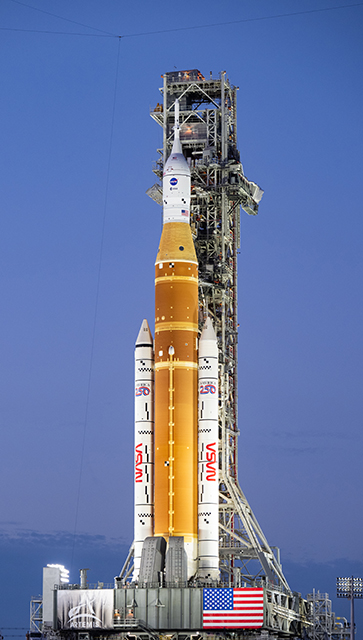
By leveraging legacy hardware and a new generation of private lunar logistics, the campaign has transitioned from a series of technical demonstrations to a burgeoning orbital economy.

As reported, the Artemis II moved to its launch site at Kennedy Space Center’s Launch Pad 39B in Florida on Saturday, Jan. 17 with a launch window no earlier than Thursday, Feb. 5, 2026.

From Constellation to Artemis: The Foundation

The architectural roots of Artemis draw heavily from the now-cancelled Constellation program, specifically the Orion crew capsule and the Space Launch System (SLS). Following the retirement of the Space Shuttle in 2011, the NASA Authorization Act of 2010 mandated the development of a heavy-lift rocket capable of carrying humans beyond Low Earth Orbit (LEO).

The first significant milestone occurred on November 16, 2022, when Artemis I successfully launched from Space Launch Complex 39B. This uncrewed flight test sent the Orion spacecraft into a distant retrograde lunar orbit, testing the capsule’s heat shield during a high-velocity re-entry that reached temperatures of 5,000 degrees Fahrenheit. The mission’s success provided the baseline data required to certify the SLS and Orion for human occupancy.

The Rise of Commercial Lunar Payload Services (CLPS)

A defining shift in the Artemis strategy was the introduction of the Commercial Lunar Payload Services (CLPS) initiative. Unlike the government-owned models of the 20th century, CLPS designated NASA as one of many customers for private lunar landers. This “utility validation” phase saw its first major successes in early 2025. On March 2, 2025, Firefly Aerospace’s Blue Ghost Mission 1 achieved a fully successful soft landing, followed days later by Intuitive Machines’ Nova-C.

These missions proved that commercial providers could handle the “heavy lifting” of lunar logistics. In December 2025, NASA further solidified this strategy by awarding Blue Origin a delivery task order for the Volatiles Investigating Polar Exploration Rover (VIPER). By shifting flagship payloads to heavy-lift commercial landers like the Blue Moon Mark 1, the agency transitioned from high-risk exploration to operational infrastructure.

Artemis II: Validating Life Support in Deep Space

Unlike the uncrewed predecessor, Artemis II will carry four astronauts: Commander Reid Wiseman, Pilot Victor Glover, and Mission Specialists Christina Koch and Jeremy Hansen. The mission is a 10-day flight test designed to confirm that Orion’s life-support and communication systems can sustain human life in the high-radiation environment of deep space.
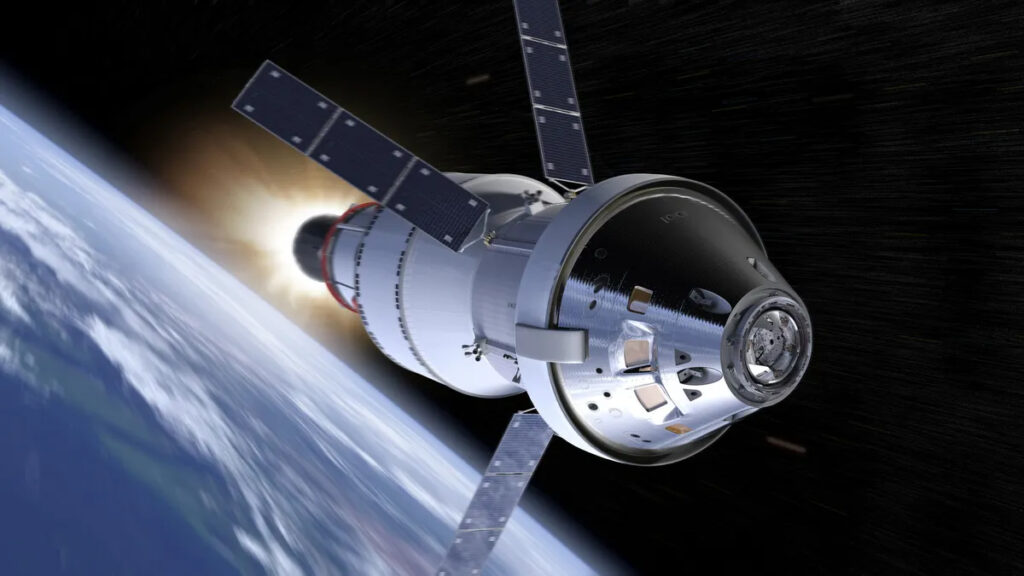
Depiction of the Orion spacecraft during trans-lunar injection

The mission profile involves a multi-trans-lunar injection (MTLI) burn, which will send the crew on a free-return trajectory extending more than 230,000 miles from Earth. At their maximum distance, the crew will fly approximately 6,400 miles beyond the Moon’s far side, becoming the first humans to venture beyond LEO since the Apollo 17 mission in 1972. The four astronauts won’t land on the moon, but during their 10-day journey beyond the moon and back, they’ll get farther from Earth than any humans have ever been.

Technical Parameters of the SLS “Mega Rocket”

The hardware standing at Pad 39B represents the pinnacle of current heavy-lift capability:

  • Total Height: 322 feet (98 meters).
  • Thrust: 8.8 million pounds at liftoff, 15% more than the Saturn V.
  • Core Stage: Powered by four RS-25 engines and two five-segment Solid Rocket Boosters.
  • Payload: Orion spacecraft equipped with the European Service Module (ESM).

Rationale: The Geopolitical and Economic High Ground

The strategic impetus for Artemis extends beyond scientific discovery. The program is the primary vehicle for the United States to maintain “Space Superiority” amidst a bifurcating global market. As China expands its own lunar capabilities through the International Lunar Research Station (ILRS) and a worldwide ground tracking network, the U.S. has utilized the Artemis Accords to build a coalition of over 40 signatory nations.

Economically, the campaign serves as a catalyst for a projected trillion-dollar space economy. Current NASA Administrator Jared Isaacman has emphasized that the goal is to create a “railroad to the Moon,” enabling startups and established aerospace firms to operate profitably in cislunar space. This vision was reinforced in early 2026 when the U.S. Congress rejected plans to slash NASA’s science budget, instead restoring funding to ensure the Artemis roadmap remains on schedule despite the cancellation of high-cost outliers like Mars Sample Return.

Current Manifest and the Road to Artemis III

The current program timeline reflects the “Hard Reality” of deep space integration.

  • Artemis II (April 2026): The first crewed mission will send Commander Reid Wiseman, Pilot Victor Glover, and Mission Specialists Christina Koch and Jeremy Hansen on a free-return trajectory around the far side of the Moon. This 10-day flight test will validate Orion’s environmental control and life support systems.
  • Artemis III (Mid-2027): This mission is slated to land the first woman and person of color at the lunar South Pole. It requires the successful rendezvous between an Orion spacecraft and a SpaceX Starship Human Landing System (HLS) in a near-rectilinear halo orbit (NRHO).
  • Gateway and Beyond (2028-2030): Subsequent missions will focus on the assembly of the Lunar Gateway, an international space station that will serve as a staging point for surface sorties and future missions to Mars.

Long-term Vision: The Gateway to Mars

The ultimate objective of Artemis is to transform the Moon from a destination into an operational hub. By utilizing in-situ resource utilization (ISRU)—the process of extracting water ice from polar craters to create oxygen and propellant—NASA intends to prove that human life can be sustained indefinitely away from Earth. As the industry moves toward 2030, the success of the Artemis campaign will be measured not by footprints, but by the reliability of the infrastructure that now bridges the Earth and its nearest neighbor.

Filed Under: Launch, Mission Deployments & Manifests

Primary Sidebar

Coverage

  • Missions & Constellations
  • Business & Finance
  • Military & Defense
  • Launch
  • Software Automation & Ground Systems
  • Government & Regulation
  • Services & Applications

Most Read Stories

  • Rheinmetall Withdraws From Mynaric Bidding Process; Rocket Lab Acquisition Clears Major Competitive Hurdle
  • L3Harris Unveils XL-300P: The First P25 Handheld with 5G and Satellite Direct-to-Device Connectivity
  • Rheinmetall Walked Away. Germany Should Take the Hint.
  • Guardians in the Kill Chain: How the Space Force Led the Opening Salvo of Operation Epic Fury
  • Rocket Lab Emerging as Potential Bus Provider for 2,800-Satellite Equatys Constellation

Secondary Sidebar

Footer


Satnews is a leading provider of satellite news, events, publications, research and other satellite industry information in both commercial and military enterprises worldwide.

Stories By Category

  • Business & Finance
  • Government & Regulation
  • Launch
  • Military & Defense
  • Missions & Constellations
  • Services & Applications
  • Software Automation & Ground Systems
  • Spectrum & Licensing
  • Startups & NewSpace Business

About Us

  • Leadership & Editorial Team
  • SatNews History
  • Free Satnews Subscription
  • SatNews Events
  • Magazines

Navigation

  • Latest Stories
  • Magazines
  • Events
  • Contact
  • Cookie & Privacy Policy for Satnews

We use cookies to ensure that we give you the best experience on our website. If you continue to use this site we will assume that you are happy with it.
x
Sign up Now (For Free)
Access daily or weekly satellite news updates covering all aspects of the commercial and military satellite industry.
Invalid email address
Notify Me Regarding ( At least one ):
We value your privacy and will not sell or share your email or other information with any other company. You may also unsubscribe at anytime.

Click Here to see our full privacy policy.
Thanks for subscribing!