

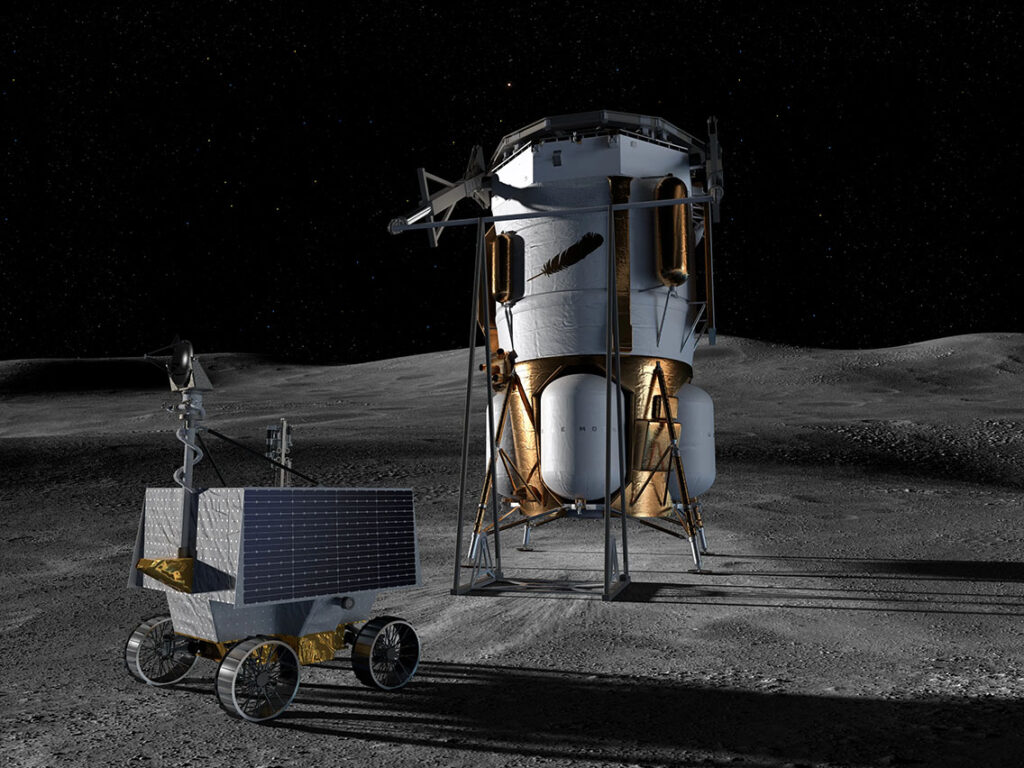
WASHINGTON, D.C. — In a decisive move for the future of the Artemis campaign, NASA has officially awarded a delivery task order to Blue Origin for the transport of the Volatiles Investigating Polar Exploration Rover (VIPER) to the lunar South Pole.
Scheduled for late 2027, the mission will utilize Blue Origin’s Blue Moon Mark 1 (MK1) cargo lander to resurrect a mission that had previously faced cancellation due to cost and schedule overruns with its former provider.
The award represents a significant milestone for NASA’s Commercial Lunar Payload Services (CLPS) program. By leveraging Blue Origin’s heavy-lift lunar architecture, NASA is moving the VIPER mission—an essential resource-mapping precursor for human stays—away from the high-risk “exploration” phase that characterized the early days of CLPS. This pivot signals the arrival of “CLPS 2.0,” an era defined by more robust mission architectures and a shift toward what industry analysts call “Utility Validation.”
Breaking the “Hard Reality” of Lunar Commercialization
The selection of Blue Origin serves as a critical course correction against the “Hard Reality” of lunar commercialization. Early CLPS missions were often marked by the inherent volatility of startup-led lander projects, where the primary goal was simply reaching the surface. The VIPER award suggests that NASA is no longer willing to treat its flagship science instruments as high-risk experiments. Instead, the agency is prioritizing cargo-class reliability to ensure that “utility” data—specifically the location and accessibility of lunar water ice—is secured before the next generation of astronauts arrives.
This mission is a Med-Score Accelerant for the broader lunar economy. By shifting the delivery responsibility to a provider with the scale of Blue Origin, NASA is validating the industry’s request for specific, large-scale cargo delivery services rather than just small-scale tech demonstrations. The mission architecture includes end-to-end payload integration and a sophisticated offloading demonstration, ensuring the golf-cart-sized rover can safely exit the lander to begin its 100-day prospecting mission.
A Focus on Lunar Infrastructure
Industry experts note that this award highlights a transition from “exploration” to “operational infrastructure.” VIPER is equipped with the TRIDENT drill, developed by Honeybee Robotics (a Blue Origin company), which will penetrate up to one meter of regolith to sample volatiles. The integration of this technology within the Blue Moon ecosystem creates a streamlined pipeline for resource verification—a necessity for the In-Situ Resource Utilization (ISRU) goals that underpin a permanent human presence.
As the industry moves toward late 2027, the success of this task order will be viewed as the definitive proof-of-concept for the “Utility Validation” phase. It moves the conversation beyond the novelty of landing and toward the practical, hard-won reality of operating heavy machinery in the most extreme environments of the lunar South Pole.
The award of the VIPER delivery task order to Blue Origin marks a transformative moment for the Commercial Lunar Payload Services (CLPS) ecosystem. As the program transitions from its “Pathfinder” phase into a high-stakes operational era, the ripple effects on established players like Intuitive Machines (IM) and Firefly Aerospace are significant, redefining the competitive landscape for the late 2027–2030 manifest.
The Consolidation of “CLPS 2.0”
With the successful landings of Firefly’s Blue Ghost (March 2, 2025) and Intuitive Machines’ Nova-C (March 6, 2025), the “shots on goal” era has evolved into a flight-proven hierarchy. The VIPER award to Blue Origin signifies NASA’s new procurement reality: heavy-lift reliability over low-cost experimentation.
- For Intuitive Machines: As the first provider to achieve a commercial soft landing, IM remains the “agile workhorse.” However, the VIPER decision suggests that for flagship-class payloads (500kg+), NASA may prefer the massive margins of Blue Origin’s Blue Moon Mark 1. IM will likely pivot toward its CP-11 (2026) and Mission 4 (2027) task orders, focusing on “Data-as-a-Service” and lunar communication networks to maintain a competitive moat against the heavy-lift titans.
- For Firefly Aerospace: Having solidified its reputation with the March 2025 landing, Firefly is successfully carving out a niche in complex orbital delivery. Its recent 2030 award and its 2028 Gruithuisen Domes mission—which notably utilizes a Honeybee Robotics (Blue Origin-owned) rover—show a growing symbiosis between “mid-tier” providers and the Blue Origin infrastructure.
The Shift to Utility Validation
The VIPER mission is the ultimate test of “Utility Validation.” By bypassing smaller landers for the Blue Moon architecture, NASA is acknowledging that the “Hard Reality” of the Moon requires a scale that smaller startups struggle to provide at fixed-price margins.
This creates a bifurcated market for 2027–2030:
- Heavy Logistics: Blue Origin and potentially SpaceX (Starship HLS) will handle “Must-Land” infrastructure and resource prospecting.
- Specialized Science: Providers like Firefly and Draper will handle “Precision Science” and far-side missions that require unique orbital insertion or specialized sensor suites.
The Med-Score Accelerant
This task order acts as a Med-Score Accelerant because it provides a bridge to the human landing system (HLS). By flying the VIPER mission on Blue Moon MK1, Blue Origin is essentially conducting a full-dress rehearsal for the cargo requirements of Artemis V. For other CLPS providers, this means the window for becoming a “prime” logistics partner for human stays is narrowing, forcing a strategic shift toward specialized services like lunar night survival and subsurface drilling.
