

On August 7, 2026, satellite operator SES announced the successful completion of Rendez-vous 1 (RDV1) under the European Union’s Infrastructure for Resilience, Interconnectivity and Security by Satellite (IRIS²) program.
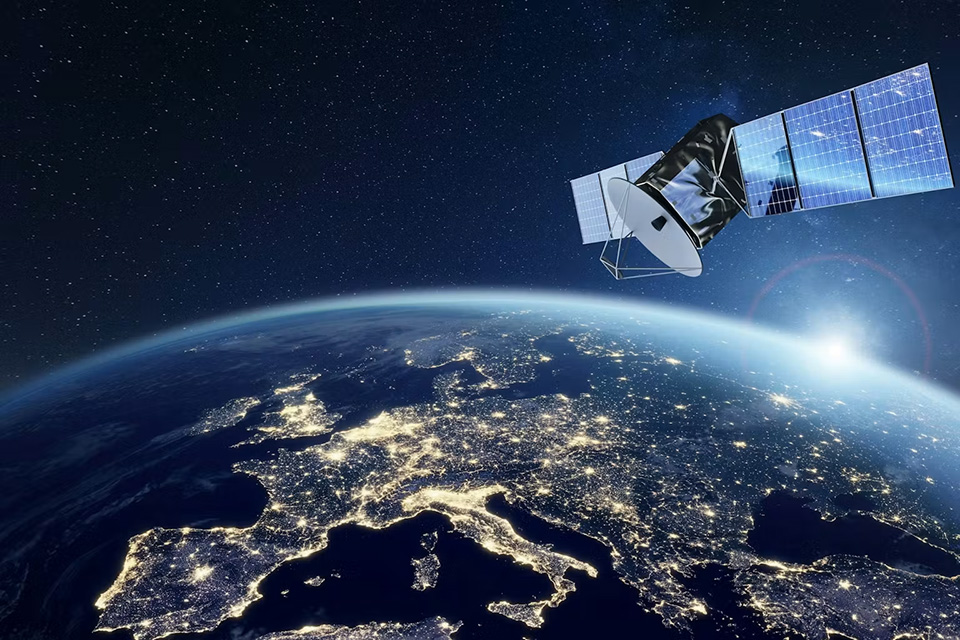
The validation milestone establishes the technical baseline, cost allocations, and industrial architecture for the Medium Earth Orbit (MEO) segment of Europe’s multi-orbit sovereign communications network. The successful conclusion of the RDV1 review permits the SpaceRISE consortium, led by SES alongside European industry partners and the European Space Agency (ESA), to transition directly into active satellite manufacturing, ground segment integration, and user terminal development.
Financial Framework and MEO Segment Architecture
Following the technical baseline confirmed during RDV1, SES expects its total capital commitment for the MEO constellation layer to reach up to €1.35 billion. The capital expenditure covers the procurement and deployment of 18 MEO satellites, with service entry targeted for 2030. SES’s investment share for 2026 remains within its previously stated fiscal year 2026 capital expenditure outlook, benefiting from European public funding and built-in financial risk mitigation mechanisms. The commercial contract is structured to deliver an internal rate of return (IRR) meeting or exceeding SES’s 10% hurdle rate requirement. Under the concession terms, SES retains commercial monetization rights for approximately 90% of the MEO constellation’s operational capacity, enabling long-term service provisioning across enterprise, mobility, cloud, and government sectors.
The agreement builds on the formal execution of the 12-year IRIS² Concession Contract signed in December 2024, establishing the public-private partnership framework between the European Commission and the SpaceRISE industrial group.
Industrial Responsibilities and In-House Payload Assembly
As part of the program’s division of labor, SES will lead the design, payload construction, assembly, integration, and testing (AIT) for the 18 MEO spacecraft at its dedicated satellite facilities in Luxembourg. The upgraded payload architecture integrates high-throughput digital processing components to support encrypted multi-orbit connectivity for institutional and defense end-users.
In addition to satellite manufacturing responsibilities, SES is appointed lead system integrator for IRIS² user terminal development, network operations, and multi-orbit Low Earth Orbit (LEO) and MEO service routing managed through primary IRIS² ground control centers. The infrastructure complements SES’s operational O3b fleet and O3b mPOWER MEO constellation, linking sovereign government traffic with commercial non-geostationary orbit (NGSO) network architectures.
“The successful completion of RDV1 marks an important step towards delivering Europe’s next-generation secure, sovereign connectivity infrastructure,” said Adel Al-Saleh, CEO of SES. “IRIS² builds on SES’s proven leadership in MEO and reinforces our long-term vision for secure, resilient and high-performance connectivity. Together with our existing O3b fleet and meoSphere roadmap, the programme positions SES to address evolving government and commercial requirements while supporting Europe’s ambitions for secure and sovereign multi-orbit communications.”
Operational Schedule and Implementation Phase
With the RDV1 milestone completed, SES, the European Space Agency, and SpaceRISE consortium partners will initiate full hardware fabrication, payload integration, user terminal prototyping, and ground station deployment. The partners will progress through subsequent design review milestones over the next three years to maintain the target operational launch timeline for 2030.
