

On August 5, 2026, a spent SpaceX Falcon 9 upper stage unintentionally struck the surface of the Moon at high velocity. The 4-metric-ton rocket body, measuring approximately 12 meters in length, impacted near Einstein Crater on the Moon’s sunlit western limb at 02:35 Eastern Time (06:35 BST).
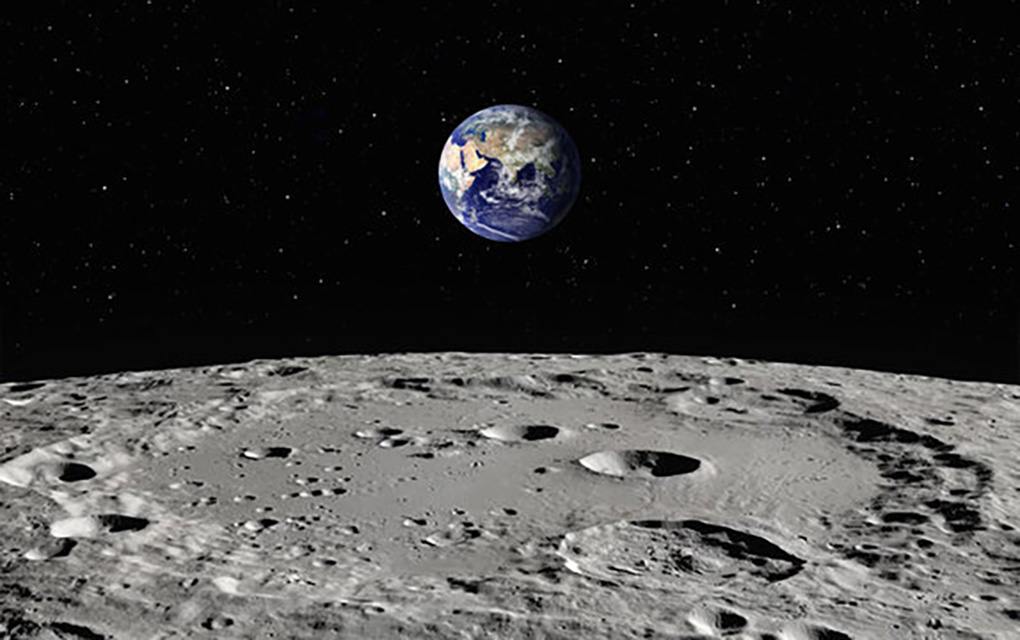
Orbital trajectory tracking confirms the rocket stage collided with the lunar terrain at a velocity of roughly 5,400 mph (8,700 km/h). Analysts estimate the high-speed impact produced a fresh crater measuring between 18 and 30 meters in diameter and 4 to 5 meters deep, scattering a localized plume of lunar regolith across the surrounding surface.
Commercial Payload Delivery and Mission History
The upper stage was launched on January 15, 2025, from Launch Complex 39A at NASA’s Kennedy Space Center in Florida. The mission delivered two commercial lunar landers toward deep space: Firefly Aerospace’s Blue Ghost Mission 1 and ispace’s Resilience lander.
Following separation into trans-lunar injection, the two spacecraft embarked on distinct surface itineraries. On March 2, 2025, Firefly’s Blue Ghost lander completed a precision touchdown in Mare Crisium, successfully executing operations for ten NASA science instruments. Conversely, ispace’s Resilience lander suffered an altimeter processing anomaly during final descent in June 2025, resulting in a hard surface impact.
Unlike missions deployed into Low Earth Orbit (LEO), where second stages execute controlled de-orbit burns into terrestrial oceans, deep-space upper stages remain in chaotic, highly eccentric orbits governed by three-body gravitational dynamics.
Orbital Mechanics and Trajectory Evolution
After releasing its lunar payloads, the Falcon 9 upper stage vented residual propellants into space. Over the subsequent 18 months, gravitational perturbations from the Sun and Earth, combined with solar radiation pressure, continually altered the object’s orbital inclinations until its trajectory intersected the lunar surface.
Orbital mechanics analyst Bill Gray generated independent tracking calculations predicting the collision window weeks ahead of impact. Because the collision occurred along the sunlit western limb near the lunar horizon, direct optical observation of the thermal flash from terrestrial observatories was obscured by daylight geometry.
“What has happened is essentially a mixture of solar activity and gravity forces have put it on a path toward the moon,” said Julianna Scheiman, SpaceX’s Director of NASA Science and Dragon Programs. She added that NASA and SpaceX are actively discussing protocols to manage and prevent uncontrolled lunar stage impacts on future deep-space missions.
“The impact poses no danger to Earth, and NASA scientists are planning to collect lunar data from the event and refine techniques for tracking objects in space,” confirmed Jimi Russell, NASA spokesperson.
Seismic Observations and Cislunar Debris Mitigation
Planetary scientists at Los Alamos National Laboratory and partner research institutes view the accidental collision as a valuable opportunity to evaluate artificial hypervelocity impacts on the lunar crust. Because the Moon lacks an atmosphere and active weather, ejecta dust thrown up by the impact will settle gradually under low gravitational acceleration.
NASA’s Lunar Reconnaissance Orbiter (LRO) and South Korea’s Danuri (KPLO) spacecraft are scheduled to perform high-resolution imaging passes over the Einstein Crater region. Planetary scientists will compare pre-impact and post-impact orbital photographs to map the exact crater dimensions, subsurface ejecta composition, and seismic energy transmission.
The event underscores growing tracking and debris mitigation requirements across cislunar space as commercial flight volume expands under NASA’s Artemis program and international lunar exploration architectures.
