

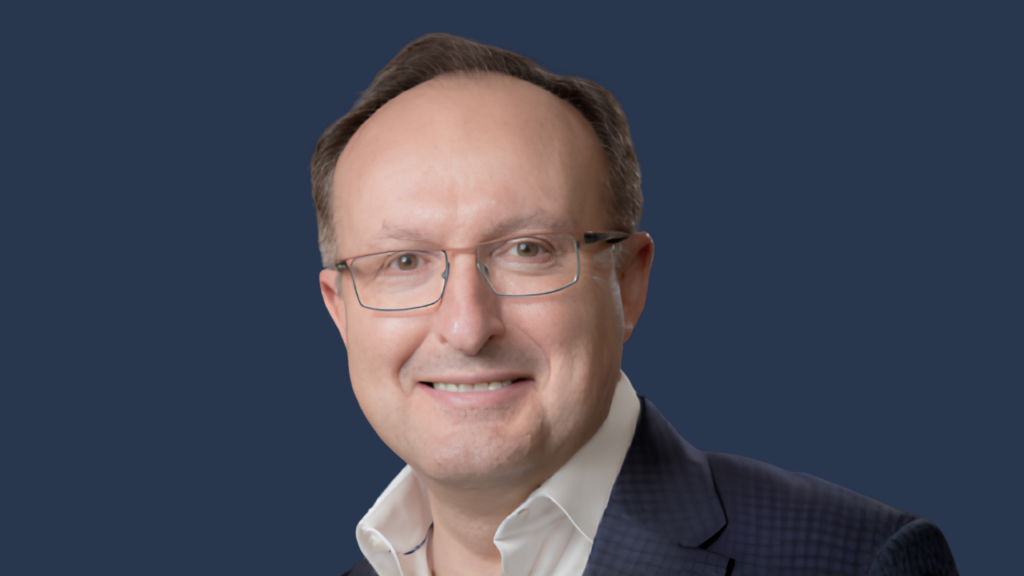
A megawatt of computing in orbit needs 5,640 square meters of photovoltaic array at beginning of life and 2,500 square meters of radiator, and lands between 34 and 59 kilograms per kilowatt all in. A NASA Jet Propulsion Laboratory astrophysicist published that arithmetic on April 29, along with the cost ceiling it implies: launch and spacecraft construction together have to come in between $250 and $1,000 per kilogram. That allowance, the paper says, “is 3.4–13.5 times below the current public Falcon 9 dedicated low-Earth-orbit launch-price benchmark alone, before spacecraft build is included.” The scientist who ran those numbers takes the Satellite Innovation stage at Silicon Valley Space Week in October.
Dr. Slava Turyshev is Senior Research Scientist at NASA’s Jet Propulsion Laboratory, California Institute of Technology, and an adjunct professor in the Department of Physics and Astronomy at the University of California, Los Angeles. He took a master’s with honors and a doctorate from Lomonosov Moscow State University in 1987 and 1990, and a Doctor of Science habilitation in astrophysics from the same university in 2008. He also holds an MBA in technology management from UCLA’s Anderson School. From 2003 to 2012 he was principal investigator for the investigation of the Pioneer Anomaly. He was NASA project scientist for the CNES and ESA MICROSCOPE mission from 2016 to 2020, has been JPL project scientist for the Advanced Lunar Laser Ranging Facility at Table Mountain Observatory since 2015, and led the NASA Innovative Advanced Concepts Phase III study on imaging exoplanets through the solar gravitational lens. He has written more than 240 scientific publications and two books, and is an academician of the International Academy of Astronautics. His recent work turns on emerging space infrastructure: orbital data centers, high-rate optical networks, and the systems engineering of large-scale computing in orbit.
Reduced launch and build cost is one of four conditions the paper puts on general-purpose computing in orbit. Financial analysis in August projected a shift in launch economics as SpaceX moves payloads from Falcon 9 to Starship, which addresses the launch half of that condition. The filings have grown in parallel: Cowboy Space Corporation, whose chief operating officer shares this panel, has asked to fly up to 20,000 orbital data center satellites. The externalities are now being counted too, with an environmental analysis on August 20 flagging upper-atmosphere pollution and electronic waste from mega-constellations built for space-based artificial intelligence processing. Turyshev’s own conclusion splits the question. The paper calls space-native preprocessing and communications-integrated edge compute credible early regimes. General-purpose compute serving users on the ground closes only under low communication intensity, high effective utilization, long delivered lifetime, and very low combined launch and build cost.
Turyshev joins “Orbital Data Centers — Investable Infrastructure or Thermodynamic Bet?” on Tuesday, October 27, from 12:15 p.m. to 1:00 p.m. in the Hahn Auditorium at the Computer History Museum in Mountain View. The program calls it the largest capital and engineering story of 2026 and asks whether AI data centers can be built in space, with believers and skeptics arguing the engineering and the economics. The other panelists are Janna Lewis, Senior Vice President of Policy and General Counsel at Astroscale U.S.; Jason Aspiotis, Chief Executive Officer and Co-Founder of OwlO Cloud; Rob DeMillo, Chief Executive Officer and Co-Founder of Sophia Space; Filip Rezabek, Co-Founder and Chief Technology Officer of SpaceComputer; and Joseph Yaffe, Chief Operating Officer and Chief Legal Officer of Cowboy Space Corporation. The agenda lists no moderator. The session follows a technical brief by Dr. Paul Struhsaker of Arrasar Partners on the radiators, watts and orbits the hardware actually needs.
Silicon Valley Space Week runs Tuesday, October 27 through Thursday, October 29 at the Computer History Museum, with Satellite Innovation across the first two days and the MilSat Symposium across the last two. Turyshev’s panel comes at midday on the opening day. The paper behind his numbers is on arXiv as 2604.27197.
