

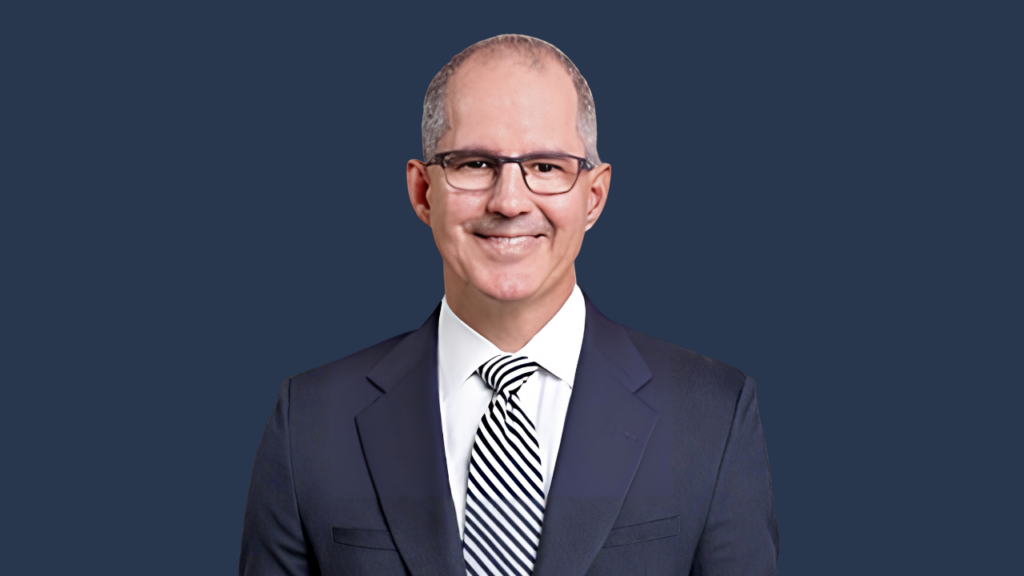
In February, the National Telecommunications and Information Administration told the Federal Communications Commission it had identified the first five megahertz of the 500 it is required by law to clear for commercial use. The band it chose, 1675 to 1680 MHz, carries NOAA weather satellite downlinks. Three more federal bands are under study on the same statutory clock, and the Administration cleared the last of the four study plans on July 31. The NTIA official who helps direct that work takes the Satellite Innovation stage at Silicon Valley Space Week in October.
Scott Patrick is the Executive Director of the Office of Spectrum Management at the National Telecommunications and Information Administration, the agency that manages federal spectrum use and advises the President on telecommunications policy. He helps direct NTIA’s work on national spectrum strategies and policies, including the development of spectrum-sharing and repurposing strategies that balance federal and commercial demand. Patrick came to regulation from engineering: early in his career he was a research engineer at the U.S. Naval Research Laboratory, where he helped develop fiber optic electromagnetic sensors. He later served as an attorney in the Wireless Telecommunications Bureau at the Federal Communications Commission and spent years in private practice counseling telecom, cable, broadcast, and broadband companies. He holds a master’s degree in electrical engineering from the University of Maryland and a law degree from the University of Virginia.
His office sits at the center of the hardest question in American spectrum policy: how to open federal bands to commercial use without breaking the systems already in them. The February letter is a working example of the tradeoff. Clearing 1675 to 1680 MHz means ringing four federal satellite downlink sites with coordination zones, at Fairmont, West Virginia; Sioux Falls, South Dakota; Suitland, Maryland; and Wallops, Virginia, while every other site migrates to an internet-based distribution system. NTIA also committed to studying the same band as a candidate for direct-to-device satellite service. Meanwhile the commercial side of the ledger keeps moving. In late July the FCC approved its Upper C-band order, clearing 160 MHz of satellite spectrum, and days earlier proposed opening unlicensed Bluetooth and Wi-Fi bands to space-based systems. As SatNews argued in a recent editorial, regulatory decisions increasingly set the ceiling on how far a constellation can grow.
That is the premise of Patrick’s session. He joins “Regulators as Capacity Allocators” on Tuesday, October 27 at 11:00 a.m., alongside Yaswant Devarakonda, Manager for the Space and Spectrum Policy Center at the Computer & Communications Industry Association, and Kevin Kelly, Partner at Actum. Brian Weimer, Partner and Space and Satellite Practice Leader at Sheppard Mullin, moderates. The session examines how government licensing decisions now determine which satellite networks get to grow. It opens half an hour after the “WRC-27: The Clock Starts Now” market brief wraps at 10:30, which frames the international side of the same contest: the 2027 world conference that divides radio frequencies among satellite operators. Both run on the Satellite Innovation track in the Hahn Auditorium at the Computer History Museum in Mountain View.
NTIA has until July 2027 to identify the first 200 megahertz of the 500. The people working out how that gets done will be on stage in Mountain View roughly nine months before the deadline arrives.
