

Targeting growing onboard data storage demands for Earth observation, communications payloads, and artificial intelligence (AI) workloads, Teledyne e2v Semiconductors announced on Nov. 12 the addition of 8 gigabyte (GB) and 16 GB NASA Grade flight models to its radiation-tolerant double data rate 4 (DDR4) memory portfolio.
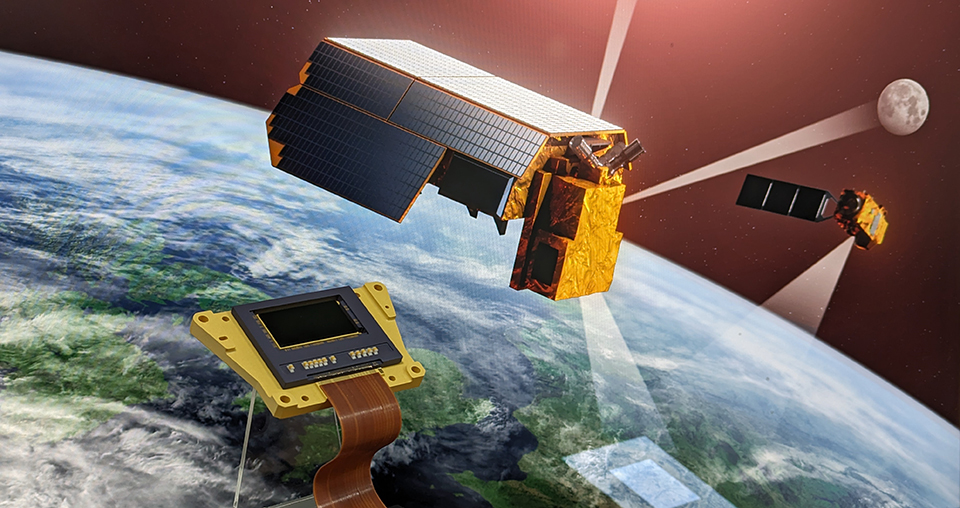
The Grenoble, France-based subsidiary of Teledyne Technologies stated that the high-density flight devices will be available by the end of 2026 for both government space agency programs and commercial New Space operators.
Pinout Compatibility and Board Integration
Modern satellite subsystems—including high-resolution imaging sensors, software-defined payloads, and onboard processors—require higher memory capacity to execute data-intensive applications without sacrificing reliability. Consolidating more capacity into a single memory package allows spacecraft engineers to reduce overall component counts, saving circuit board space, lowering power consumption, and simplifying system architecture.
Both the 8 GB and 16 GB models retain the exact pinout of Teledyne e2v’s existing DDR4 family. This continuity enables hardware designers to scale system memory from 4 GB to 8 GB or 16 GB without redesigning existing boards, while meeting NASA quality and assurance requirements.
“Our customers are putting more computing power into every spacecraft, and they need memory that keeps pace without adding risk,” said Frederic Devrière, product marketing manager at Teledyne e2v. “These flight models let them plan for that growth now.”
