

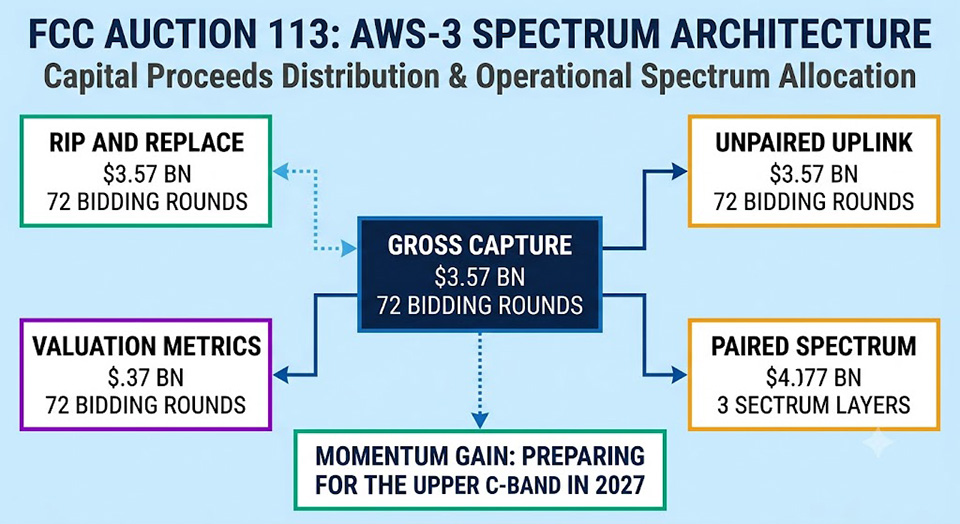
WASHINGTON, D.C. — June 24, 2026 — Breaking a four-year spectrum allocation drought, the Federal Communications Commission (FCC) officially wrapped up Auction 113—the Advanced Wireless Services (AWS-3) re-auction—on Tuesday, June 23rd. Bidding crossed 72 rigorous rounds, generating a grand total of $3,572,889,200 in gross proceeds from 200 distinct wireless mid-band licenses.

The auction was highly anticipated across the telecom and satellite sectors, as it marked the FCC’s first major spectrum release since 2022. Up to $3.3 billion of the generated proceeds will be redirected immediately to close the severe budget shortfall in the FCC’s mandated “Rip and Replace” program, which reimburses rural and domestic carriers for purging vulnerable Huawei and ZTE hardware from their active mobile networks.
Resolving a Fallow Decade of Litigated Spectrum
The 200 licenses auctioned encompass a hodgepodge of mid-band frequencies, specifically spanning the 1695–1710 MHz band (for low-power, unpaired mobile uplink transmit operations), and the paired 1755–1780 MHz / 2155–2180 MHz bands.
These 5G-grade airwaves had lain completely fallow in the FCC’s inventory for over a decade. They originally belonged to licenses won during the historic Auction 97 in 2014 by two smaller designated entities (DEs)—Northstar Wireless and SNR Wireless—which were heavily backed by EchoStar subsidiary Dish Network. The FCC later invalidated billions of dollars in small-business bidding credits claimed by those entities, ruling them ineligible. Following a complex maze of defaults, legal standoffs, and a formal settlement finalized in May 2026, EchoStar handed the licenses back to the agency for re-auction, successfully evading a massive shortfall fine after bids safely cleared the $2.9 billion threshold on June 16th.
A total of 17 entities qualified to participate in the fast-paced descending clock auction format. While the FCC is expected to unveil the complete, anonymized list of specific license winners later this week, Wall Street analysts indicate that the “Big Three” wireless giants—AT&T, T-Mobile, and Verizon—likely captured the vast majority of the inventory to densify their existing contiguous mid-band macro sites.
SatCom Disruption: The SpaceX Wildcard
For the satellite communications industry, the primary point of intrigue surrounds the aggressive participation of SpaceX. The aerospace giant qualified as an active bidder, driving immense industry speculation regarding its direct-to-device (D2D) satellite-to-cellular ambitions.
Industry analysts note that while these fragmented AWS-3 licenses are largely configured for terrestrial cell towers and have limited use for standard wide-area satellite D2D links, Starlink may have aggressively targeted specific unpaired geographic blocks to expand capacity or create leverage. Crucially, SpaceX is locked in an active regulatory battle with the major legacy telecom providers, who are attempting to limit Starlink’s satellite direct-to-cell expansion under claims of terrestrial network interference. SpaceX’s entry into this field is seen by market watchdogs as a strategic “warm-up” exercise ahead of the massive Upper C-Band auction slated for July 2027.
Robust Premium Demands in Key Metro Markets
According to a summary compiled by David Barden, senior telecom analyst at New Street Research, the final average clearing price for the auction landed at a solid $2.53 per MHz-POP (a core telecom metric measuring the price of 1 megahertz of spectrum bandwidth per individual in a license’s population coverage zone).
The auction highlighted stark geographic valuation disparities based on urban network density:
- Honolulu, Hawaii: Set the high-water mark for the auction, scaling up to an exceptional $5.67/MHz-POP.
- Chicago, Illinois: Breached the premium baseline, with both Chicago-based licenses clearing above $4.00/MHz-POP.
- New York & Boston: Maintained heavy tier-one demand, securing final valuations of $3.30/MHz-POP and $3.28/MHz-POP, respectively.
- American Samoa: Stood as the lowest clearing market in the inventory, pricing out at just 15 cents/MHz-POP.
The final gross proceeds landed roughly 4% higher than Dish’s original, contested valuation in 2014. Barden noted that this result strongly validates the underlying valuation of paired AWS-3 spectrum blocks currently held by operators, demonstrating that carrier demand for licensed, mid-band 5G real estate remains exceptionally strong even amidst shifting macroeconomic headwinds.
“Today’s successful auction generated billions of dollars in competitive bids to put spectrum to effective commercial use, and it bolsters competition in the wireless marketplace,” stated FCC Chairman Brendan Carr. “We will carry this momentum forward as we prepare for the upper C-band auction in the year ahead.“
