

On May 12, 2026, Thales Alenia Space announced a major milestone for the ExoMars 2028 mission with the successful integration of the structural models in Turin and their subsequent transfer to Cannes, France.
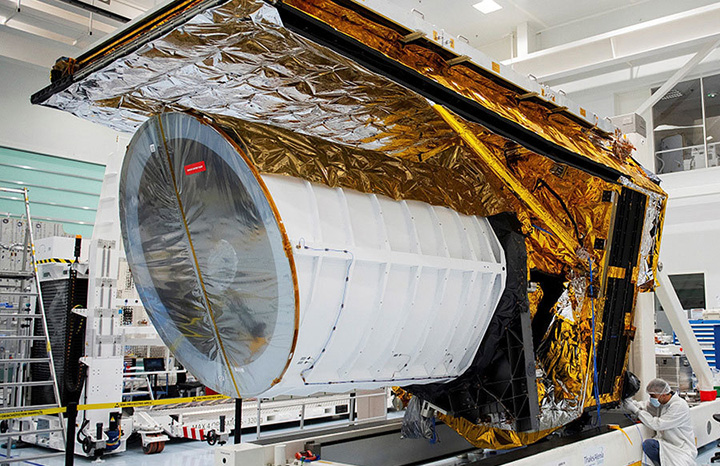
These core elements will now undergo an intensive phase of testing and verification to validate the spacecraft’s mechanical design before flight hardware is finalized.
Validating the Rosalind Franklin Delivery System
The structural models represent a high-fidelity physical configuration of the flight modules designed to deliver the Rosalind Franklin rover to the Martian surface. This includes the Carrier Module, which manages the cruise phase from Earth to Mars, and the Entry, Descent, and Landing Module (EDLM).
In Cannes, the hardware will undergo vibration and acoustic testing to simulate the extreme dynamic environment of launch. Following this phase, the units will return to Turin for shock and separation tests, as well as static structural verification. This sequence is a critical risk-mitigation step, ensuring that the upgraded European landing platform—developed under a €522 million framework contract signed in April 2024—can withstand the stresses of a deep-space mission.
Technical Configuration and Mission Profile
The ExoMars 2028 mission is led by the European Space Agency (ESA) with substantial contributions from NASA. The mission objectives focus on searching for signs of past or present life beneath the Martian surface using a drill capable of reaching depths of two meters.
- Launch Vehicle: SpaceX Falcon Heavy (Contracted via NASA).
- Launch Site: Kennedy Space Center, Florida.
- Target Launch Window: October – December 2028.
- Arrival at Mars: Expected in 2030.
- Landing Site: Oxia Planum.
- Key Hardware: Leonardo-developed 2-meter drill and the NASA-contributed Mars Organic Molecule Analyzer (MOMA) mass spectrometer.
Strategic Cooperation and Launch Services
The project reflects a reinforced international partnership. While ESA is responsible for the carrier, landing platform, and rover, NASA recently confirmed the selection of a SpaceX Falcon Heavy to launch the mission. NASA is also providing the braking engines for the landing platform and radioisotope heater units (RHUs) to maintain the rover’s internal temperatures during the harsh Martian nights.
This hardware delivery to Cannes signifies that the industrial team, led by Thales Alenia Space in Italy and involving Airbus Defence and Space (UK), ArianeGroup (France), and OHB (Germany), is maintaining a steady cadence toward the 2028 launch window.
Timeline for Flight Hardware Integration
Upon the successful completion of the current structural test campaign, the team will transition to the Proto-Flight Model (PFM). This fully integrated flight hardware will undergo its own dedicated test sequence, including thermal vacuum and electromagnetic compatibility (EMC) testing, throughout 2027. These final verifications will pave the way for shipment to the Kennedy Space Center ahead of the late 2028 launch date.
