

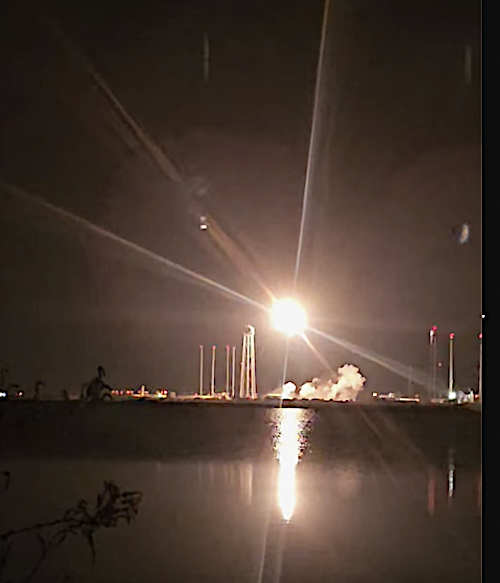
Rocket Lab successfully launched its HASTE launch vehicle from Launch Complex 2 on Wallops Island, Virginia, on Tuesday, September 30th, for an undisclosed customer. The mission was Rocket Lab’s 4th HASTE launch overall. Photo captured by Satnews.
A suborbital variant of Electron — the world’s most frequently launched small orbital rocket — HASTE includes much of the same innovative technology as Electron, including carbon fiber composite structures and 3D printed rocket engines, but has a modified upper Kick Stage tailored for hypersonic technology tests and a larger payload capacity of up to 700 kg / 1,540 lbs. HASTE can deploy technologies at speeds of more than 7.5km per second to test air-breathing, glide, and ballistic payloads, as well as technologies to re-enter Earth’s atmosphere from space. Combined, the HASTE and Electron launch vehicles have deployed 200+ payloads for government and commercial customers to date.
Rocket Lab’s HASTE suborbital flight of JUSTIN mission now set for Tuesday launch
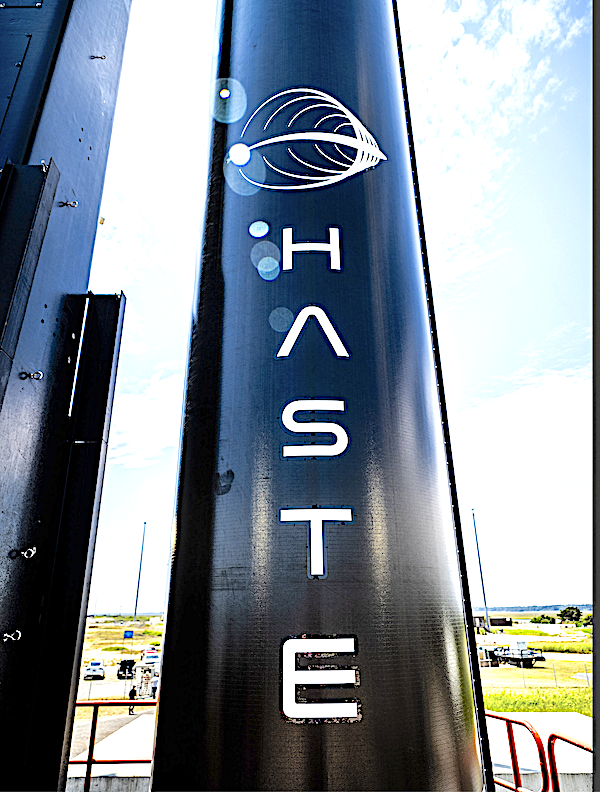
JUSTIN is the mission name for a Rocket Lab HASTE suborbital flight, scheduled to launch on Tuesday, September 30, 2025 at 4:45 PM – 10:00 PM PDT, from the Mid-Atlantic Regional Spaceport in Virginia. The “JUSTIN” mission uses Rocket Lab’s Electron rocket in a suborbital configuration under its Hypersonic Accelerator Suborbital Test Electron (HASTE) program to test hypersonic technology for the U.S. government.
The HASTE vehicle is a modified suborbital variation of the Electron to offer fast, affordable test opportunities for hypersonic technology (flight at speeds of Mach 5, or five times the speed of sound, or greater). The tests are for the development of U.S. military hypersonic weapons, that include cruise missiles and hypersonic glide vehicles (HGV) that are a type of warhead for ballistic missiles that can maneuver and glide at hypersonic speed. The tests include air-breathing engines, thermal protection systems, and guidance components.
The forecast calls for a temperature of 70°F, overcast clouds, 100% cloud cover and a wind speed of 14mph.
Rocket Lab’s HASTE to test hypersonic technology on suborbital flight for government’s top secret JUSTIN mission
JUSTIN is the mission name for a Rocket Lab HASTE suborbital flight, scheduled to launch on Monday, September 29, 2025, at 11:45 PM UTC, from the Mid-Atlantic Regional Spaceport in Virginia. The “JUSTIN” mission uses Rocket Lab’s Electron rocket in a suborbital configuration under its Hypersonic Accelerator Suborbital Test Electron (HASTE) program to test hypersonic technology for the U.S. government.
The forecast calls for a temperature of 71°F, overcast clouds, 100% cloud cover and a wind speed of 11mph.Wallops Flight Facility, Virginia, USA
Rocket Lab Launch Complex 2 (Launch Area 0 C) has witnessed the launch of 7 rockets, including 3 orbital launch attempts. While Wallops Flight Facility, Virginia, USA, has been the site for 81 rocket launches.

Wallops Flight Facility is a rocket launch site on Wallops Island on the Eastern Shore of Virginia, United States, just east of the Delmarva Peninsula and north-northeast of Norfolk. The facility is operated by the Goddard Space Flight Center in Greenbelt, Maryland, and primarily serves to support science and exploration missions for NASA and other federal agencies.
WFF includes an extensively instrumented range to support launches of more than a dozen types of sounding rockets; small expendable suborbital and orbital rockets; high-altitude balloon flights carrying scientific instruments for atmospheric and astronomical research; and, using its Research Airport, flight tests of aeronautical research aircraft, including uncrewed aerial vehicles.
