

On Thursday, July 9, 2026, the Federal Communications Commission (FCC) officially approved a license application from California-based space startup Reflect Orbital to operate communications frequencies for its upcoming Eärendil-1 demonstration satellite.
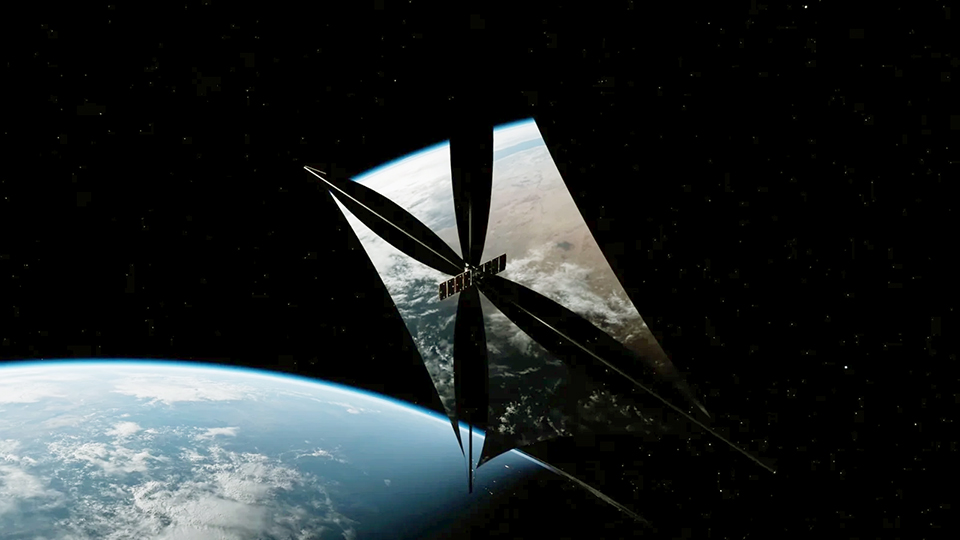
The regulatory clearance allows the company to move forward with a short-duration technology test designed to validate the feasibility of in-orbit sunlight reflection. The experimental spacecraft is manifested to launch later this year on a SpaceX rideshare mission.
Eärendil-1 Orbital and Structural Specifications
The Eärendil-1 baseline architecture focuses on testing a deployable, high-reflectivity thin-film structure in low-Earth orbit (LEO).
- Mass: The spacecraft has a total liftoff mass of approximately 142 kilograms.
- Reflector Size: Once deployed, the steerable thin-film mirror mechanism measures roughly 18 meters by 18 meters (approximately 60 feet by 60 feet).
- Orbital Profile: The satellite will operate at a LEO altitude between 600 kilometers and 650 kilometers.
- Beam Footprint: The mirror assembly is engineered to project a moving patch of redirected sunlight down to Earth’s surface, creating an illuminated circular ground footprint roughly five kilometers (three miles) wide.
Commercial Objectives and Jurisdictional Deliberations
Reflect Orbital’s primary market rationale rests on providing “sunlight on demand” to augment ground infrastructure. Intended applications include directing supplementary light to solar farms to sustain power generation after sunset, illuminating large-scale nighttime construction zones, and supporting search-and-rescue teams during localized environmental disasters.
The application generated significant regulatory friction, drawing nearly 1,900 public comments—the vast majority of which opposed the concept due to concerns regarding astronomical observation interference and light pollution. However, the FCC noted in its final order that non-rf environmental factors like optical reflectivity and light pollution fall outside its statutory purview under the Communications Act. The agency concluded that making spectrum available to evaluate novel orbital activities serves the public interest by encouraging domestic space sector innovation.
Constellation Projections and Astronomy Interference Risks
While the current FCC authorization strictly governs a single prototype satellite, the approval has amplified systemic friction between the NewSpace industry and the scientific community. Reflect Orbital’s long-term business model envisions a massive network consisting of up to 50,000 mirror-equipped satellites by 2035.
Astronomical research modeling warns that a large-scale deployment of this type could increase natural nighttime sky background brightness by 200% to 300%, potentially blinding sensitive ground-based telescope facilities. Scientists are also monitoring potential localized upper-atmosphere thermal variations and isotherm shifts resulting from concentrated beams of artificial sunlight. Eärendil-1 will serve as a foundational test case, allowing researchers to gather real-world data on glare limits, orbital track precision, and beam dispersion properties.
