

In mid-May 2026, NASA released its preliminary mission architecture for Artemis III, finalizing a dramatic restructuring of the lunar campaign. Following a structural reorganization spearheaded by NASA Administrator Jared Isaacman, the agency confirmed that Artemis III—targeted for launch no earlier than late 2027—will pivot from a crewed lunar landing to a complex systems demonstration in low Earth orbit (LEO).
The revamped flight profile serves as an operational risk-mitigation step, creating a high-fidelity test environment to evaluate how the Orion spacecraft, its crew, and ground teams interact with commercial landers before attempting a landing on the Moon’s South Pole during Artemis IV in 2028.
Non-Propulsive Spacer Integration on the Space Launch System
A primary architectural departure for Artemis III is the elimination of the traditional propulsive upper stage on the Space Launch System (SLS) rocket.
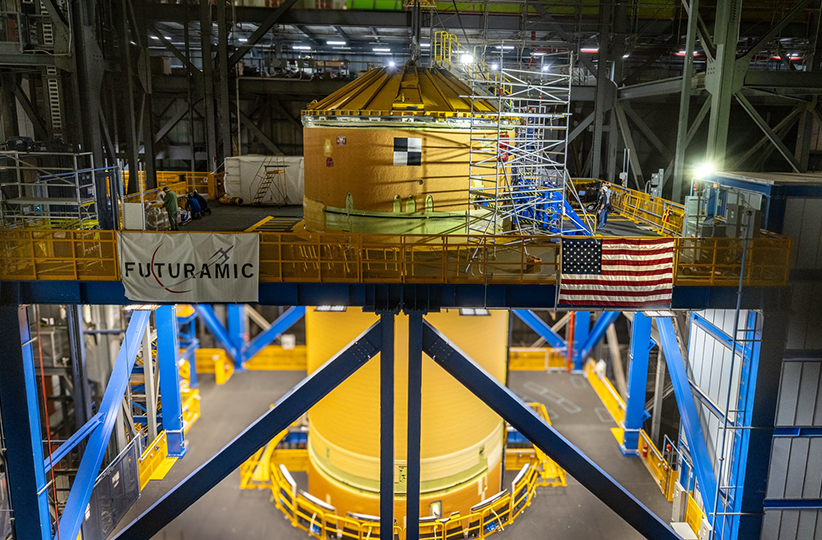
To preserve the agency’s final remaining Interim Cryogenic Propulsion Stage (ICPS) for the Artemis IV lunar landing mission, the Artemis III SLS will instead carry a structural “spacer.” Fabricated at the Marshall Space Flight Center in Alabama, this non-propulsive component mimics the precise physical dimensions, mass properties, and interface connection points of a standard upper stage between the launch vehicle stage adapter and the Orion spacecraft.
Without an upper stage to boost the capsule out of the atmosphere, Orion’s European Service Module (ESM) will take over the primary propulsive workload. Upon separation from the core booster, the ESM will execute a prolonged engine burn to circularize the spacecraft’s trajectory into a 460-kilometer low Earth orbit, providing a stable baseline for the multi-vehicle integration campaign.
Joint Commercial Rendezvous and Docking Campaign
Once established in LEO, the four-person Artemis III crew will execute a complex rendezvous and docking sequence with separately launched commercial pathfinders. The single launch campaign represents the first time NASA will actively integrate hardware from its two Human Landing System (HLS) providers simultaneously.
The mission profile involves two primary commercial target vehicles:
- SpaceX Starship HLS Pathfinder: A low Earth orbit variant designed to validate proximity operations, structural docking interfaces, and propellant management systems.
- Blue Origin Blue Moon Mark 2 Pathfinder: A high-fidelity prototype utilized to evaluate automated rendezvous telemetry and crew transfer dynamics.
Astronauts are scheduled to demonstrate the mechanical and electrical performance of Orion’s docking system for the first time in flight. While the agency is still refining the specific concept of operations, preliminary guidelines state that the crew will spend an extended period in orbit to evaluate life-support systems, and astronauts may potentially enter at least one of the lander test articles to assess intra-vehicular interfaces and habitation concepts.
Logistics, Communications, and Commercial Solicitations
Because the mission will remain in low Earth orbit rather than venturing into deep space, the crew will not have access to the deep space communications infrastructure utilized during the Artemis II lunar flyby earlier this year. The International Space Station primarily relies on the Tracking and Data Relay Satellite (TDRS) network, but NASA engineers anticipate severe bandwidth capacity bottlenecks when routing high-definition video, telemetry, and multi-vehicle coordination streams simultaneously.
To resolve this limitation, NASA has issued an open solicitation for commercial communications providers to supply dedicated, high-bandwidth LEO relay services during the flight. The mission will also carry a series of secondary CubeSat payloads and may evaluate the lander interface systems designed for Axiom Space’s AxEMU spacesuits, maximizing the scientific and technical return of the Earth-orbit trial.
Upgraded Reentry Profile and Heat Shield Verification
The conclusion of the Artemis III flight will focus on expanding the operational boundaries of Orion’s recovery systems. Following the completion of the commercial docking trials, the ESM will execute a de-orbit burn to position the capsule for atmospheric reentry.
The mission will mark the operational debut of an upgraded ablative heat shield block configuration. Engineers redesigned the thermal protection layer to address minor, localized erosion anomalies discovered after the uncrewed Artemis I flight. By testing these material improvements during a high-speed LEO entry, NASA intends to validate more flexible, robust, and steep skip-reentry profiles, ensuring the capsule can safely return crews from high-energy lunar trajectories during the subsequent landing missions.
