

On May 14, 2026, NASA confirmed that the Liquid Oxygen Flight Demonstration, or LOXSAT, has entered its final pre-launch testing phase at Rocket Lab’s Spacecraft Production Complex in Long Beach, California.
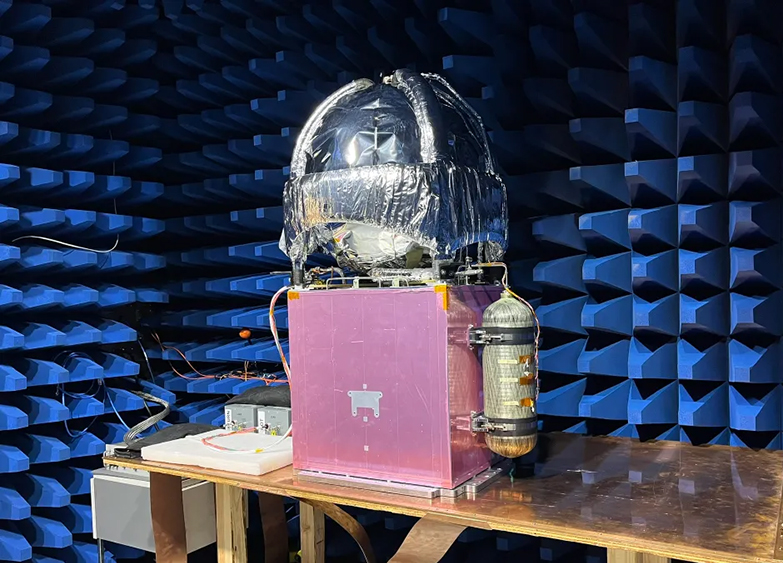
Developed by Eta Space under a NASA Tipping Point contract, the mission aims to validate technologies required for long-term orbital propellant storage and transfer. The integrated payload will launch aboard an Electron rocket from Mahia, New Zealand, with the launch window opening no earlier than July 17, 2026.
Overcoming Thermodynamic Hurdles in Microgravity
The baseline objective of the LOXSAT mission is to mitigate the technical risks associated with handling super-cold liquids in space. On Earth, gravity naturally separates liquids from gases, allowing for predictable fuel pumping and venting. In microgravity, surface tension dominates, causing fluids to cling to tank walls and float as chaotic bubbles. This behavior makes simple tasks like gauging remaining fuel levels or transferring propellants between spacecraft highly unpredictable.
During its scheduled nine-month mission in low Earth orbit, LOXSAT will systematically validate 11 separate cryogenic fluid management (CFM) technologies. The testing suite focuses on zero-loss storage systems, high-accuracy propellant gauging, and automated internal tank pressure controls. By maintaining liquid oxygen at temperatures below minus 297 degrees Fahrenheit without venting valuable mass, the payload will establish baseline performance models for future in-space logistics.
Hardware Integration on the Photon Satellite Bus
The mission represents a collaborative assembly across multiple commercial and civil aerospace entities. Rocket Lab has completed the manufacturing and structural testing of the custom Photon-LEO satellite bus, which houses the automated command, power, and attitude control systems required to support the extensive test schedule.
The propulsion and docking mechanics rely on specialized subsystems provided by industrial partners:
- Cryogenic Coupling: Altius Space Machines, a subsidiary of Voyager Space, developed a specialized cryogenic fluid transfer disconnect and latching mechanism.
- Automated Refueling: The docking interface is engineered to perform repeated mating and de-mating cycles to demonstrate automated fluid line connection under microgravity conditions.
- Mission Management: Personnel from NASA’s Marshall Space Flight Center, Glenn Research Center, and Kennedy Space Center are providing technical oversight for the integrated systems review.
Foundation for the Commercial Cryo-Dock Depot
The data harvested from the LOXSAT flight will serve as the immediate technological platform for Eta Space’s proposed commercial architecture, Cryo-Dock. Planned for a full-scale orbital deployment by 2030, Cryo-Dock is envisioned as an autonomous, multi-user orbital propellant depot. The facility will store large quantities of liquid oxygen and liquid methane, the two primary propellants utilized by modern heavy-lift launch vehicles.
The ability to refuel spacecraft in Earth orbit alters the payload constraints of deep space exploration. Rather than launching a vehicle with all the heavy fuel required for an entire round-trip journey to the Moon or Mars, spacecraft can launch lightweight and top off their tanks in orbit. This infrastructure-centric approach aligns with NASA’s broader goal to cultivate a sustainable cislunar economy, transitioning the agency from a primary infrastructure builder into a commercial customer for orbital commodities.
