

The U.S. Space Command commander told reporters at Space Symposium 2026 that eight intelligence analysts begin operational work at Redstone Arsenal this week as the command advances its maneuver warfare strategy.
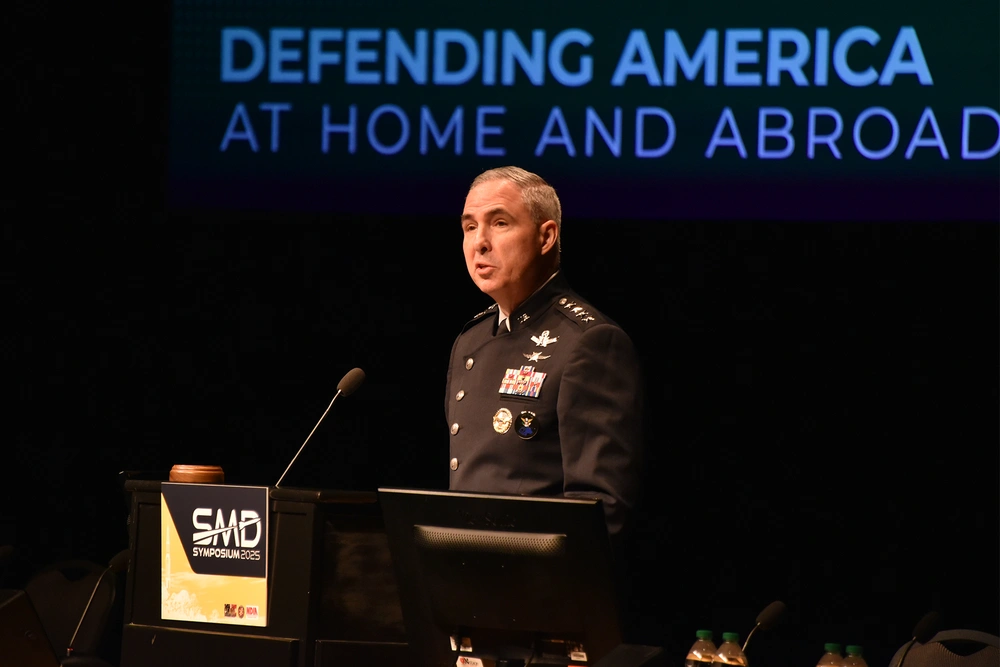
COLORADO SPRINGS — Gen. Stephen Whiting, Commander of U.S. Space Command, said at Space Symposium 2026 that the command will move its first operational personnel to Redstone Arsenal in Huntsville, Alabama, this week — the first true operational element of USSPACECOM at its future permanent home. Whiting disclosed the milestone during an on-the-record media briefing moderated by Col. Phil Ventura, USSPACECOM’s Director of Public Affairs, where he also detailed a maneuver warfare strategy, lessons from the recent Iran conflict, and coordination with European allies.
Eight intelligence analysts form the initial tranche, Whiting said, distinct from the roughly 20 staff already working at a Redstone transition office. They will occupy a top-secret facility — a SCIF gifted to Space Command by the Missile and Space Intelligence Center — that will ultimately house 80 people this year. “I’ll announce today for the first time that this week we will have our first US Space Command staff members arriving at Redstone who are not arriving to execute the transition. They’re arriving to do an operational mission,” Whiting said. The command expects 200 personnel at Redstone by year-end, with the full headquarters staff in place by 2031 or 2032. That timeline, Whiting said, is “still three to four years faster than a traditional military construction timeline,” a pace he credited to new authorities in the latest National Defense Authorization Act.
This week we will have our first US Space Command staff members arriving at Redstone who are not arriving to execute the transition. They’re arriving to do an operational mission.
To retain civilian expertise during the multi-year move, Whiting said he is using statutory authority to grant a 10 percent pay raise to civilians assigned to the Colorado Springs headquarters. Those who relocate to Huntsville will receive a 100 percent salary incentive paid over four years — a 25 percent annual bump for the first four years. Civilians make up 60 percent of his headquarters, he said, and the command has committed to giving each civilian at least a one-year notice before their function moves.
On the warfighting side, Whiting said USSPACECOM is advancing modeling and simulation work on what he called “Apollo maneuvers,” a concept he first outlined in January, and will soon hand the work to the command’s war gaming branch for tabletop exercises and eventually live-fly events using on-orbit assets. He tied the effort to a broader pivot to maneuver warfare in space and described the president’s budget as “truly a generational investment,” with additional funding expected for sustained space maneuver.
Whiting drew direct lessons from the recent Iran conflict. “Even a medium power like Iran will seek to target our space capabilities. We do not live in an era of sanctuary anymore,” he said, pointing to USSPACECOM’s first “element of victory” — operating through an attack. He also flagged the ubiquity of commercial space, noting adversaries and their proxies now have near-constant access to battlefield imagery. Space Command and U.S. Cyber Command were “the early movers” in recent operations against Iran, Whiting said, working in concert with the joint force to inhibit Tehran’s ability to communicate, sense, and command its forces. He cited the Space Force’s Counter-Communication System as an available capability.
Even a medium power like Iran will seek to target our space capabilities. We do not live in an era of sanctuary anymore.
Allied cooperation ran through the briefing. Whiting named Germany, France, the United Kingdom, Australia, Canada, and New Zealand as Operation Olympic Defender partners and welcomed Germany’s announced €35 billion investment and new space strategy. On cislunar, he said USSPACECOM has developed a cislunar requirements document and is watching Chinese lunar ambitions closely, concerned that the moon could be used as a vantage point “to hide military capability that can be brought back toward geosynchronous orbit.”
Closing the briefing, Whiting framed Chairman Gen. Caine’s recent public recognition of space contributions as part of the “ongoing normalization” of space as a warfighting domain. USSPACECOM will sustain that posture, he said, as its Huntsville footprint grows through 2027 and 2028 toward full headquarters stand-up early in the next decade.
