

On Wednesday, April 15, 2026, during a keynote address at the 41st Space Symposium in Colorado Springs, Chief of Space Operations General B. Chance Saltzman released two foundational documents that redefine the service’s trajectory: “Future Operating Environment 2040” and “Objective Force 2040.” Collectively numbering 160 pages, these documents outline a 15-year roadmap to expand the Space Force into a significantly larger and more autonomous combat-ready service.
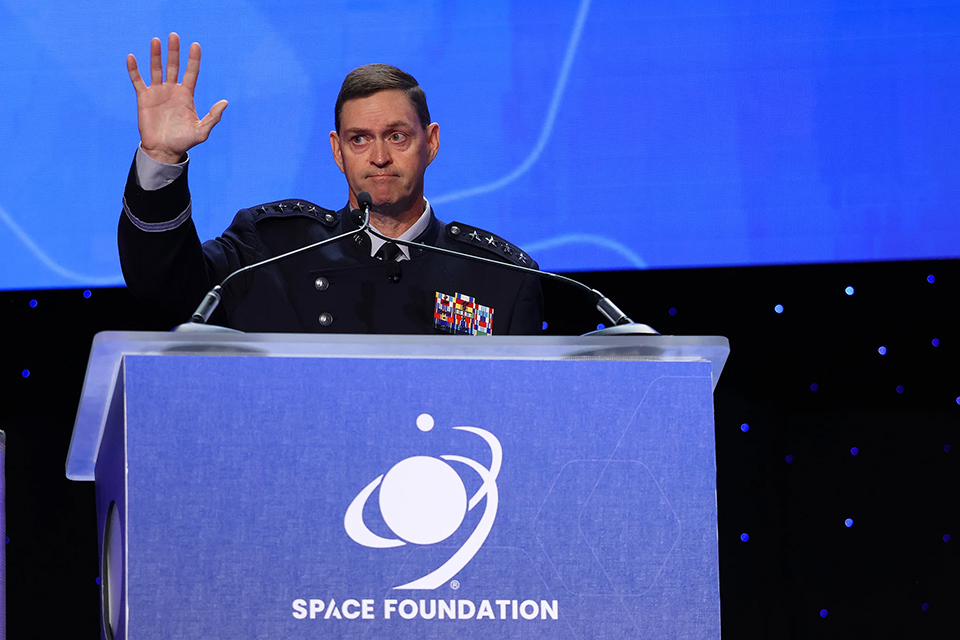
General Saltzman characterized the current era as a “point of departure,” asserting that the service must grow by thousands of Guardians—including officers, enlisted, and civilians—to meet the operational tempo demanded by the evolving threat landscape. The rollout coincided with the release of a record-breaking Fiscal Year 2027 budget request and signaled the CSO’s final major strategic push before his planned retirement later this year.
Mapping the Future Operating Environment
The “Future Operating Environment 2040” serves as an analytical framework rather than a specific intelligence assessment. It identifies China as the primary pacing threat, predicting an adversary capable of deploying integrated, AI-enabled space-ground operations on a global scale.
The document describes a “grueling” future domain dominated by:
- Machine-Speed Conflict: AI and cyber agents sensing and acting faster than human decision cycles.
- Proliferated Adversary Constellations: Thousands of Chinese low-Earth orbit (LEO) satellites for low-latency data transfer and sophisticated counterspace operations.
- Ambiguous “Grey Zone” Tactics: Increased use of commercial-style proximity operations to mask military interference.
The Objective Force: Quantifying the 2040 Fleet
Derived from the operating environment analysis, the “Objective Force 2040” defines the specific systems and infrastructure required to maintain space superiority. While portions of the plan related to orbital and electronic warfare remain classified, the unclassified version calls for a fleet potentially exceeding 30,000 satellites to ensure redundancy.
Key focus areas for the Objective Force include Navigation Warfare (NAVWAR), which calls for augmenting GPS with a hybrid architecture of allied and commercial PNT (Positioning, Navigation, and Timing) systems. This shift is designed to ensure warfighters remain connected even if primary constellations are contested.
Speed as a Strategic Requirement
The blueprint marks a formal pivot in Space Force acquisition philosophy, moving away from sequential testing and “pursuing perfection.” Saltzman emphasized that the service must prioritize “Minimum Viable Capabilities” that can be fielded quickly and upgraded incrementally.
“We simply cannot wait for ‘perfect’ any longer,” Saltzman stated. “A system that is good enough and delivered sooner provides real combat capability. Speed is now a strategic requirement, not just an efficiency goal.” This rationale supports the realignment of acquisitions under Portfolio Acquisition Executives to bypass the bureaucratic “Valley of Death” that often stalls space innovation.
Combat Credibility and Real-World Application
General Saltzman cited recent real-world success as proof that the Space Force is no longer a theoretical entity. He pointed to Guardians’ contributions to Operations Midnight Hammer, Absolute Resolve, and Epic Fury over the last year as evidence that space superiority is now a mandatory precondition for Joint Force success.
“You have space superiority if you can use space the way you want, and the adversary cannot use space the way they want,” Saltzman explained. He noted that the success of the new training pipelines—such as the Officer Training Course and the advanced Galaxy program—is essential for developing a force that can innovate at every level.
Expansion and Infrastructure 2027–2040
The first five years of the Objective Force are already reflected in the Space Force’s five-year budget projection. The roadmap anticipates a significant expansion of the physical footprint of the service, including new bases, training structures, and dedicated R&D facilities.
As the Space Force enters its seventh year, the service will update the Objective Force framework annually and republish it every five years. The ultimate goal is a resilient, responsive force of 30,000+ satellites and nearly 30,000 personnel, ensuring that the U.S. remains the dominant power in the cislunar and orbital domains through 2040.
