

• Skip to primary navigation
  • Skip to main content
  • Skip to primary sidebar
  • Skip to secondary sidebar
  • Skip to footer
  • NEWS:
  • SatNews
  • SatMagazine
  • MilSatMagazine
  • SmallSat News
  • |     EVENTS:
  • SmallSat Symposium
  • Satellite Innovation
  • MilSat Symposium
  • SmallSat Europe

SatNews

Satellite Industry Intelligence Since 1983

Subscribe
  • LATEST
  • Missions & Constellations
    • Exploration & Science Missions
    • In-Orbit Servicing & Orbital Operations
    • LEO Constellations
    • Mission Autonomy & Onboard Systems
    • Mission Deployments & Manifests
    • Navigation & PNT
    • SmallSat
    • Spacecraft & Payload Technology
    View All in Missions & Constellations →
    NexSat Space Systems Debuts with ACE ‘Invisible’ Aero-Conformal AntennaNexSat Space Systems Debuts with ACE ‘Invisible’ Aero-Conformal Antenna
    Rocket Lab Emerging as Potential Bus Provider for 2,800-Satellite Equatys ConstellationRocket Lab Emerging as Potential Bus Provider for 2,800-Satellite Equatys Constellation
    SES Taps K2 Space for Next-Gen ‘meoSphere’ MEO NetworkSES Taps K2 Space for Next-Gen ‘meoSphere’ MEO Network
    Dual-Use by Design: Telesat Lightspeed and the End of Civilian Telecom in LEODual-Use by Design: Telesat Lightspeed and the End of Civilian Telecom in LEO
  • Business
    • Contracts & Commercial Deals
    • Earnings & Financial Reporting
    • Events & Conferences
    • Funding & Venture Capital
    • Market Forecasts
    • Mergers & Acquisitions
    • Personnel Moves & Appointments
    View All in Business & Finance →
    SpaceX Accelerates Record-Breaking IPO Following Trillion-Dollar xAI MergerSpaceX Accelerates Record-Breaking IPO Following Trillion-Dollar xAI Merger
    Laser Communications and the Rise of Orbital Data CentersLaser Communications and the Rise of Orbital Data Centers
    OHB SE Exceeds Profitability Targets with Record €3.2 Billion BacklogOHB SE Exceeds Profitability Targets with Record €3.2 Billion Backlog
    Satellogic Executes Strategic Pivot as 2025 Revenue Climbs 38%Satellogic Executes Strategic Pivot as 2025 Revenue Climbs 38%
  • Defense
    • Counterspace & ASAT
    • Defense Budgets & Procurement
    • ISR & Reconnaissance
    • MILSATCOM
    • Missile Warning & Defense
    • National Security Programs
    • Space Domain Awareness
    View All in Military & Defense →
    Dual-Use by Design: Telesat Lightspeed and the End of Civilian Telecom in LEODual-Use by Design: Telesat Lightspeed and the End of Civilian Telecom in LEO
    ThinKom Showcases Modular MILSATCOM Architecture for Contested EnvironmentsThinKom Showcases Modular MILSATCOM Architecture for Contested Environments
    The Pentagon’s SmallSats Have An Amnesia ProblemThe Pentagon’s SmallSats Have An Amnesia Problem
    U.S. Space Force Awards $446.8 Million Agreement to Kratos for MEO Missile Tracking Ground SegmentU.S. Space Force Awards $446.8 Million Agreement to Kratos for MEO Missile Tracking Ground Segment
  • Gov
    • Export Controls & Compliance
    • International Space Agreements
    • National Space Policy
    • Space Law & Treaties
    • Space Sustainability & Debris Policy
    • Space Traffic Management / Debris Removal
    View All in Government & Regulation →
    Space Force Reassigns Final GPS III Mission to SpaceX Following Vulcan AnomalySpace Force Reassigns Final GPS III Mission to SpaceX Following Vulcan Anomaly
    NASA Realignment ‘Ignition’ Accelerates Shift Toward Commercial Lunar EconomyNASA Realignment ‘Ignition’ Accelerates Shift Toward Commercial Lunar Economy
    SpaceX and GSO Giants Clash Over FCC Spectrum Sharing Rules and Power LimitsSpaceX and GSO Giants Clash Over FCC Spectrum Sharing Rules and Power Limits
    Rheinmetall Walked Away. Germany Should Take the Hint.Rheinmetall Walked Away. Germany Should Take the Hint.
  • Launch
    • Launch Providers
    • Launch Schedule & Calendars
    • Launch Sites & Infrastructure
    • Rocket Technology & Vehicles
    View All in Launch →
    Space Force Reassigns Final GPS III Mission to SpaceX Following Vulcan AnomalySpace Force Reassigns Final GPS III Mission to SpaceX Following Vulcan Anomaly
    China satellite investment soars as SpaceX sparks race for spaceChina satellite investment soars as SpaceX sparks race for space
    L3Harris Honors Goddard Centennial with Advances in Nuclear and Electric PropulsionL3Harris Honors Goddard Centennial with Advances in Nuclear and Electric Propulsion
    Firefly Aerospace Returns to Flight with Successful “Stairway to Seven” MissionFirefly Aerospace Returns to Flight with Successful “Stairway to Seven” Mission
  • Software
    • Autonomous Ground Operations
    • Data Processing & AI/ML
    • Digital Twins & Modeling
    • Ground Segment & Teleports
    • Mission Planning & Simulation
    • Space Systems Software Engineering
    • Spectrum & Licensing
    View All in Software Automation & Ground Systems →
    NexSat Space Systems Debuts with ACE ‘Invisible’ Aero-Conformal AntennaNexSat Space Systems Debuts with ACE ‘Invisible’ Aero-Conformal Antenna
    Laser Communications and the Rise of Orbital Data CentersLaser Communications and the Rise of Orbital Data Centers
    ThinKom Showcases Modular MILSATCOM Architecture for Contested EnvironmentsThinKom Showcases Modular MILSATCOM Architecture for Contested Environments
    Kymeta Sets Roadmap for KuKa 8 Series Multi-Band TerminalsKymeta Sets Roadmap for KuKa 8 Series Multi-Band Terminals
  • Services & Apps
    • Climate & Environmental Monitoring
    • Disaster Response & Security Mapping
    • Earth Observation & Imaging
    • Maritime & Aviation Satcom
    • Satellite Communications
    View All in Services & Applications →
    Marlink Reports 50% Surge in GNSS Interference Impacting Global ShippingMarlink Reports 50% Surge in GNSS Interference Impacting Global Shipping
    Laser Communications and the Rise of Orbital Data CentersLaser Communications and the Rise of Orbital Data Centers
    Optical Surfaces Ltd Targets Aerospace Surveillance with Ritchey-Chrétien OpticsOptical Surfaces Ltd Targets Aerospace Surveillance with Ritchey-Chrétien Optics
    CubeSpace Challenges Vertical Integration with Record ADCS Production MilestoneCubeSpace Challenges Vertical Integration with Record ADCS Production Milestone
  • SatNews Events
  • Magazines
  • Calendar

Your Teleport Can’t Dodge a Missile

March 12, 2026

By Ricardo Dias, CEO, United Teleports

What’s at Stake:

  • The March 9 missile strike on SES’s Ha’Ela teleport is the first deliberate targeting of a commercial satellite ground facility in a major conflict. Teleports are now strategic infrastructure, not just technical infrastructure.
  • Single-site architectures are indefensible for mission-critical services. The industry needs geographic redundancy, automated traffic rerouting, and cross-operator mutual aid agreements.
  • The $54 billion ground segment market has invested heavily in cyber resilience but barely addressed kinetic threats. That calculus must change.

The missile strike that damaged SES’s Ha’Ela teleport facility in central Israel on March 9 should serve as a wake-up call for the satellite communications industry. Teleports have long been viewed as reliable, almost invisible components of the global connectivity ecosystem. They quietly link satellites in orbit to terrestrial networks that power broadcasting, enterprise communications, government services, and internet access.

But the events in Israel highlight a difficult reality: teleports are not just technical infrastructure. They are strategic infrastructure.
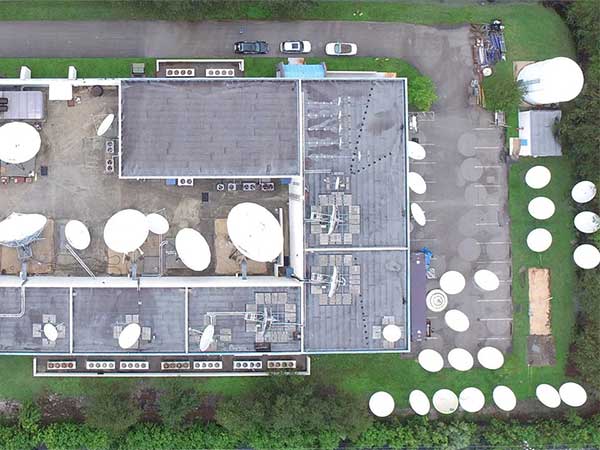
United Teleports’ Port St. Lucie facility in Florida. Image courtesy of United Teleports.

In a world where communications networks underpin national security, media distribution, and economic activity, ground-based satellite facilities are increasingly visible, and potentially vulnerable, nodes in the global digital backbone.

For teleport operators, the implications are significant.

The Ground Segment Is the Exposed Flank

The satellite industry often focuses its resilience discussions on space: orbital congestion, satellite redundancy, and anti-satellite threats. Yet the ground segment has always been the most physically exposed part of the system.

Unlike satellites, teleports cannot maneuver. They are fixed installations, often with large antenna farms that are easily identifiable in satellite imagery or open-source mapping platforms. Their role as gateways for international communications makes them strategically important. SES alone operates 45 teleports worldwide serving its GEO and MEO constellations. Each one is a node that, if disrupted, ripples through the services it supports.

Whether the strike on the Ha’Ela facility was a deliberate targeting decision or collateral damage in a broader attack, the lesson is the same: teleports must now be considered potential targets in conflict environments.

That changes how the industry should think about resilience.

Single-Site Architectures Are No Longer Defensible

The first and most important takeaway is that single-site architectures are no longer sufficient for mission-critical services.

Many satellite services still rely on primary uplink locations with limited redundancy beyond backup power systems or spare equipment. Those measures protect against equipment failures or weather events. They are not enough if an entire facility becomes unavailable.
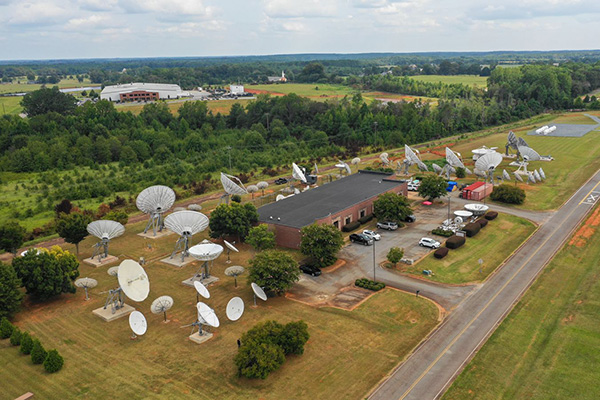
United Teleports’ Thomaston Facility Georgia Image courtesy of United Teleports.

Teleport operators should be designing their networks around geographic redundancy. That means maintaining multiple teleport locations capable of handling traffic if another site goes offline. These facilities should not merely be passive backups. They should be integrated operational nodes capable of carrying full service loads when required.

Equally important is automation. Network orchestration systems should allow traffic to be rerouted rapidly between teleports without lengthy manual intervention. Virtualized gateway technologies and cloud-based network management platforms are making this increasingly feasible.

In essence, teleport networks must evolve toward the same resilience principles used by global internet backbones and hyperscale data center operators.

Diversify the Entire Signal Path

True resilience also requires diversity beyond the teleport itself.

Satellite operators and service providers should maintain access to multiple satellites and orbital resources, ensuring that services can be rerouted through alternative gateways if necessary.

Similarly, terrestrial connectivity into and out of teleport facilities must be diversified. Multiple fiber routes, independent carriers, and geographically diverse network interconnection points can prevent disruptions from cascading through the system.

A teleport that survives an incident but loses all fiber connectivity is effectively offline. Ground infrastructure resilience must extend across the entire network path.

Harden What You Can

United Teleports’ Miami Facility Florida. Image courtesy of United Teleports.

While redundancy ensures service continuity, teleport operators should also evaluate physical infrastructure protection.

Historically, teleports have been designed primarily for RF performance, efficiency, and cost. The World Teleport Association’s security assessments have focused predominantly on cyber threats: IP-enabled systems, denial-of-service attacks, and signal interference. The Ha’Ela strike introduces a different category of risk that most facility planners have simply never had to think about.

Measures might include reinforced equipment buildings, protected or underground technical rooms, distributed antenna layouts, and enhanced monitoring and perimeter security systems. These steps do not eliminate risk, but they can reduce the likelihood that a single strike or localized incident will disable critical operations.

The Mutual Aid Model

Another important resilience strategy is interconnection between teleport operators.

Shared infrastructure agreements and partnerships allow traffic to be rerouted through partner facilities in other regions if necessary. In many cases, teleport operators already support each other during satellite relocations, maintenance windows, or temporary capacity demands.

Extending these cooperative models to emergency scenarios can significantly strengthen the resilience of the global satellite ecosystem. Connectivity is increasingly global in nature. Teleport networks should reflect that reality.

Not Every Teleport Is in a War Zone

That’s true. The Ha’Ela facility sits in an active conflict zone, and most of the world’s teleport sites will never face a precision missile. Full geographic redundancy is expensive, margins are thin, and maintaining a backup site for an event that may never happen is a hard sell to a board.

But the argument isn’t that every teleport needs a bunker. It’s that the industry’s resilience planning has assumed a threat model that the Ha’Ela strike just expanded. Even operators in stable regions should be asking whether their plans account for facility-level loss, from any cause, not just equipment failure or weather.

What Decision-Makers Should Do Now

The satellite industry prides itself on reliability. For decades, teleports have quietly operated with impressive uptime, supporting services that millions of people rely on every day.

But the Ha’Ela incident underscores that the risk landscape is changing. As satellite communications continue to play a central role in broadcasting, government communications, and broadband connectivity, ground infrastructure is becoming more visible in geopolitical and strategic contexts.

Teleport operators should be asking a specific question: if our primary facility became unavailable tomorrow morning, how long before services restore? Do we actually know the answer?

If services can automatically shift to another site with minimal disruption, the system is resilient. If the answer is “we’d figure it out,” the industry still has work to do.


Ricardo Dias is CEO and co-founder of United Teleports, a Miami-based teleport operator specializing in television content distribution and data services across the Americas.

Filed Under: Ground Segment & Teleports, Military & Defense, Satellite Communications Tagged With: Editorial

Primary Sidebar

Coverage

  • Missions & Constellations
  • Business & Finance
  • Military & Defense
  • Launch
  • Software Automation & Ground Systems
  • Government & Regulation
  • Services & Applications

Most Read Stories

  • SpaceX Prepares for Record-Breaking $1.75 Trillion Confidential IPO Filing in March
  • The Iran Precedent: Operation Epic Fury and the Law of Armed Conflict in Space
  • AST SpaceMobile Encapsulates BlueBird 7 Satellite for Inaugural New Glenn Mission
  • Rheinmetall Withdraws From Mynaric Bidding Process; Rocket Lab Acquisition Clears Major Competitive Hurdle
  • Bidding War Intensifies for Mynaric as Rheinmetall Challenges Rocket Lab Acquisition

Secondary Sidebar

Footer


Satnews is a leading provider of satellite news, events, publications, research and other satellite industry information in both commercial and military enterprises worldwide.

Stories By Category

  • Business & Finance
  • Government & Regulation
  • Launch
  • Military & Defense
  • Missions & Constellations
  • Services & Applications
  • Software Automation & Ground Systems
  • Spectrum & Licensing
  • Startups & NewSpace Business

About Us

  • Leadership & Editorial Team
  • SatNews History
  • Free Satnews Subscription
  • SatNews Events
  • Magazines

Navigation

  • Latest Stories
  • Magazines
  • Events
  • Contact
  • Cookie & Privacy Policy for Satnews

We use cookies to ensure that we give you the best experience on our website. If you continue to use this site we will assume that you are happy with it.
x
Sign up Now (For Free)
Access daily or weekly satellite news updates covering all aspects of the commercial and military satellite industry.
Invalid email address
Notify Me Regarding ( At least one ):
We value your privacy and will not sell or share your email or other information with any other company. You may also unsubscribe at anytime.

Click Here to see our full privacy policy.
Thanks for subscribing!