

By Nick David, Editorial Lead, SatNews
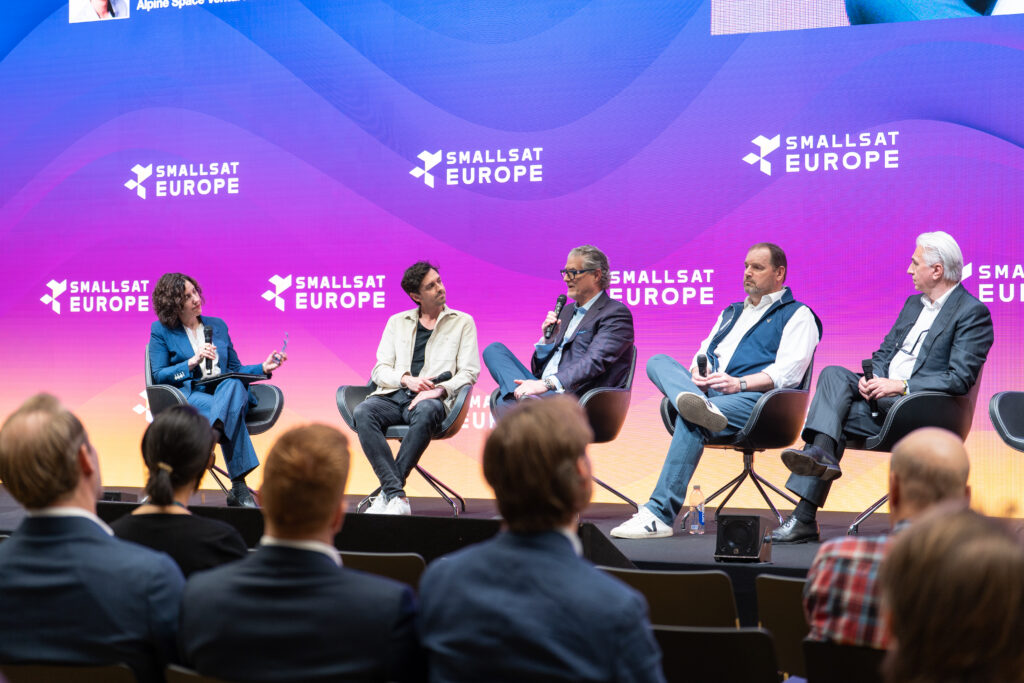
The honest summary of Day 1 of SmallSat Europe 2026 is that the capital is in, the technology exists, the talent is available, and none of it works without procurement reform. The Defense Stage and the Business Stage arrived at that conclusion from different angles and ended in the same place. The European space industry is now operating against a procurement architecture that was designed for a different industrial era, and the architecture is the lever that decides whether the capital pivot builds an ecosystem or simply reinforces the incumbent prime base.
That is a more pointed argument than the European space industry usually makes in public. It is also the right one.
“The requirements to fulfill for secrecy are secret.”— Dr. Christian Schmierer, HyImpulse
What “the procurement is broken” actually means
Military space procurement carries classification requirements that, in practice, advantage the firms already cleared to read them. “The requirements to fulfill for secrecy are secret,” HyImpulse’s Christian Schmierer put the chicken-and-egg most plainly. A new entrant cannot bid on a requirements document it cannot access. It cannot get cleared without an existing contract. It cannot get the contract without bidding. The cleared prime, who already knows which boxes to tick, wins by default, not by intentional design, but by structural advantage that compounds over budget cycles.
That dynamic is bad for the prime contractors too. They end up bidding on the same set of programs against the same set of competitors with the same set of margins, and the innovation that European defense space says it wants happens somewhere else.
The proposed counter-move is procedural. Separate the parts of defense space procurement that genuinely need classification from the parts that do not, and procure the latter in open competition. “If you buy a car, it’s the same car that in the civilian manufacturer can buy. Doesn’t need to be classified,” Schmierer reached for the closest analogy: “If the Bundeswehr uses Deutsche Bahn to move around stuff for FedEx to send parcels, then maybe the same type of procurement could also be used for commercial space service.” The Bundeswehr already uses Deutsche Bahn to move equipment and FedEx to send parcels. Neither contract is classified.
Procurement Now vs. Procurement Reformed
HOW IT WORKS NOW
- Requirements classified by default.
- Cleared primes know which boxes to tick.
- New entrants cannot bid on what they cannot read.
- Clearance requires a contract; contract requires clearance.
- Same firms bid every program. Margins compress.
HOW IT SHOULD WORK
- Separate what genuinely needs classification.
- Open competition for the rest.
- Programs of record awarded to new entrants.
- UK MOD 13-contract model: small money, large pipeline.
- ESA Φ-lab co-funding: 6–7x private leverage.
The model that already works
The U.K. Ministry of Defence’s recent program of issuing thirteen defense space contracts to startups, each at a few million pounds, is the procurement innovation worth tracking. Small money. Large pipeline effect. The thirteen firms are now inside the MOD’s contracting orbit, with operational trust that turns into bigger contracts in subsequent budget cycles. The cost was low. The strategic value was the demand signal: the institutional declaration that the buyer was actually willing to buy from non-traditional suppliers.
ESA’s Φ-lab Investing in Industrial Innovation program is the European-level demonstration. Companies that have worked with Φ-lab have raised approximately €1 billion in private investment against €150 million of ESA co-funding over four years. A six-to-seven-times private leverage ratio. That is a working model.
Procurement Reform · Working Models
13
UK MOD defense space contracts to startups
6–7x
ESA Φ-lab private leverage (€1B / €150M)
7 → 500
Ukrainian drone companies, 2022–2024
€3.3B
Ramstein IT (€1.1B) + Drone (€2.2B) coalitions
The institutional design lesson from Ukraine is the same model at higher tempo. “Translate the requirements. Make them readable. Pay for the work,” former Ukrainian Deputy Defence Minister Kateryna Chernohorenko summarized in her Defense Stage fireside. Seven Ukrainian drone companies at the start of the 2022 invasion. Five hundred by the end of 2024. The transformation was not engineering. It was a procurement environment that translated frontline demand into contracts fast enough for industry to scale into the gap. The Ramstein coalitions Ukraine helped structure delivered €1.1 billion for IT and €2.2 billion for Drones. A space coalition along the same lines does not yet exist.
Why this matters now
Without procurement reform on the same window as the capital pivot, the math fails. Europe needs “actual programs of record being awarded to new entrants into the market, not just grants being given out to hundreds of companies,” Alpine Space Ventures’ Sven Meyer-Brunswick told the Liquidity Event panel. Without programs of record, the revenue does not arrive. Without revenue, the venture and private-equity capital that catalyzes scale-ups does not commit. Without scale-ups, the supply chain stays at its current cadence. The budget gets absorbed by the prime base that already knows how to absorb it, and the European missing-middle ecosystem the Day 1 program kept describing never gets built.
This is not theoretical. The lesson from European launcher history, concentration on a single national prime model produced the monopolization Europe is now trying to undo, is sitting in the room. The diversification choice is available. The procurement window to make it is short.
The verdict from Day 1
Procurement reform is the operative lever. What gets bought. By whom. From whom. On what terms. How fast. Europe has the budget. It has the technology. It has the political alignment. The capital pivot dated to October 2024 converts into a competitive ecosystem only if the procurement architecture changes in the same window. The decisions of the next eighteen months tell us which side of that gap European defense space lands on.
The honest answer Day 1 surfaced is that the lever is still sitting there, waiting to be pulled.
Key Takeaway
Procurement reform is the operative lever. What gets bought, by whom, from whom, on what terms, and how fast. The U.K. MOD’s 13-startup contract model and ESA Φ-lab’s 6-to-7x private leverage ratio are the working European examples. Without reform on the same window as the capital pivot, the budget gets absorbed by primes who already know how to absorb it, new entrants do not get revenue, and the European missing-middle ecosystem never gets built. The decisions of the next eighteen months tell us which side of that gap European defense space lands on.
About the Author
A storyteller at heart, Nick David covers space policy, satellite markets, defense, and the technologies reshaping how humanity operates beyond Earth. With a background in creative direction, brand strategy, and editorial storytelling, he brings a modern lens to complex subjects and a relentless curiosity about what comes next.
