

BEIT SHEMESH, ISRAEL – On Monday, March 9, 2026, a barrage of long-range precision missiles launched by Hezbollah targeted the SES Ha’Ela Satellite Station (also known as the Emek HaEla Teleport) in the Valley of Elah. The strike, which marked a significant escalation in the use of long-range guided munitions against Israeli infrastructure, resulted in reported damage to ground segment hardware and surrounding infrastructure.
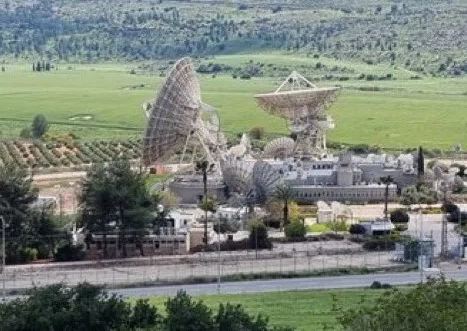
While Hezbollah claimed the facility serves the “Communications and Cyber Defense Division of the Israeli enemy army,” the site is a civilian-commercial teleport operated by the Luxembourg-based satellite giant SES. Following the strike, the Israel Defense Forces (IDF) issued a military censorship order regarding the extent of the damage due to the site’s critical role in regional connectivity.
Ha’Ela as a Strategic Ground Hub
The Ha’Ela Teleport is one of the most significant ground gateways in the Middle East. It serves as a primary link for global satellite networks, facilitating:
- Broadband & Broadcast: Distribution of television signals and data streams for millions of viewers across Europe, the Middle East, and Africa.
- MILSATCOM Support: While commercially operated, teleports of this scale are often utilized by government and defense agencies for secure backhaul and redundant communications.
- Infrastructure: The site houses over 100 high-precision parabolic antennas configured for multi-orbit communication with Geostationary (GEO) and Medium Earth Orbit (MEO) fleets, including SES’s O3b mPOWER constellation.
Rationale: Targeting the “Early-Warning” Shield
The strike on the Ha’Ela facility aligns with a broader regional strategy to degrade the “early-warning shield” of Israeli and allied forces. According to statements from the Iranian news agency Tasnim, the targeting of such facilities is intended to trigger a “wide wave of disruptions” in communications and early-warning data flows.
The missiles used in the attack—reportedly precision ground-to-ground variants—traveled approximately 160 kilometers from the Lebanese border. Paramedics and police reported that while the teleport was the intended target, shrapnel and impacts also caused light injuries and damage in nearby residential areas of Beit Shemesh and Ramle.
Global Implications for Ground Segment Security
The vulnerability of large, stationary antenna farms to precision missile strikes underscores a growing trend in the satellite industry: the move toward Ground Segment Resilience.
- Proliferation: Operators are increasingly looking to distribute ground functions across a larger number of smaller, geographically diverse sites.
- Mobility: The development of mobile, rapidly deployable gateways to replace stationary teleports in conflict zones.
- Optical Integration: The deployment of Optical Ground Stations (OGS), such as the one recently opened by SSC Space in Chile, which offer narrower beams that are harder to target and jam.
Operational Resilience
SES has not yet released a formal public statement regarding the specific operational impact on its fleet services. However, industry analysts expect the company to leverage its federated global network to reroute traffic through alternative teleports in Europe and Asia to maintain service continuity. The IDF Home Front Command remains under investigation regarding why air defense sirens were reportedly not activated until moments before the impact.
