

Lockheed Martin, Seagate Space, and Firefly Aerospace announced a three-way strategic collaboration on Monday, May 4, to develop sea-based launch capabilities for national security missions.
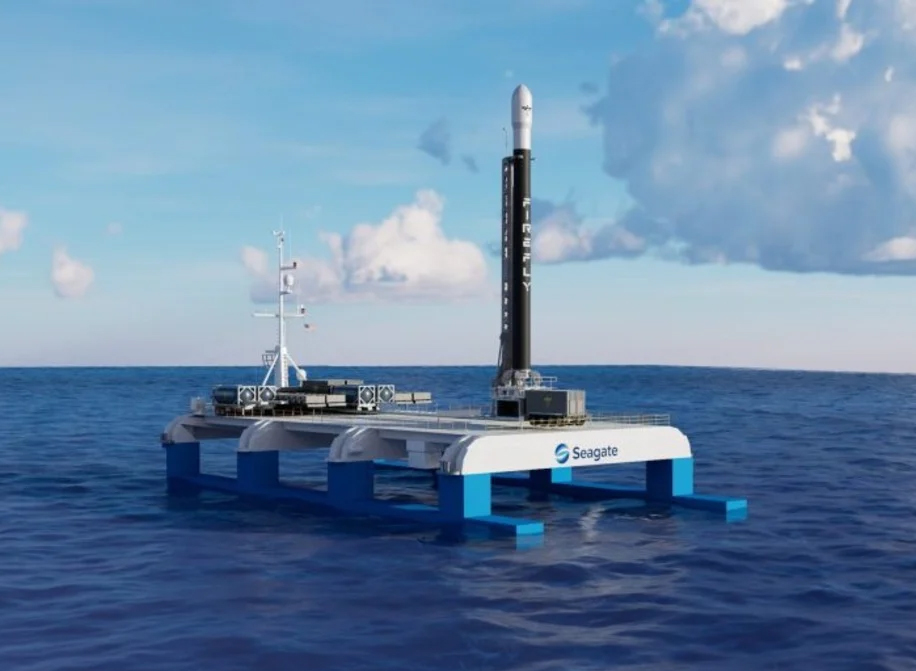
The partnership combines Lockheed Martin’s extensive heritage in missile defense and tactical systems with Seagate’s offshore launch infrastructure and Firefly’s responsive Alpha rocket. The initiative aims to provide the U.S. military with the ability to deploy payloads on tactical timelines from diverse, mobile locations, bypassing the bottlenecks of traditional land-based spaceports.
Leveraging the Gateway Offshore Launch Platform
The collaboration centers on the “Gateway” offshore launch platform, a purpose-built semi-submersible drone ship developed by Seagate Space. In December 2025, the platform received Approval in Principle (AIP) from the American Bureau of Shipping (ABS), marking it as the first offshore asset to meet newly established standards for maritime spaceports. The Gateway platform is designed to be rapidly deployable and cost-effective, offering a stable launch environment that can be positioned at various latitudes to optimize orbital insertion for specific mission requirements.
Firefly Alpha and Sea-Based Integration
The primary launch vehicle for the partnership is Firefly’s Alpha rocket, a two-stage, liquid-fueled small-lift vehicle.
- Payload Capacity: Approximately 1,000 kg to Low Earth Orbit (LEO).
- Launch Profile: Designed for rapid integration, as demonstrated in the “Victus Diem” Space Force exercise where Firefly processed a payload in under 12 hours.
- Mobile Operations: The sea-based configuration utilizes Seagate’s maritime logistics to transport and stage the Alpha vehicle entirely offshore, reducing the need for permanent coastal infrastructure and simplifying the regulatory landscape for flight corridors over open water.
Strategic Rationale for Responsive Space
The integration of Lockheed Martin as the defense prime shifts the collaboration from a purely commercial arrangement into a national security framework. By blending Lockheed Martin’s expertise in “targets and countermeasures” with responsive launch technology, the group aims to address the Department of Defense’s vision for Tactically Responsive Space (TacRS). This capability allows military planners to replace lost orbital assets or deploy new sensors in a crisis scenario within hours or days, rather than months or years.
“Having a capability to address the growing need for speed and flexibility to launch payloads on tactical timelines from diverse locations is key to national security,” stated Johnathon Caldwell, Vice President and General Manager of Strategic and Missile Defense Systems for Lockheed Martin Space.
Future Flight Demonstrations and Outlook
The next phase of the collaboration will involve a series of mission-application concepts and flight-demonstration projects. These tests will build on the “Stairway to Seven” mission (Alpha Flight 7) conducted in March 2026, which validated Block II upgrades for the Alpha rocket. Looking ahead, the partners intend to establish a network of staging and recovery infrastructure that allows for a high cadence of sea-based launches. Success in these demonstrations could pave the way for a permanent offshore launch capability for the U.S. Space Force by late 2027.
