

Chris Forrester — The Middle East is in terrible turmoil. However, despite bombs and justifiable anxiety and gas prices around the world reaching astronomical proportions, more level-headed businesses are planning for the future.
Some clear examples are easy to find: there’s Dubai, once a minor Emirate compared to its rich next-door neighbour Abu Dhabi and now – in more normal times – a holiday and retirement ‘hot spot’.
A few miles away across the Arabian Gulf there’s Qatar, where its natural gas reserves are amongst the planet’s largest. Saudi Arabia is investing billions in re-inventing itself as a more friendly place to visit, but its popular Saudi Film Festival has just been postponed (from April to June).
Dubai has successfully established itself as a media-friendly city, becoming home to dozens of high-profile TV stations and a vibrant programming production centre equal to the best elsewhere in the wider Arab region. Its high-profile trade shows attract thousands of visitors – some to sell and others to buy. Last year’s CabSat event brought in more than 32,000 visitors. But this year’s event (June 2-4) is under threat and even if it goes ahead visitor numbers wll be impacted.
Abu Dhabi, and in particular its sovereign wealth fund Mubadala, and now with an immense portfolio of investments topping $330 billion including high-profile stakes in India’s Reliance Jio, Waymo, Etihad Airways and Formula 1. Indeed, there are reports that Mubadala is investing in the new Cadillac Formula 1 team for the 2026 season.
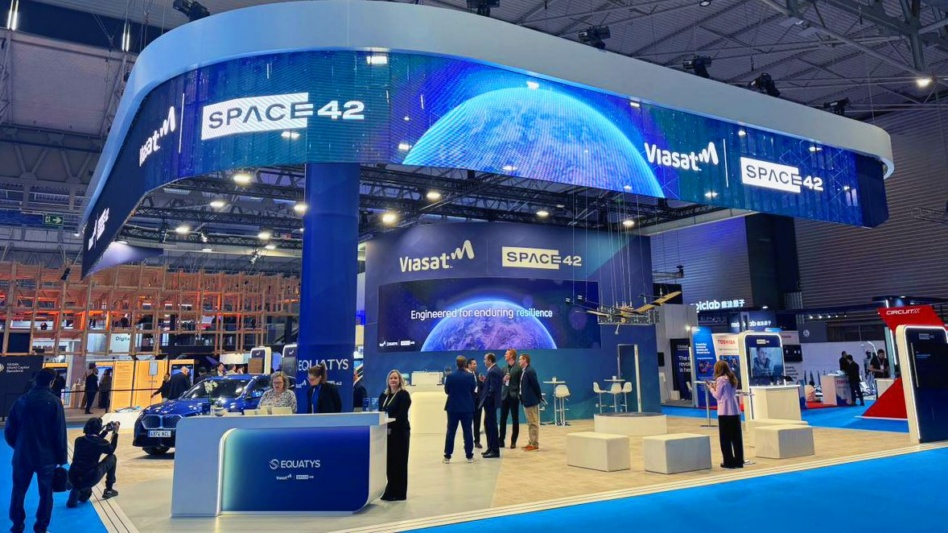
But Abu Dhabi is also looking to space to boost its influence well beyond its modest borders. Space42 is itself a joint-venture (with Bayanat and under the G42 umbrella of businesses) and which describes itself as an “AI-powered SpaceTech company that seamlessly integrates satellite communications, geospatial insights, and artificial intelligence capabilities for customers globally”.
Space42 already owns the Al-Yah/Yahsat satellites as well as the Thuraya craft. These already enjoy considerable local governmental support from the United Arab Emirates, and few doubt that a LEO fleet will gain considerable support from the Gulf region where it would hold a unique position for government, military and consumers alike. Yahsat beams its signals to more than 150 countries across Europe, the Mid-East, Africa, South America, Asia and Australia.
Space42 and California-based Viasat are now close to issuing a contract covering the build and then launch of 2800 low Earth orbiting (LEO) mega-constellation and targeting to be in service during 2029-2030.
Space42’s existing fleet of geostationary satellites already enjoy considerable local governmental/military support from the United Arab Emirates, and few doubt that a LEO fleet will gain considerable support from the wider Gulf region where it would hold a unique position for government, military, business and consumers alike.
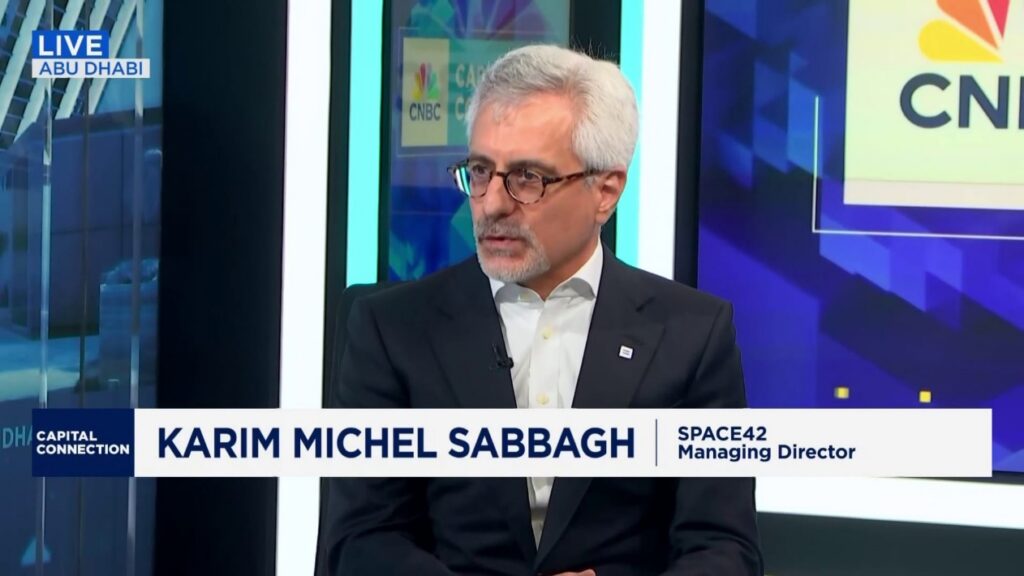
Space42 and Viasat’s joint-venture is in the form of Equatys and is also targeting direct-to-device cellular reception. Space42 is headed up by Karim Michel Sabbagh (a former CEO at SES) and according to reports is expected to announce “before this summer” on an additional strategic investor in Equatys, and on a contract with the manufacturer of the Equatys satellite bus.
The overall Equatys plan is for 2800 satellites operating at 500, 640 and 1023 kms altitude and thus covering the planet. The planned costs to date are to invest some $420 million this year, and $180 million in 2027 on the LEO fleet.
Sabbagh said that the joint-venture expected the costs to a consumer on the ground, to add access to the Equatys fleet would be about 5 percent of a user’s typical phone bill.
Space42 has other targets in mind for the fleet, not least their existing AI focused business from Bayanant. When Yahsat and Bayanant merged in December 2023 the pair said the intention was to create the MENA region’s first AI-powered space technology company with global reach. They have developed excellent capabilities covering geospatial and mobility solutions, satellite communications and business intelligence. “The proposed combination will yield an AI-powered platform for transformative technologies to enable space-based services with significant impact on societies and economies.”
The pair are developing comprehensive world-class AI-powered geospatial solutions to a growing number of sectors such as Government Services, Environment, Energy & Resources, Smart Cities and Transportation. Its offering includes topographic, hydrographic and aeronautical products and charts, as well as spatial data surveying, analysis, management, modeling, visualization and cartography services. Bayanat’s solutions harness vast amounts of premium and unique data from a range of sources including various types of satellites such as Synthetic Aperture Radar (SAR) satellite, Optic Satellite, as well as High Altitude Pseudo Satellites (HAPS) and conventional mapping and surveying powered by AI to drive geospatial intelligence.
Sabbagh told delegates to the Washington 2026 show that the challenge could be compared to moving from two-dimensional chess to three-dimensional chess. “It’s interesting gymnastics… and it’s very healthy for our industry,” he said.
But Sabbagh also addressed the challenges for the Viasat j-v, and where Equatys must integrate and manage resources across its own LEO constellation (the various Viasats and Thuraya craft and their MSS operations), in their existing GEO layer, and the terrestrial networks of Mobile Network Operators (MNO) worldwide. That level of multi-domain interoperability has never been attempted at this scale, it has been suggested.
Sabbagh admitted that the concept was new but was “perfectly within our reach”.
The challenge now is to see the constellation built and launched, and then integrated into the terrestrial cellular offerings. They can absolutely depend on the local telco Etisalat (Number 2 in the MENA region) for FD2D activity, and hope to persuade the Number 1 player which is Saudi Arabia’s Saudi Telecom. They’ll also need to tempt Qatar-based Ooredoo (Number 3), Kuwait’s Zain Group (Number 4) and Number 5 in the region which is Oman Telecommunications to join the scheme.
Viasat and Thuraya have some lucrative and very useful contracts and contacts already in place. Bringing a few of these contracts to the Equatys table and the scheme could well work financially. Bring on board a few other telcos from Asia, Latin America and anywhere where Viasat/Thuraya have some influence, and confidence would be very high. Add in an airline or two for in-flight connectivity, and success should be assured.
