

By Nick David, Editorial Lead, SatNews
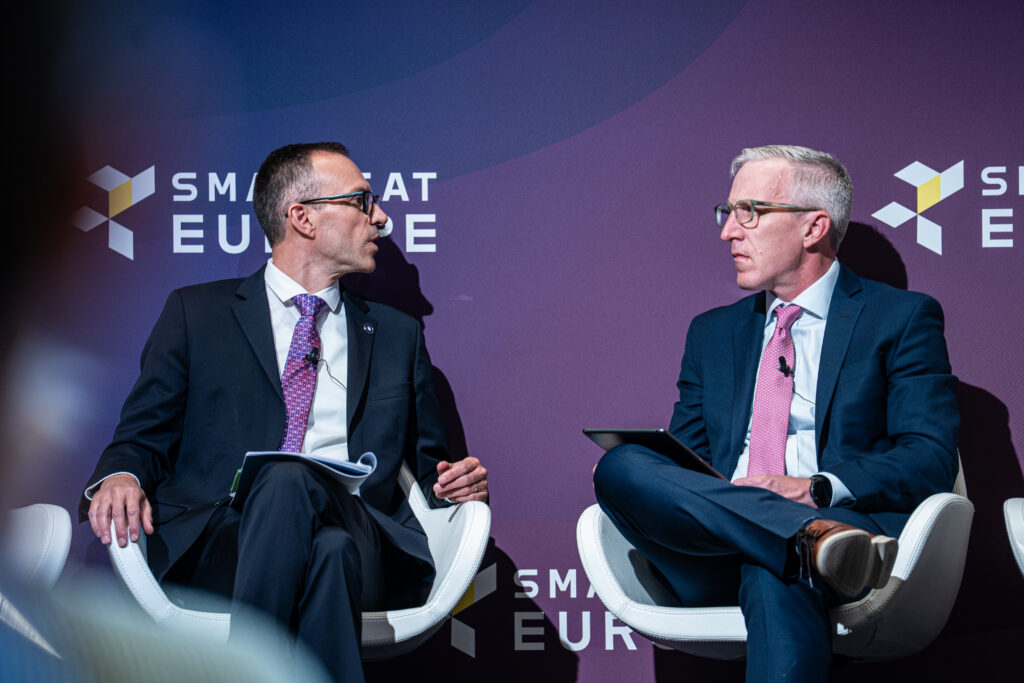
The line that defined Day 2 of SmallSat Europe 2026 came from someone who spent twenty years as an air defence pilot before he ever sat on a space-policy panel.
“I was an air defense pilot for 20 years of my career. And in air defense, when a missile is shot, it’s already too late. So you have to work on the rules of engagement of the intent.” Brigadier General Daniele Donati, Chief of the Space Policy Office, Italian Air Force – Logistics Command, Test and Training Range
Donati used the line on the Defense Posture and Reaction to Space Threats panel, moderated by SpaceNews European correspondent Dr. Emma Gatti. The point lands harder coming from someone with two decades flying intercepts. European space doctrine, Donati was arguing, has been written for the wrong half of the engagement. The gray zone of proximity ops, rendezvous, and inspection is where the active fight already is.
By the end of the afternoon, every panel on the Defense Stage had moved in the same direction. The threat is operational. The doctrine has not caught up. The replenishment economics have not been priced in. The commercial-to-defence integration layer is missing. None of it was being treated as news anymore. It was being treated as the work.
Resilience replaces redundancy as the design principle
Donati walked the room through a conceptual move European militaries are making in public for the first time.
“We always thought about space in redundancy terms. We want more satellites because if one is broken or damaged we can have many more. Now we need to think about satellites working in a degraded environment, not only working or not working. You can’t always think in black or white.”
Regina Peldszus, Space Security Specialist at the European External Action Service and the policy voice on the panel, supplied the structural piece behind the reframe. Member states are already telling Brussels they have been inspected, approached, or shadowed in orbit. The diplomatic vocabulary, she said, has not caught up to what a sub-threshold incident actually looks like.
“Many of our member states have been calling out that they’ve been inspected or approached. And that’s always kind of, how close is too close? Can you really say this is a threat? There’s a lot of sub-threshold nudging going on that is very easily deniable and that you cannot attribute very easily.”
The kinetic line is clear. The cognitive line, where intent matters more than outcome, is the work of the next two years on the European side.
Replenishment velocity becomes the design metric
That distinction decides the procurement question downstream. If contested orbit is a 2030 scenario, Europe has time to build redundant exquisite assets. If it is a 2026 operating condition, Europe has to start optimising for replenishment now.
The Building Resilient Infrastructure in Space for Defense panel, moderated by Quilty Space CEO Chris Quilty, made the case in venture-side vocabulary. Jeroen Rotteveel, the founder and CEO of Delft-based ISISPACE Group, gave the day its other quotable framing.
“Infrared sensors can be replaced in a week, in a month, in a year. And I think that’s what communications knows as well. If we cannot replace those assets in space within a week, it’s much easier to replenish things on ground.” Jeroen Rotteveel, CEO, ISISPACE Group
The test Rotteveel was describing is not how many satellites a constellation has, or what each satellite can do. The test is the wall-clock interval between an asset getting taken out and its replacement being on station and producing data. Replenishment velocity is the new constellation-design metric.
Rotteveel also surfaced the dual-use vulnerability the resilience reframe makes visible. Above a certain capability tier, defence security requirements make any civilian use of the same architecture really difficult. The inverse risk is sharper. Civilian assets routed into dual-use roles become legitimate targets in conflict.
“Using civil assets in a dual-use capacity, if they all become legitimate targets in conflicts, that’s something I don’t think we’re ready for as especially a smallsat community which has always been very inclusive, maybe even a bit naïve in terms of international collaboration and cooperation.”
The naïveté, several speakers said publicly for the first time on Day 2, is now getting priced out.
Old frame, new frame
Day 2 Design Principle Shift
OLD FRAME: REDUNDANCY
Exquisite, expensive assets. Built when satellites were costly and adversary action was hypothetical. Capability per satellite was the headline metric. Replacement timelines measured in years. The architecture Europe has.
NEW FRAME: RESILIENCE
Distributed, replenishable assets. Built for a contested operating environment. Replenishment velocity becomes the metric. Replacement timelines measured in weeks. The architecture Europe needs.
The integration layer is the real product
The Buying Commercial Services During Wartime panel, also moderated by Gatti, took the contested-orbit framing and moved it from doctrine to the integration layer. Jack Bowden, Future Mission Manager at Open Cosmos; Juan Tomás Hernani, CEO of Satlantis; Martin Langer, CEO of OroraTech; and Maxime Jambon, Chief of Staff and VP of Public Affairs at Exotrail, kept returning to the same observation. Commercial operators do not always know what defence wants. Defence does not always know what commercial can deliver. The layer that translates operationally useful data into something a person in the field can act on without a PhD in remote sensing is the actual product.
Langer, whose company has been retrofitting its civilian thermal Earth observation business for defence buyers, made the strongest version of the argument.
“If you connect to firefighters in the field, I would say 98% of the boilerplate is already there. You connect with data into the field in a fashion that people can understand without having a PhD in remote sensing.”
Hernani made the inverse case from the SATLANTIS side. Defence procurement organisations are structurally split between the user and the buyer, and the buyer has to find the solution in a market dynamic enough that no single supplier can position cleanly against a fixed requirements sheet. Langer extended the point on the same panel: “How do you find the needle in the haystack if you don’t know where to look?”
Jambon, Exotrail’s Chief of Staff and VP of Public Affairs, surfaced the practical bottleneck. “It’s super complex to get close to the operational teams. As a company, we are very far from them.” Procurement contingencies are proxied through tender language that, once the contract closes, leaves the commercial company without direct visibility into how the operational team is actually using the product. The feedback loop closes too slowly to drive the next iteration of the product.
The institutional capstone
The last conversation of the Defense Stage was a fireside chat between SpaceNews Chief Content and Strategy Officer Mike Gruss and Rear Admiral Louis Tillier, Director of the European Union Satellite Centre (SatCen) in Madrid. SatCen integrates national source assets across European intelligence services, with more coming online as national constellations launch.
“Typically I don’t think we’re looking for having 15 different constellations failing over each other exactly at 10 a.m. in the morning. So this is the challenge, how we make this interoperable and complementary and efficient.” Rear Adm. Louis Tillier, Director, EU Satellite Centre
The hard work of the next two years for SatCen, Tillier told Gruss, is not adding new sources. It is making the sources already in the pipeline work together when it matters. Tillier gave one statistic that made the trajectory visible. In 2011, eighty per cent of the imagery SatCen used was non-European, mainly American. Today, eighty-six per cent of the imagery SatCen uses by value comes from European providers. The shift is the European industrial base maturing into a sovereign-capable supplier tier. The bottleneck is now interoperability, not source.
Tillier closed with the day’s most useful framing of where the analyst workflow is heading. “We really need to have more streaming platforms,” he said, pairing that with a metaphor: space is entering an era of mass consumption, “and if data was treated like Michelin-starred meals in the past, in the future it will be much more consumed like fast food.”
The verdict from Day 2
Day 2 did not resolve any of the open questions. What it did was move the European space industry’s public conversation about contested operations from the hypothetical column to the operating column. Donati put the doctrine pivot in a single line. Rotteveel put replenishment velocity on the table as the new design metric. Tillier framed the SatCen integration job as the work of the next two years.
The threat is operational. The doctrine has not caught up.
It is being treated as the work.
Key Takeaway
Day 2 was the day Europe publicly accepted that contested orbit is a 2026 operating condition, not a 2030 scenario. Donati put the doctrine pivot in a single line. Rotteveel put replenishment velocity on the table as the new constellation-design metric. Tillier framed the SatCen interoperability job as the work of the next two years.
About the Author
A storyteller at heart, Nick David covers space policy, satellite markets, defense, and the technologies reshaping how humanity operates beyond Earth. With a background in creative direction, brand strategy, and editorial storytelling, he brings a modern lens to complex subjects and a relentless curiosity about what comes next.
