

By Simon Payne, SatNews
Executive Summary
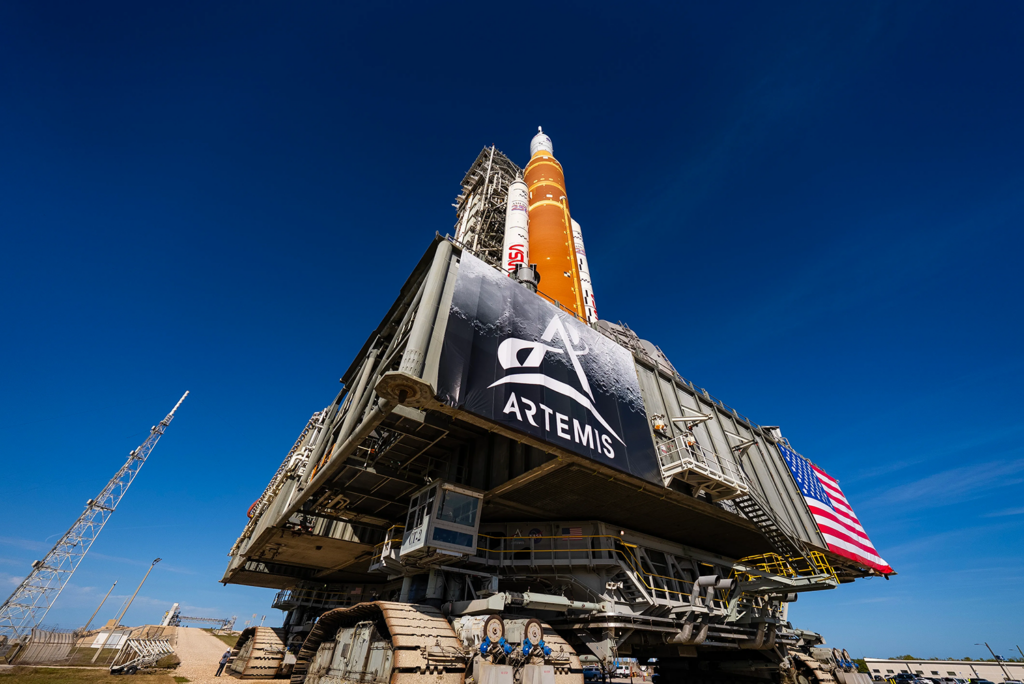
The January 17 rollout of Artemis II represents a genuine technical achievement and a policy paradox. The Space Launch System on Pad 39B is the product of a 2010 Congressional mandate shaped in part by the goal of preserving aerospace workforce continuity, an objective NASA pursued through cost-plus contracting. Fifteen years later, that same architecture is critically dependent on fixed-price commercial partners for surface operations—partners that the original legislation sought to constrain.
The irony is stark: the bill designed to insulate NASA from commercial disruption has made NASA’s surface ambitions dependent on commercial capability for mission success.
The central question is whether this hybrid model can deliver sustained surface capability before lunar South Pole access sites become operationally constrained.
The 2010 Divergence: Three Paths, One Year
To understand why NASA is rolling out a roughly $4 billion-per-launch vehicle in an era of reusable rockets, we must examine what happened in 2010, when three divergent futures began that are now converging on Pad 39B.
Path One: The Legislative Lock-In
The NASA Authorization Act of 2010 mandated development of a heavy-lift launch vehicle while explicitly directing NASA to leverage existing Shuttle-era contracts, workforce, and industrial base. The approach ultimately produced an architecture built around RS-25 engines and Shuttle-derived solid rocket boosters, and was widely understood at the time as a means of cushioning workforce disruption in Alabama, Florida, and Utah following Shuttle retirement.
The Act represented a political compromise: canceling Constellation while preserving the workforce and capabilities it had supported.
This was political engineering, but not necessarily corrupt engineering. Tens of thousands of families depended on Shuttle-era employment. The policy question Congress faced was whether a managed transition through heavy-lift development was preferable to immediate economic disruption.
NASA’s choice of cost-plus contracting was deliberate. This procurement structure prioritizes reliability and workforce stability over development speed or per-unit cost efficiency. Over more than a decade of development, SLS has consumed on the order of $24 billion in federal funding. Full mission costs, including Orion and ground systems, approach $4.1 billion per flight.
Congress chose to build a bridge. The question is whether it was built to the right shore.
Path Two: The Unwanted Stepchild
Here is where the 2010 story turns strange.
Six weeks before the Authorization Act passed, SpaceX successfully launched Falcon 9 for the first time. By December 2010, Dragon completed orbital flight and recovery, the first commercial spacecraft to do so.
At the time, Commercial Orbital Transportation Services (cargo) was accepted as a niche utility, but political resistance to Commercial Crew was severe. The 2010 Act contained language constraining funding for commercial human spaceflight, reinforcing a belief that while contractors could haul cargo, only the government should haul astronauts.
The bill that mandated SLS effectively marginalized the very program that would later become indispensable to NASA’s human spaceflight operations.
As of 2026, SpaceX provides all operational crew transport to the ISS, delivering capability roughly three years before Starliner and at a substantially lower development cost. The Commercial Crew program was built on fixed-price procurement, shifting risk to industry; SpaceX delivered early, while Boeing’s Starliner endured repeated delays and at least $1.5 billion in losses absorbed under the same contract framework.
The procurement structure mattered more than the technical challenge.
The 2010 Act attempted to protect NASA from an uncertain future. Instead, it left NASA structurally reliant on the commercial systems it initially sought to limit.
Path Three: The Quiet March
While Congress debated Shuttle workforce preservation and SpaceX fought for commercial crew legitimacy, China launched Chang’e 2 in October 2010, producing a global lunar map with resolution down to roughly seven meters that informed subsequent landing-site analysis, including at the lunar South Pole.
The cadence tells the story: Chang’e 3 landed in Mare Imbrium (2013), Chang’e 4 achieved the first far-side landing (2019), Chang’e 5 returned samples (2020), and Chang’e 6 returned far-side samples in June 2024. Chang’e 7, expected in 2026, is explicitly designed for South Pole operations, carrying ground-penetrating radar and volatile-analysis instruments.
This represents a consistent 18–24 month mission cadence using incrementally evolved hardware—a development philosophy fundamentally different from NASA’s episodic, high-complexity approach.
While NASA spent the decade refurbishing engines designed in the 1980s, China was surveying the terrain Artemis now seeks to occupy.
The 2010 Paradox
These three paths were set in motion within twelve months. Now they converge:
- The rocket mandated in 2010 to preserve traditional aerospace is on the pad.
- It relies on commercial systems to enable human surface operations.
- Both are advancing toward sites China began characterizing in 2010.
The vehicle rolling to Pad 39B is the physical embodiment of this policy paradox.
The Geographic Constraint
The strategic importance of lunar South Pole access stems from a specific geological limitation: the scarcity of locations offering both near-continuous sunlight and proximity to water ice.
Permanently shadowed regions (PSRs) contain water ice preserved by the absence of solar radiation. Operating within PSRs requires power generated from solar arrays positioned on terrain receiving near-continuous illumination. These requirements intersect primarily along crater rims.
Lunar Reconnaissance Orbiter illumination and terrain studies consistently show that while dozens of candidate sites exist near the lunar South Pole, only a small fraction of crater-rim locations, most notably at Shackleton, Shoemaker, Haworth, and de Gerlache, combine very high illumination with close proximity to permanently shadowed regions.
The Moon is resource-rich. But it is location-poor.
Early arrivals at these sites gain operational advantages in power generation, communications geometry, and logistics efficiency. While the Outer Space Treaty prohibits territorial claims, it does not prevent operational exclusivity through proximity. Safety zones, plume impingement constraints, and radio-frequency interference effectively limit simultaneous access.
Arriving second does not preclude participation, but it constrains options. Less favorable illumination, longer traverses to PSRs, and higher operational complexity become structural features, not temporary inconveniences.
The Procurement Culture Divide
NASA now operates two fundamentally different acquisition cultures:
Legacy Architecture (SLS/Orion):
Cost-plus contracts with Boeing, Northrop Grumman, and Aerojet Rocketdyne. Development is managed through traditional NASA centers, with schedules shaped by workforce continuity and Congressional authorization cycles. Stability is prioritized over speed.
Surface Architecture (HLS/Blue Moon):
Fixed-price contracts with SpaceX (Starship HLS) and Blue Origin (Blue Moon). NASA specifies requirements; vendors control design, testing, and intellectual property. Payment is milestone-based. Speed and cost discipline are prioritized, with higher tolerance for failure.
The cancellation of the VIPER rover in July 2024 crystallized this divide. Manifested on Astrobotic’s Griffin lander under the CLPS program, the mission was terminated not due to technical failure but because cost growth and schedule risk threatened broader portfolio objectives.
Under the legacy model, such a program would likely have been restructured and extended. Under the commercial model, NASA absorbed the loss and moved on.
NASA reduced delivery risk by outsourcing execution, but in doing so it surrendered direct control over destination assurance.
The Critical Path: Orbital Refueling
The defining tension of Artemis is structural: the SLS on Pad 39B can deliver crew to lunar orbit. It cannot land them on the Moon.
Artemis III requires Orion to rendezvous in lunar orbit with a separately launched Starship HLS. That lander must be fueled in low Earth orbit by a propellant depot supplied through a rapid series of tanker flights.
This requires SpaceX to demonstrate large-scale cryogenic propellant management, including aggregating well over a thousand tons of liquid oxygen and methane in Earth orbit through multiple tanker flights. Challenges include boiloff control over extended aggregation periods, ullage management in microgravity, and repeated autonomous docking and transfer operations.
SpaceX’s progress on this capability—not SLS readiness—defines the Artemis III critical path. Original plans targeted demonstrations in late 2025 or early 2026. Delays comparable to Starship’s early flight-test campaign would push surface operations regardless of launch vehicle availability.
The critical path is no longer in Florida. It is in Texas.
The Timeline Risk
The upcoming Artemis II wet dress rehearsal will clarify near-term viability. Artemis I required multiple rollbacks before launch, suggesting non-trivial schedule risk.
If Artemis II slips into late 2026, a specific political risk emerges: American astronauts conducting a lunar flyby as Chang’e 7 begins South Pole surface operations.
The capabilities are not equivalent—one is crewed, the other robotic. But agenda-setting matters. Hardware on the ground establishes operational presence, site familiarity, and international signaling. A visual narrative of “China operating while America transits” would complicate claims of leadership even if technical realities remain asymmetric.
For Artemis III, delays in commercial readiness force constrained choices: accept schedule slips, reduce surface duration through partial fueling, or restructure missions around alternative landers. None preserve the current capability envelope on the current timeline.
The Workforce Question
Shuttle-era workforce displacement was inevitable. The roughly $24 billion, fifteen-year transition that followed the 2010 Act delayed, but did not prevent it. SLS production today employs a fraction of Shuttle-era numbers. Meanwhile, the commercial sector employs tens of thousands across geographically distributed facilities with different skill demands.
The critique is not that workforce considerations were invalid—it is that optimizing for continuity may have delayed investment in architectures with greater long-term sustainability. Whether that tradeoff was justified depends on societal values regarding labor transition versus technological acceleration.
The bridge preserved some jobs for fifteen years. It did not alter the destination.
What Success Requires
The current architecture demands three conditions: SpaceX demonstrating reliable orbital refueling by late 2026, Artemis II flying successfully to sustain political support, and Congressional funding surviving multiple election cycles.
History advises caution. Apollo endured only under acute geopolitical pressure. Artemis operates in a more diffuse strategic environment despite growing Chinese activity.
Failure modes are clear: refueling setbacks, schedule erosion, budget fatigue. In that scenario, SLS risks becoming a high-cost transport system without a viable surface layer to justify its cadence.
If that occurs, 2010 will have built a bridge to nowhere.
The 2010 Reckoning
Artemis is reckoning with 2010. That year produced three futures: a Congressional mandate to preserve legacy aerospace, a commercial bet on disruption, and a Chinese commitment to incremental presence. For fifteen years they evolved separately. Now they converge on a few dozen square kilometers of crater rim.
The vehicle on Pad 39B will demonstrate whether SLS fulfills its mandate to deliver crew to lunar space. The system that lands humans will be commercial. The sites themselves were characterized by a program that began while Congress debated Shuttle jobs.
The question is no longer whether 2010 was optimal. It is whether the hybrid architecture it produced, legacy lift paired with commercial surface systems, can execute before operational constraints harden.
The data that matters now is not crawler speed to the pad. It is propellant transfer efficiency in low Earth orbit, measured in tons per hour and boiloff percentage. That will determine whether the bridge built in 2010 reaches the shore—or ends midstream.
The rocket rolling to Pad 39B is a monument to 2010. Whether it becomes a monument to the past or a bridge to the future will be decided in the next eighteen months—in Texas, not Florida.
