

• Skip to primary navigation
  • Skip to main content
  • Skip to primary sidebar
  • Skip to secondary sidebar
  • Skip to footer
  • NEWS:
  • SatNews
  • SatMagazine
  • MilSatMagazine
  • SmallSat News
  • |     EVENTS:
  • SmallSat Symposium
  • Satellite Innovation
  • MilSat Symposium
  • SmallSat Europe

SatNews

Satellite Industry Intelligence Since 1983

Subscribe
  • LATEST
  • SatNews Events
  • Magazines
  • Calendar
  • Subscribe
  • Missions & Constellations
    • Exploration & Science Missions
    • In-Orbit Servicing & Orbital Operations
    • LEO Constellations
    • Mission Autonomy & Onboard Systems
    • Mission Deployments & Manifests
    • Navigation & PNT
    • SmallSat
    • Spacecraft & Payload Technology
    View All in Missions & Constellations →
    Interlune Secures $6.9 Million NASA Contract for Lunar Resource ExtractionInterlune Secures $6.9 Million NASA Contract for Lunar Resource Extraction
    Smallsat Sector to Deploy 16,900 Satellites Through 2035 as Market Reaches Industrial MaturitySmallsat Sector to Deploy 16,900 Satellites Through 2035 as Market Reaches Industrial Maturity
    NanoAvionics Satellites Reach Orbit on SpaceX CAS500-2 MissionNanoAvionics Satellites Reach Orbit on SpaceX CAS500-2 Mission
    Viasat Completes ViaSat-3 Constellation with Successful Flight 3 LaunchViasat Completes ViaSat-3 Constellation with Successful Flight 3 Launch
  • Business
    • Contracts & Commercial Deals
    • Earnings & Financial Reporting
    • Events & Conferences
    • Funding & Venture Capital
    • Market Forecasts
    • Mergers & Acquisitions
    • Personnel Moves & Appointments
    View All in Business & Finance →
    SmallSat Europe Speaker Focus: Massimo Comparini, Leonardo Space DivisionSmallSat Europe Speaker Focus: Massimo Comparini, Leonardo Space Division
    Lockheed Martin, Firefly, and Seagate Partner for Sea-Based National Security LaunchLockheed Martin, Firefly, and Seagate Partner for Sea-Based National Security Launch
    SmallSat Europe Speaker Focus: Jorge Ciccorossi, ITU Radiocommunications BureauSmallSat Europe Speaker Focus: Jorge Ciccorossi, ITU Radiocommunications Bureau
    XDLINX Space Labs Inaugurates Advanced Satellite Integration Lab with ISRO LeadershipXDLINX Space Labs Inaugurates Advanced Satellite Integration Lab with ISRO Leadership
  • Defense
    • Counterspace & ASAT
    • Defense Budgets & Procurement
    • ISR & Reconnaissance
    • MILSATCOM
    • Missile Warning & Defense
    • National Security Programs
    • Space Domain Awareness
    View All in Military & Defense →
    U.S. Space Force Integrates Domain Awareness Capabilities into Balikatan 2026U.S. Space Force Integrates Domain Awareness Capabilities into Balikatan 2026
    BAE Systems Enters Production for NavGuide M-Code GPS ReceiverBAE Systems Enters Production for NavGuide M-Code GPS Receiver
    Space Force Awards $3.2 Billion in Golden Dome Contracts for Orbital Interceptor ConstellationSpace Force Awards $3.2 Billion in Golden Dome Contracts for Orbital Interceptor Constellation
    USSF Finalizes GPS III Constellation with Successful SV-10 DeploymentUSSF Finalizes GPS III Constellation with Successful SV-10 Deployment
  • Gov
    • Export Controls & Compliance
    • International Space Agreements
    • National Space Policy
    • Space Law & Treaties
    • Space Sustainability & Debris Policy
    • Space Traffic Management / Debris Removal
    View All in Government & Regulation →
    ESA spells out satellite benefits – and risksESA spells out satellite benefits – and risks
    Canada Tightens Re-entry Regulations as SpaceX Starlink Constellations DescendCanada Tightens Re-entry Regulations as SpaceX Starlink Constellations Descend
    The waiver was the policy. Thursday is the paperwork.The waiver was the policy. Thursday is the paperwork.
    SmallSat Europe Speaker Focus: Tanja Masson-Zwaan, Leiden UniversitySmallSat Europe Speaker Focus: Tanja Masson-Zwaan, Leiden University
  • Launch
    • Launch Providers
    • Launch Schedule & Calendars
    • Launch Sites & Infrastructure
    • Rocket Technology & Vehicles
    View All in Launch →
    GalaxEye Successfully Launches “Mission Drishti” OptoSAR SatelliteGalaxEye Successfully Launches “Mission Drishti” OptoSAR Satellite
    Foxconn Launches Second-Generation PEARL Satellites via SpaceX Falcon 9Foxconn Launches Second-Generation PEARL Satellites via SpaceX Falcon 9
    FAA Grounds Blue Origin Following New Glenn Upper Stage Failure and Facility AnomalyFAA Grounds Blue Origin Following New Glenn Upper Stage Failure and Facility Anomaly
    NanoAvionics to Launch Trio of Milestone Payloads on SpaceX CAS500-2 MissionNanoAvionics to Launch Trio of Milestone Payloads on SpaceX CAS500-2 Mission
  • Software
    • Autonomous Ground Operations
    • Data Processing & AI/ML
    • Digital Twins & Modeling
    • Ground Segment & Teleports
    • Mission Planning & Simulation
    • Space Systems Software Engineering
    • Spectrum & Licensing
    View All in Software Automation & Ground Systems →
    SES Accelerates Multi-Orbit IFC Strategy with meoSphere and Next-Gen ESA DevelopmentSES Accelerates Multi-Orbit IFC Strategy with meoSphere and Next-Gen ESA Development
    SmallSat Europe Speaker Focus: Koen Willems, ST Engineering iDirect EuropeSmallSat Europe Speaker Focus: Koen Willems, ST Engineering iDirect Europe
    GMV to Lead Mission Planning for ESA’s Next-Generation Copernicus ExpansionGMV to Lead Mission Planning for ESA’s Next-Generation Copernicus Expansion
    Global Invacom Secures Exclusive Worldwide Distribution for Prodelin Antenna RangeGlobal Invacom Secures Exclusive Worldwide Distribution for Prodelin Antenna Range
  • Services & Apps
    • Climate & Environmental Monitoring
    • Disaster Response & Security Mapping
    • Earth Observation & Imaging
    • Maritime & Aviation Satcom
    • Satellite Communications
    View All in Services & Applications →
    Solstar Confirms Successful On-Orbit Operation of Deke Space Communicator Following Launch on SpaceX Transporter-16 MissionSolstar Confirms Successful On-Orbit Operation of Deke Space Communicator Following Launch on SpaceX Transporter-16 Mission
    IEC Telecom Unveils Voucher-Based Connectivity Solution at Singapore Maritime Week 2026IEC Telecom Unveils Voucher-Based Connectivity Solution at Singapore Maritime Week 2026
    GomSpace and STETMAN Establish UASAT Joint Venture for Ukrainian Sovereign CommunicationsGomSpace and STETMAN Establish UASAT Joint Venture for Ukrainian Sovereign Communications
    Market Dynamics and Non-Terrestrial Network (NTN) ChipsetsMarket Dynamics and Non-Terrestrial Network (NTN) Chipsets

Debris from DART impact could reach Earth

September 25, 2024

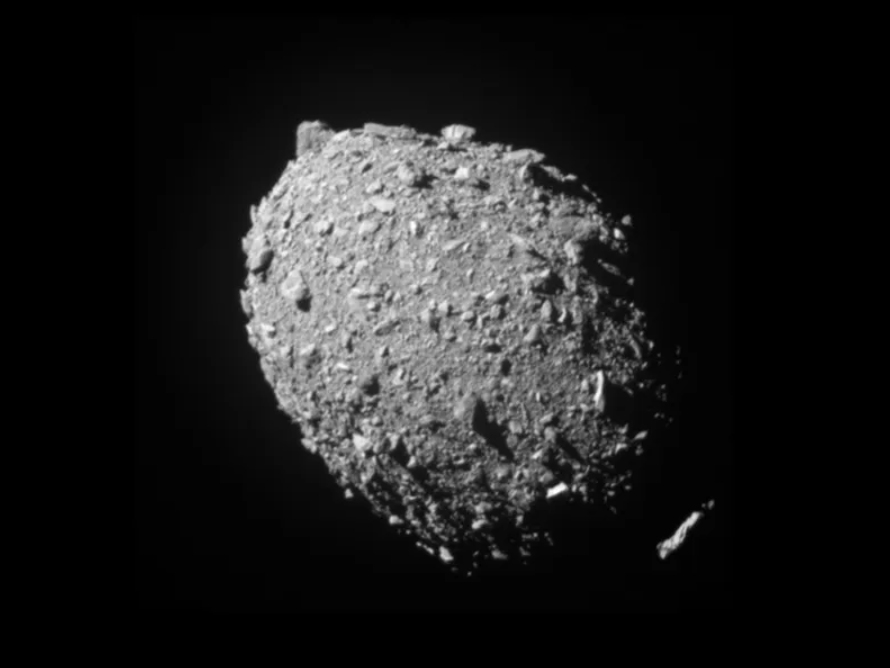
On September 26, 2022, DART impacted the asteroid moonlet Dimorphos, a small body just 530 feet (160 meters) in diameter. It orbits a larger, 2,560-foot (780-meter) asteroid called Didymos.
Photo courtesy of NASA

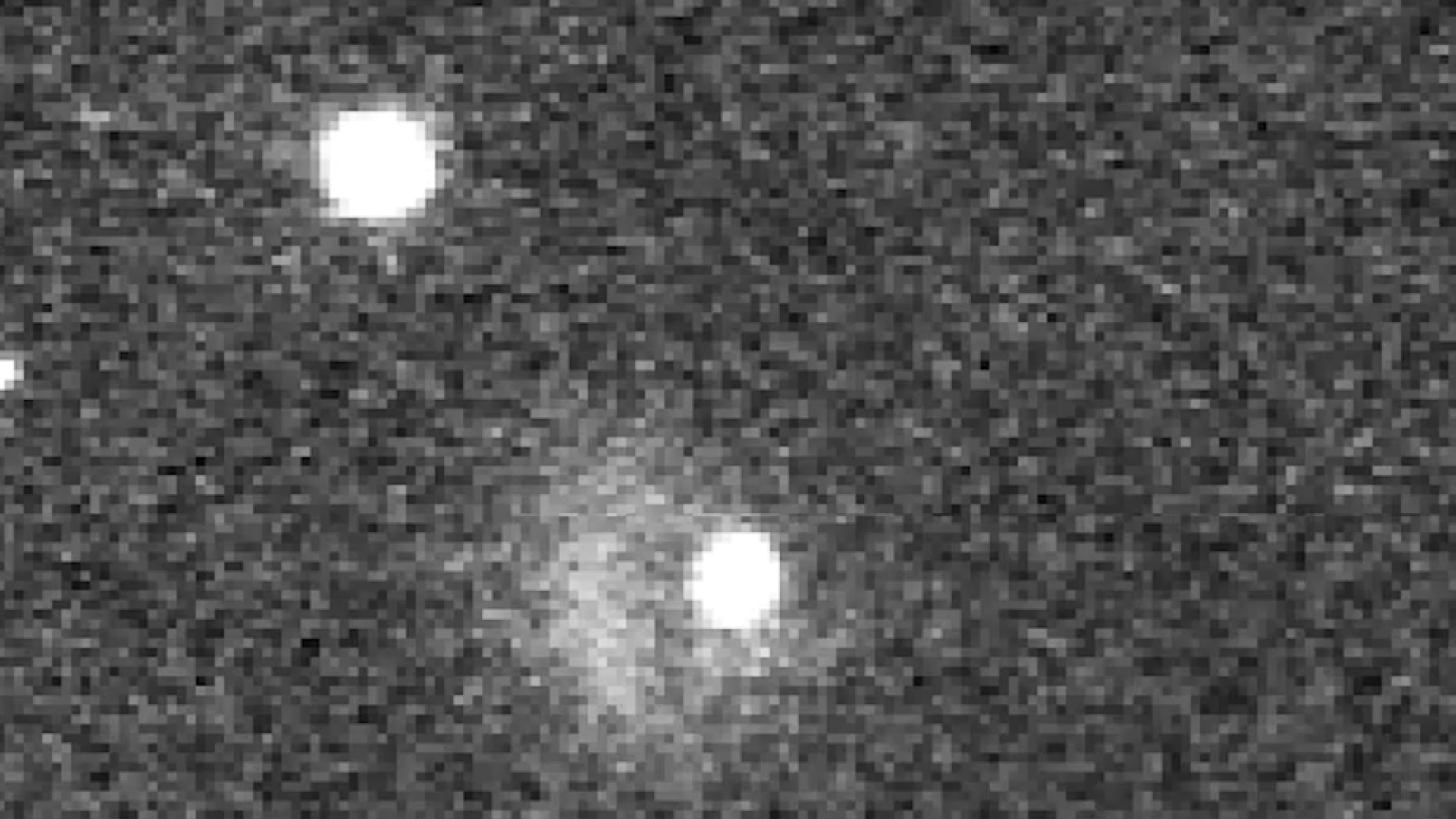
In 2022, NASA’s DART spacecraft made history, and changed the Solar System forever, by impacting the Dimorphos asteroid and measurably shifting its orbit around the larger Didymos asteroid. In the process a plume of debris was thrown out into space.

The latest modelling, available on the preprint server arXiv and accepted for publication in the September volume of The Planetary Science Journal, shows how small meteoroids from that debris could eventually reach both Mars and Earth – potentially in an observable (although quite safe) manner.

On September 26, 2022, NASA’s approximately half-ton Double Asteroid Redirect Test (DART) spacecraft impacted the 151 m diameter Dimorphos asteroid at an approximate speed of 6.1 km/s, shortening its orbit around Didymos by more than half an hour during the first part of an international planetary defence collaboration.
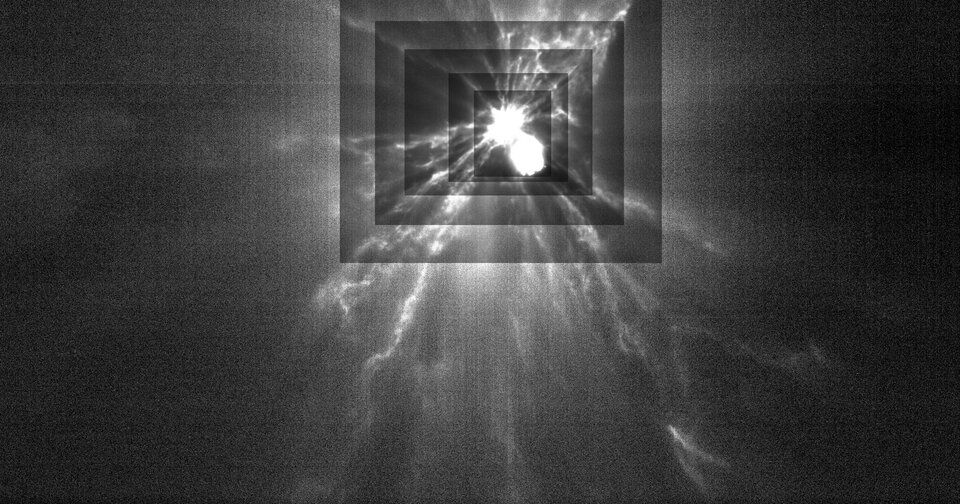
LICIACube image of asteroid ejecta

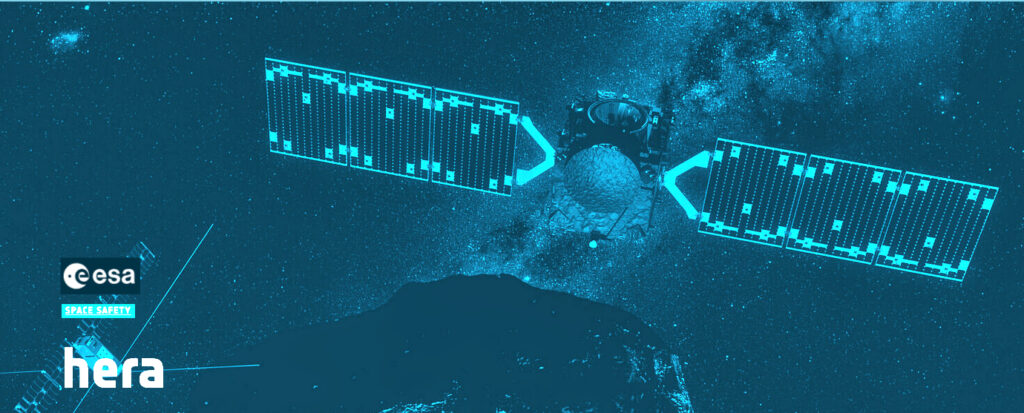
ESA’s Hera spacecraft will be launched this October to reach Dimorphos and perform a close-up ‘crash scene investigation’, gathering data on the asteroid’s mass, structure and make-up to turn this kinetic impact method of planetary defence into a well understood and repeatable technique.
“The DART impact offers a rare opportunity to investigate the delivery of ejecta to other celestial bodies, thanks to the fact that we know the impact location and that this impact was observed by the Italian LICIACube deployed from DART as well as by Earth-based observers,” said co-author and ESA Hera mission scientist Michael Kueppers. “We simulated the ejecta to match LICIACube observations using three million particles grouped into three size populations – 10 cm, 0.5 cm and 30 μm, or thousandths of a millimetre – moving at speeds of 1 to 1000 m/s or a faster rate of up to 2 km/s. Our accurate knowledge of the impact site and impactor properties in terms of size, mass and velocity plus the observations of the ejecta are what allowed us to estimate the long-term fate of the material leaving the Didymos system. Combined with Hera’s upcoming investigation of the target asteroid, we will end up in the unique situation of having full information about the impactor, the target asteroid, and the material ejected from it.”
$video.data_map.short_description.content
DART asteroid impact impresses in ESA’s view from the ground – Access the video

Study lead author Eloy Peña-Asensio, of the Department of Aerospace Science and Technology, Politecnico di Milano, said, “We identified ejecta orbits compatible with the delivery of meteor-producing particles to both Mars and Earth. Our results indicate the possibility of ejecta reaching the gravitational field of Mars in 13 years for launch velocities around 450 m/s, while faster ejecta launched at 770 m/s could reach its vicinity in just seven years. Particles moving above 1.5 km/s could reach the Earth-Moon system in a similar timescale. In the coming decades, meteor observation campaigns will be crucial in determining whether fragments of Dimorphos, resulting from the DART impact, will reach our planet. If this happens, we will witness the first human-made meteor shower.”
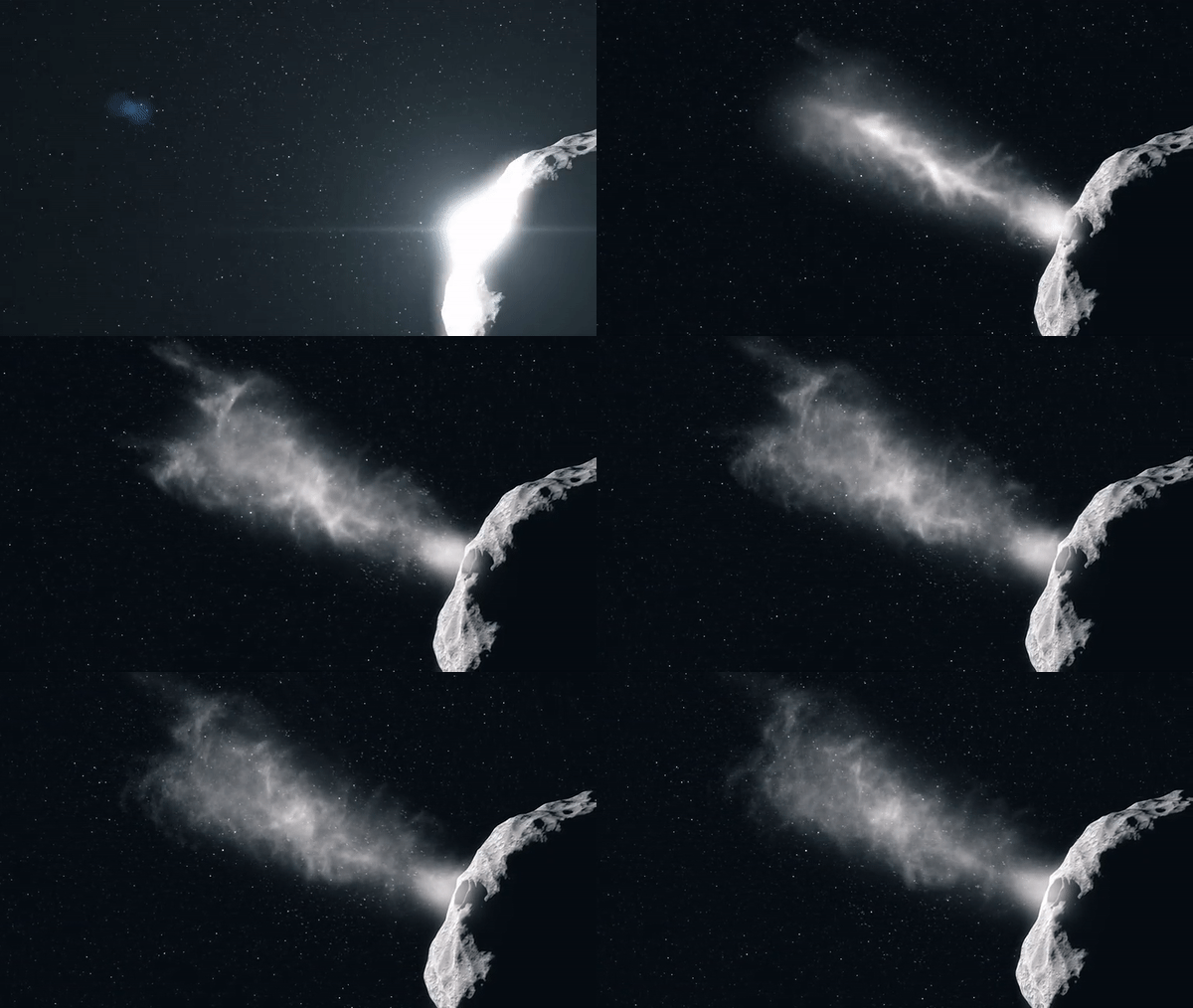
Plume ejects from Dimorphos as DART impacts

Josep M. Trigo-Rodríguez from the Spanish Institute of Space Sciences (CSIC/IEEC) supported the study of the dynamic evolution of the debris generated by DART’s impact within the framework of his contribution to the DART mission, said, “We were amazed to discover that it is possible for some centimetre-sized particles to reach the Earth-Moon system and produce a new meteor shower.“

Whether the meteoroids head towards Earth or Mars would depend on their position in DART’s cone-shaped impact plume – material on its north side is more likely to head Mars-ward while southwestern material is more likely to reach Earth. The very largest of these meteoroids would only be the size of a softball. They would be certain to burn up in Earth’s atmosphere, although they might make it through the thinner Martian atmosphere.

In any case, it appears that only smaller particles are likely to reach Earth, as these are the ones that would have been launched at the highest velocities. We cannot yet determine if these particles will be large enough to produce observable meteors, so continued monitoring of the night sky will be essential.
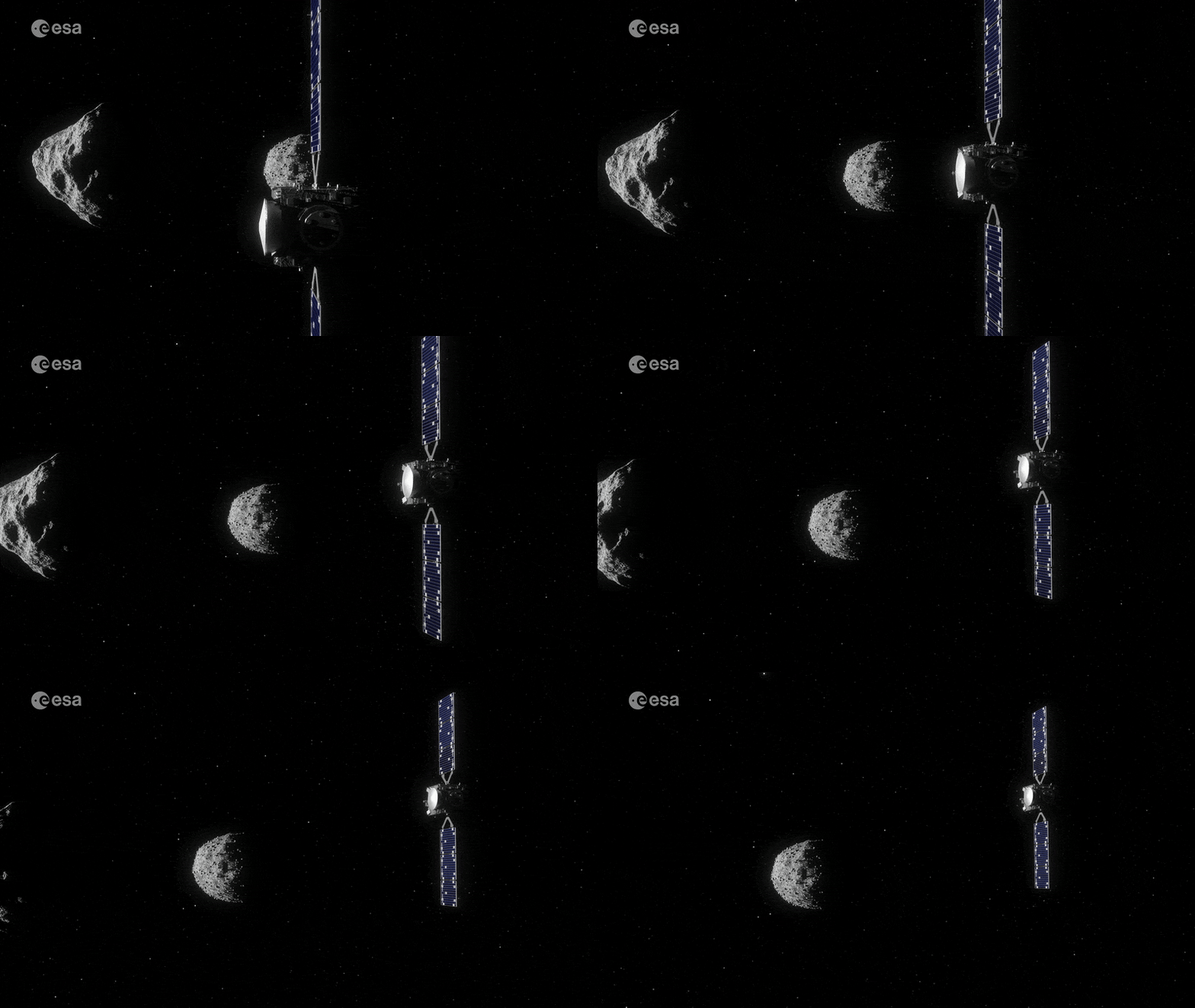
Hera approaching Didymos asteroids

$video.data_map.short_description.content
Perseid showers captured by ESA’s meteor camera — Access the video

There are more than 1,000 known meteoroid streams criss-crossing Earth’s orbit, linked to famous annual meteor showers such as the recent Perseids and the autumn Taurids. 

Astronomers have become skilled at tracing back the origin of meteors to particular meteoroid streams or parent comet or asteroid bodies. This study involves the same kind of calculation but in reverse, to foretell the likely characteristics and timings of meteors linked to DART’s impact.

Michael said, “The exciting thing is the prospect of identifying and observing meteors linked to the DART impact, either on Earth or perhaps one day even on Mars, with their brightness and colour revealing details of their makeup. Our study includes the distinct orbital characteristics that would distinguish these meteors from comparable ones. The potential meteors created by DART would be slow-moving, primarily visible from the southern hemisphere, and most likely to occur in May.”

Hera was recently transported from Europe to Cape Canaveral in the USA for launch by a SpaceX Falcon 9 in October and is due to reach the Dimorphos asteroid and begin its investigation in late 2026.

Hera loaded on Antonov cargo aircraft for flight to USA

And we’re off!

ESA’s Hera spacecraft has taken off from Cologne-Bonn airport in Germany on the first leg of a transatlantic flight to its launch site in the USA.

Follow along via @flightradar24 and @RadarBoxCom!https://t.co/iVVDT5Oq95https://t.co/N7jCGQracp pic.twitter.com/AxhvI3qniK— ESA’s Hera mission (@ESA_Hera) September 2, 2024

Filed Under: International Space Agreements

Primary Sidebar

Coverage

  • Missions & Constellations
  • Business & Finance
  • Military & Defense
  • Launch
  • Software Automation & Ground Systems
  • Government & Regulation
  • Services & Applications

Most Read Stories

  • Planet Labs Imposes Indefinite Blackout on Iran Satellite Imagery at U.S. Request
  • What the SpaceX IPO Changes for Every Satellite Operator
  • Russia Replaces Starlink With European-Built Satellites
  • NASA Shuts Off Instrument on Voyager 1 to Extend Interstellar Mission
  • Space42 and Viasat: Contract close for 2800 satellites

Secondary Sidebar

Footer


Satnews is a leading provider of satellite news, events, publications, research and other satellite industry information in both commercial and military enterprises worldwide.

Stories By Category

  • Business & Finance
  • Government & Regulation
  • Launch
  • Military & Defense
  • Missions & Constellations
  • Services & Applications
  • Software Automation & Ground Systems
  • Spectrum & Licensing
  • Startups & NewSpace Business

About Us

  • Leadership & Editorial Team
  • SatNews History
  • Free Satnews Subscription
  • SatNews Events
  • Magazines

Navigation

  • Latest Stories
  • Magazines
  • Events
  • Contact
  • Cookie & Privacy Policy for Satnews

We use cookies to ensure that we give you the best experience on our website. If you continue to use this site we will assume that you are happy with it.
x
Sign up Now (For Free)
Access daily or weekly satellite news updates covering all aspects of the commercial and military satellite industry.
Invalid email address
Notify Me Regarding ( At least one ):
We value your privacy and will not sell or share your email or other information with any other company. You may also unsubscribe at anytime.

Click Here to see our full privacy policy.
Thanks for subscribing!