

• Skip to primary navigation
  • Skip to main content
  • Skip to primary sidebar
  • Skip to secondary sidebar
  • Skip to footer
  • NEWS:
  • SatNews
  • SatMagazine
  • MilSatMagazine
  • SmallSat News
  • |     EVENTS:
  • SmallSat Symposium
  • Satellite Innovation
  • MilSat Symposium
  • SmallSat Europe

SatNews

Satellite Industry Intelligence Since 1983

Subscribe
  • LATEST
  • SatNews Events
  • Magazines
  • Calendar
  • Subscribe
  • Missions & Constellations
    • Exploration & Science Missions
    • In-Orbit Servicing & Orbital Operations
    • LEO Constellations
    • Mission Autonomy & Onboard Systems
    • Mission Deployments & Manifests
    • Navigation & PNT
    • SmallSat
    • Spacecraft & Payload Technology
    View All in Missions & Constellations →
    Radiation-Resistant Lens Designs Adapt to Accelerate Space Payload ProductionRadiation-Resistant Lens Designs Adapt to Accelerate Space Payload Production
    Seibersdorf Laboratories and Tumbleweed Partner on Microgravity R&D Service for Pharma and BiotechSeibersdorf Laboratories and Tumbleweed Partner on Microgravity R&D Service for Pharma and Biotech
    Build, Buy or Merge: Satellite Companies Move to Own Their LaunchBuild, Buy or Merge: Satellite Companies Move to Own Their Launch
    SpacePNT Selected to Supply Spaceborne GNSS Receiver Subsystem for SWISSto12 HummingSat PlatformSpacePNT Selected to Supply Spaceborne GNSS Receiver Subsystem for SWISSto12 HummingSat Platform
  • Business
    • Contracts & Commercial Deals
    • Earnings & Financial Reporting
    • Events & Conferences
    • Funding & Venture Capital
    • Market Forecasts
    • Mergers & Acquisitions
    • Personnel Moves & Appointments
    View All in Business & Finance →
    Early Signals, 2016: SpaceX’s First Backer Opened the First SmallSat SymposiumEarly Signals, 2016: SpaceX’s First Backer Opened the First SmallSat Symposium
    EnSilica Reaches Initial Agreement for $80 Million Resilient GNSS ASIC ProgramEnSilica Reaches Initial Agreement for $80 Million Resilient GNSS ASIC Program
    Thales Alenia Space Signs €240 Million Contract With OHB for Sentinel-3NG Topography AltimetersThales Alenia Space Signs €240 Million Contract With OHB for Sentinel-3NG Topography Altimeters
    A Second LEO Network Has Paying Customers and a Launch ProblemA Second LEO Network Has Paying Customers and a Launch Problem
  • Defense
    • Counterspace & ASAT
    • Defense Budgets & Procurement
    • ISR & Reconnaissance
    • MILSATCOM
    • Missile Warning & Defense
    • National Security Programs
    • Space Domain Awareness
    View All in Military & Defense →
    ARES Shield AI Completes First In-Orbit Object Detection Test Aboard D-Orbit SpacecraftARES Shield AI Completes First In-Orbit Object Detection Test Aboard D-Orbit Spacecraft
    GAO Finds Pentagon Lacks Coordinated View of Military Space Supply Chain RisksGAO Finds Pentagon Lacks Coordinated View of Military Space Supply Chain Risks
    Orbital Proximity Incidents Mask Broader Satellite Jamming ThreatOrbital Proximity Incidents Mask Broader Satellite Jamming Threat
    Lite Coms Secures Over $100 Million in Q3 2026 Defense SATCOM OrdersLite Coms Secures Over $100 Million in Q3 2026 Defense SATCOM Orders
  • Gov
    • Export Controls & Compliance
    • International Space Agreements
    • National Space Policy
    • Space Law & Treaties
    • Space Sustainability & Debris Policy
    • Space Traffic Management / Debris Removal
    View All in Government & Regulation →
    United States Finalizes 20 Agenda Item Positions Ahead of WRC-27 Spectrum NegotiationsUnited States Finalizes 20 Agenda Item Positions Ahead of WRC-27 Spectrum Negotiations
    FCC Upper C-Band Auction 115 Creates Indirect Spectrum and Market Shifts for SmallSat and LEO OperatorsFCC Upper C-Band Auction 115 Creates Indirect Spectrum and Market Shifts for SmallSat and LEO Operators
    FCC Sets April 27, 2027 Start Date for Upper C-Band Auction, Pressuring BroadcastersFCC Sets April 27, 2027 Start Date for Upper C-Band Auction, Pressuring Broadcasters
    Senate Appropriators Move to Bar Sole-Source Awards Over $100 Million for Space Data Network and SB-AMTISenate Appropriators Move to Bar Sole-Source Awards Over $100 Million for Space Data Network and SB-AMTI
  • Launch
    • Launch Providers
    • Launch Schedule & Calendars
    • Launch Sites & Infrastructure
    • Rocket Technology & Vehicles
    View All in Launch →
    NATO Stands Up Starlift Launch Brokerage to Connect Alliance Demand With Allied SpaceportsNATO Stands Up Starlift Launch Brokerage to Connect Alliance Demand With Allied Spaceports
    ULA Clears Blue Origin BE-4 Engines, Focuses Vulcan Failure Probe on Core Stage Fuel SupplyULA Clears Blue Origin BE-4 Engines, Focuses Vulcan Failure Probe on Core Stage Fuel Supply
    Google Selects Blue Origin’s New Glenn Rocket for 2029 AI Satellite LaunchGoogle Selects Blue Origin’s New Glenn Rocket for 2029 AI Satellite Launch
    NASA’s Voyager 1 Reaches One Light-Day From Earth at 16.1 Billion MilesNASA’s Voyager 1 Reaches One Light-Day From Earth at 16.1 Billion Miles
  • Software
    • Autonomous Ground Operations
    • Data Processing & AI/ML
    • Digital Twins & Modeling
    • Ground Segment & Teleports
    • Mission Planning & Simulation
    • Space Systems Software Engineering
    • Spectrum & Licensing
    View All in Software Automation & Ground Systems →
    RBC Signals Secures $10 Million Strategic Growth Investment Led by Washington Harbour PartnersRBC Signals Secures $10 Million Strategic Growth Investment Led by Washington Harbour Partners
    Ramon.Space Raises $124 Million Series B to Scale Orbital Computing InfrastructureRamon.Space Raises $124 Million Series B to Scale Orbital Computing Infrastructure
    Gilat Cuts 2026 Growth Forecast to 3% Amid Launch and IFC DelaysGilat Cuts 2026 Growth Forecast to 3% Amid Launch and IFC Delays
    U.S. Navy Expands ALL.SPACE Terminal Fleet to 108 with Follow-On Hydra MAX 2 OrderU.S. Navy Expands ALL.SPACE Terminal Fleet to 108 with Follow-On Hydra MAX 2 Order
  • Services & Apps
    • Climate & Environmental Monitoring
    • Disaster Response & Security Mapping
    • Earth Observation & Imaging
    • Maritime & Aviation Satcom
    • Satellite Communications
    View All in Services & Applications →
    Smart and Elveo Mobile Complete Direct-to-Device Satellite Trials on Philippine Sea RouteSmart and Elveo Mobile Complete Direct-to-Device Satellite Trials on Philippine Sea Route
    Thales Alenia Space Awarded DGA Contract for French IRIS Military Optical ConstellationThales Alenia Space Awarded DGA Contract for French IRIS Military Optical Constellation
    Ubotica Demonstrates Autonomous Onboard Satellite Scheduling for Maritime SurveillanceUbotica Demonstrates Autonomous Onboard Satellite Scheduling for Maritime Surveillance
    UniSQ Demonstrates Tomographic Spectrometer During KREPE-3 Re-Entry CampaignUniSQ Demonstrates Tomographic Spectrometer During KREPE-3 Re-Entry Campaign

NASA’s Mars Odyssey Shifts and Re-ups for Extended Mission

October 14, 2008

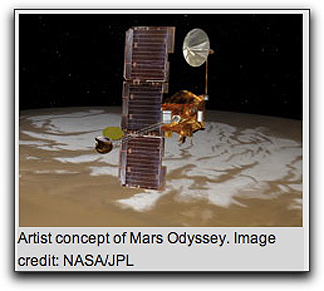
ODYSSEY It’s served the longest of six other spacecraft and now as a reward, NASA’s Mars Odyssey will alter its orbit and continue on for a third two-year extension of its mission to examine the most Earthlike of known foreign planets. Odyssey originally reached Mars in 2001.

Odyssey’s orbit is being altered to gain even better sensitivity for its infrared mapping of Martian minerals. And other tasks included during the mission extension through September 2010, it will also point its camera with more flexibility than it has ever used before.

The orbit adjustment will allow Odyssey’s Thermal Emission Imaging System to look down at sites when it’s mid-afternoon, rather than late afternoon. The multipurpose camera will take advantage of the infrared radiation emitted by the warmer rocks to provide clues to the rocks’ identities. The mission’s orbit design before now used a compromise between what works best for the Thermal Emission Imaging System and what works best for another instrument, the Gamma Ray Spectrometer.

“This will allow us to do much more sensitive detection and mapping of minerals,” said Odyssey Project Scientist Jeffrey Plaut of NASA’s Jet Propulsion Laboratory, Pasadena, Calif.

On commands from its operations team at JPL and at Denver-based Lockheed Martin Space Systems, Odyssey fired thrusters for nearly six minutes on September 30, the final day of the mission’s second two-year extension, which proved that the spacecraft is in good health, and there is enough fuel propellant supply operating it through at least 2015.

Odyssey’s orbit is synchronized with the sun, so that the local solar time has been about 5 p.m. at whatever spot on Mars Odyssey flew over as it made its dozen daily passes from between the north pole region to the south pole region for the past five years. (Likewise, the local time has been about 5 a.m. under the track of the spacecraft during the south-to-north leg of each orbit.) The push imparted by the September 30 maneuver will gradually change that synchronization over the next year or so. Its effect is that the time of day on the ground when Odyssey is overhead is now getting earlier by about 20 seconds per day. A follow-up maneuver, probably in late 2009 when the overpass time is between 2:30 and 3:00 p.m., will end the progression toward earlier times.

Because of the time change, in addition to helping the performance of the Thermal Emission Imaging System, the shift to mid-afternoon is expected to stop the use of one of three instruments in Odyssey’s Gamma Ray Spectrometer suite. The suite’s gamma ray detector needs a later-hour orbit to avoid overheating of a critical component. The suite’s neutron spectrometer and high-energy neutron detector are expected to keep operating.

The Gamma Ray Spectrometer provided dramatic discoveries of water-ice near the surface throughout much of high-latitude Mars, the impetus for NASA’s Phoenix Mars Lander mission. The gamma ray detector has also mapped global distribution of many elements, such as iron, silicon and potassium, a high science priority for the first and second extensions of the Odyssey mission. A panel of planetary scientists assembled by NASA recommended this year that Odyssey make the orbit adjustment to get the best science return from the mission in coming years.

Increased sensitivity for identifying surface minerals is a key science goal for the mission extension beginning this month. Also, the Odyssey team plans to begin occasionally aiming the camera away from the straight-down pointing that has been used throughout the mission. This will allow the team to fill in some gaps in earlier mapping and also create some stereo, three-dimensional imaging.

Odyssey will continue providing crucial support for Mars surface missions as well as conducting its own investigations. It has relayed to Earth nearly all data returned from NASA rovers Spirit and Opportunity. It shares with NASA’s Mars Reconnaissance Orbiter the relay role for Phoenix. It has made targeted observations for evaluating candidate landing sites.

Filed Under: Exploration & Science Missions

Primary Sidebar

Coverage

  • Missions & Constellations
  • Business & Finance
  • Military & Defense
  • Launch
  • Software Automation & Ground Systems
  • Government & Regulation
  • Services & Applications

Most Read Stories

  • Blue Origin Reconstructs Launch Complex 36 Tower, Targets November Return to Flight for New Glenn
  • Amazon Navigates Launch Delays with Under 400 Satellites in Orbit Ahead of Nov. 13 Vulcan Return
  • Northwood Space Secures $375M Series C at $2B Valuation to Expand Shared Ground Station Network
  • NASA Outlines Artemis IV Starship Refueling Architecture as Launch Estimates Vary
  • SpaceX Explores Boost Mobile Acquisition in Push to Build Hybrid Terrestrial-Satellite Network

Secondary Sidebar

Footer


Satnews is a leading provider of satellite news, events, publications, research and other satellite industry information in both commercial and military enterprises worldwide.

Stories By Category

  • Business & Finance
  • Government & Regulation
  • Launch
  • Military & Defense
  • Missions & Constellations
  • Services & Applications
  • Software Automation & Ground Systems
  • Spectrum & Licensing
  • Startups & NewSpace Business

About Us

  • Leadership & Editorial Team
  • SatNews History
  • Free Satnews Subscription
  • SatNews Events
  • Magazines

Navigation

  • Latest Stories
  • Magazines
  • Events
  • Contact
  • Cookie & Privacy Policy for Satnews

We use cookies to ensure that we give you the best experience on our website. If you continue to use this site we will assume that you are happy with it.
x
Sign up Now (For Free)
Access daily or weekly satellite news updates covering all aspects of the commercial and military satellite industry.
Invalid email address
Notify Me Regarding ( At least one ):
We value your privacy and will not sell or share your email or other information with any other company. You may also unsubscribe at anytime.

Click Here to see our full privacy policy.
Thanks for subscribing!