

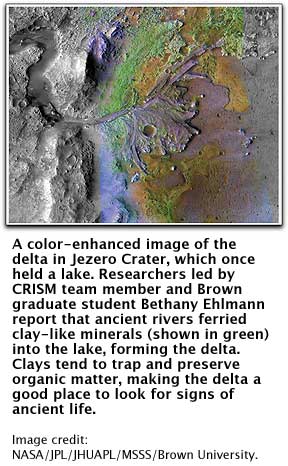
 Two studies based on data from NASA’s Mars Reconnaissance Orbiter have revealed the Red Planet once hosted vast lakes, flowing rivers, and a variety of other wet environments that had the potential to support life. One study, published in the July 17 issue of Nature, shows that vast regions of the ancient highlands of Mars, which cover about half the planet, contain clay minerals, which can form only in the presence of water. Volcanic lavas buried the clay-rich regions during subsequent, drier periods of the planet’s history, but impact craters later exposed them at thousands of locations across Mars. The data for the
study derives from images taken by the Compact Reconnaissance Imaging
Spectrometer for Mars, or CRISM, and other instruments on the
orbiter. The clay-like minerals, called phyllosilicates, preserve a record of
the interaction of water with rocks dating back to what is called the
Noachian period of Mars’ history, approximately 4.6 billion to 3.8
billion years ago. This period corresponds to the earliest years of
the solar system, when Earth, the moon and Mars sustained a cosmic
bombardment by comets and asteroids. Rocks of this age have largely
been destroyed on Earth by plate tectonics. They are preserved on the
moon, but were never exposed to liquid water. The
phyllosilicate-containing rocks on Mars preserve a unique record of
liquid water environments possibly suitable for life in the early
solar system.
Two studies based on data from NASA’s Mars Reconnaissance Orbiter have revealed the Red Planet once hosted vast lakes, flowing rivers, and a variety of other wet environments that had the potential to support life. One study, published in the July 17 issue of Nature, shows that vast regions of the ancient highlands of Mars, which cover about half the planet, contain clay minerals, which can form only in the presence of water. Volcanic lavas buried the clay-rich regions during subsequent, drier periods of the planet’s history, but impact craters later exposed them at thousands of locations across Mars. The data for the
study derives from images taken by the Compact Reconnaissance Imaging
Spectrometer for Mars, or CRISM, and other instruments on the
orbiter. The clay-like minerals, called phyllosilicates, preserve a record of
the interaction of water with rocks dating back to what is called the
Noachian period of Mars’ history, approximately 4.6 billion to 3.8
billion years ago. This period corresponds to the earliest years of
the solar system, when Earth, the moon and Mars sustained a cosmic
bombardment by comets and asteroids. Rocks of this age have largely
been destroyed on Earth by plate tectonics. They are preserved on the
moon, but were never exposed to liquid water. The
phyllosilicate-containing rocks on Mars preserve a unique record of
liquid water environments possibly suitable for life in the early
solar system.
Rivers Ran, Lakes Lapped On Mars
Two studies based on data from NASA’s Mars Reconnaissance Orbiter have revealed the Red Planet once hosted vast lakes, flowing rivers, and a variety of other wet environments that had the potential to support life. One study, published in the July 17 issue of Nature, shows that vast regions of the ancient highlands of Mars, which cover about half the planet, contain clay minerals, which can form only in the presence of water. Volcanic lavas buried the clay-rich regions during subsequent, drier periods of the planet’s history, but impact craters later exposed them at thousands of locations across Mars. The data for the
study derives from images taken by the Compact Reconnaissance Imaging
Spectrometer for Mars, or CRISM, and other instruments on the
orbiter. The clay-like minerals, called phyllosilicates, preserve a record of
the interaction of water with rocks dating back to what is called the
Noachian period of Mars’ history, approximately 4.6 billion to 3.8
billion years ago. This period corresponds to the earliest years of
the solar system, when Earth, the moon and Mars sustained a cosmic
bombardment by comets and asteroids. Rocks of this age have largely
been destroyed on Earth by plate tectonics. They are preserved on the
moon, but were never exposed to liquid water. The
phyllosilicate-containing rocks on Mars preserve a unique record of
liquid water environments possibly suitable for life in the early
solar system.
