

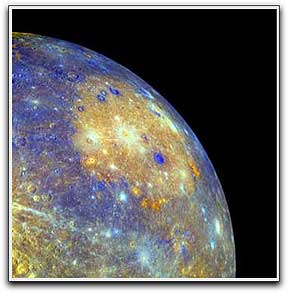
 SPACE — Scientists have argued about the origins of Mercury’s smooth plains and the source of its magnetic field for more than 30 years. Now, analyses of data from the January 2008 flyby of the planet by the Mercury Surface, Space Environment, Geochemistry and Ranging (MESSENGER) spacecraft have shown that volcanoes were involved in plains formation and suggest that its magnetic field is actively produced in the planet’s core. Scientists additionally took their first look at the chemical composition of the planet’s surface. The tiny craft probed the composition of Mercury’s thin atmosphere, sampled charged particles (ions) near the planet, and demonstrated new links between both sets of observations and materials on Mercury’s surface. The results are reported in a series of 11 papers published in a special section of Science magazine on July 4th. The researchers found evidence of volcanic vents along the margins of the Caloris basin, one of the solar system’s youngest impact basins. They also found that Caloris has a much more complicated geologic history than previously believed. The first altitude measurements from any spacecraft at Mercury also found that craters on the planet are about a factor of two shallower than those on Earth’s moon. The measurements also show a complex geologic history for Mercury.
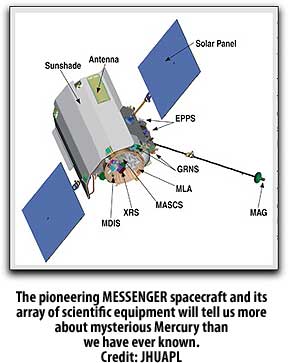 Mercury’s core makes up at least 60 percent of its mass, a figure twice as large as any other known terrestrial planet. The flyby revealed that the magnetic field, originating in the outer core and powered by core cooling, drives very dynamic and complex interactions among the planet’s interior, surface, exosphere and magnetosphere. The flyby also made the first-ever observations of the ionized particles in Mercury’s unique exosphere. The exosphere is an ultra-thin atmosphere in which the molecules are so far apart they are more likely to collide with the surface than with each other. The
planet’s highly elliptical orbit, its slow rotation and particle interactions with the magnetosphere, interplanetary medium and solar wind result in strong seasonal and day-night differences in the way particles behave.
Mercury’s core makes up at least 60 percent of its mass, a figure twice as large as any other known terrestrial planet. The flyby revealed that the magnetic field, originating in the outer core and powered by core cooling, drives very dynamic and complex interactions among the planet’s interior, surface, exosphere and magnetosphere. The flyby also made the first-ever observations of the ionized particles in Mercury’s unique exosphere. The exosphere is an ultra-thin atmosphere in which the molecules are so far apart they are more likely to collide with the surface than with each other. The
planet’s highly elliptical orbit, its slow rotation and particle interactions with the magnetosphere, interplanetary medium and solar wind result in strong seasonal and day-night differences in the way particles behave.
