

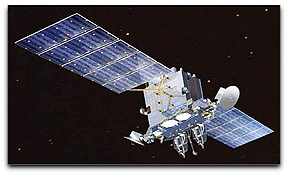
 The first Advanced Extremely High Frequency (AEHF) military communications satellite is now undergoing thermal vacuum testing at the Lockheed Martin’s Sunnyvale, California, facilities. The U.S. Air Force’s AEHF system will provide global, highly secure, protected, survivable communications for all warfighters serving under the U.S. Department of Defense. Thermal vacuum testing will verify AEHF spacecraft functionality and performance in a vacuum environment where the satellite is stressed at the extreme hot and cold temperatures it will experience in space throughout its 14-year design life. AEHF thermal vacuum testing is conducted in Lockheed Martin‘s Dual Entry Large Thermal Altitude (DELTA) chamber and is one of several critical environmental test phases that validate the overall satellite design, quality of workmanship and survivability during space vehicle launching and on-orbit operations.
Following completion of spacecraft thermal vacuum testing in late July, the Lockheed Martin Space Systems team (he Advanced EHF prime contractor) and Northrop Grumman Space Technology (the payload supplier) will perform environmental test data analysis and remaining integration and test activities necessary to prepare the vehicle for flight. The spacecraft is planned for delivery to the Air Force in early 2009 in preparation for launch aboard an Atlas V launch vehicle. Lockheed Martin is currently under contract to provide three Advanced EHF satellites and the Mission Control Segment to its customer, the Military Satellite Communications Systems Wing, located at the Space and Missile Systems Center, Los Angeles Air Force Base, California. The program is in the early stages of adding a fourth spacecraft to the planned constellation.
