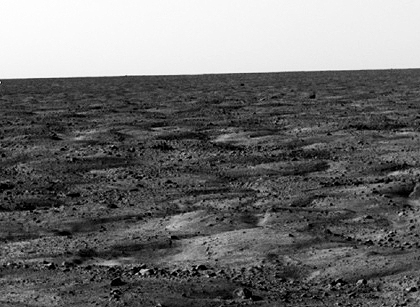
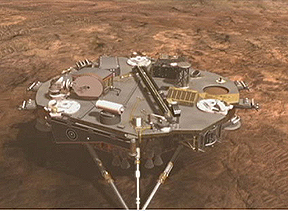
 The Phoenix Lander has arrived at its destination—Mars. The JPL control center joyfully celebrated the touchdown on the Red Planet. As we watched NASA TV, we could feel the sense of victory and joy permeating the control center. This is the first time, in 32 years, a spacecraft has landed using a propulsion system on Mars, rather than airbags. As the Director of JPL (Jet Propulsion Labs) stated, this mission was just too heavy for airbag use. Now it’s proven a soft landing is possible using propulsion. The next mission to Mars, the Mars Science Lab, is heavier than Phoenix, but the team has proven a soft landing can be obtained. NASA’s Phoenix spacecraft landed in the northern polar region of Mars and now begins three months of examining a site chosen for its likelihood of having frozen water within reach of the lander’s robotic arm.Picture below is of the Phoenix after its landing and is courtesy of NASA TV…
Peter Smith, principal lead for the mission, stated he was always optimistic regarding the landing. Excerpts from his on-camera interview included, “the team performed perfectly… couldn’t let go of the chair… it was just a thrill… landed on a spot almost horizontal to the surface, nice flat place, safe and happy… no rocks… this is a world mission.”
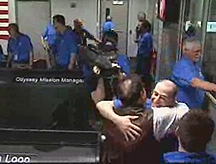 The Project Manager’s comments “…in my dreams, this couldn’t have gone as perfectly as tonight… one minute of data was received right after touchdown… there’s a 1/4 degree tilt, but we’re almost dead on with azimuth… waiting for Odyssey (ESA) to pass by to confirm solar array deployment … couldn’t have gone any better… we had all the signals, everything… no high fives yet, the solar arrays have to deploy… I tore up the contingency papers… five years of testing… we exhausted all of the possibilities, tested everything… we have the absolute best team in the world, Lockheed, JPL, Langley, Ames… best support… we’ve also proven you can fix things, learn from your mistakes, and make them work…
Congratulations to all involved with Phoenix… so far, a stunning success! Imagine—.1 meter per second was attained by the craft for a truly soft landing, so soft that the ground surface of Mars was not even disturbed! The landing went better than any of the test results predicted. Truly amazing… Below is a raw (unprocessed) image taken by the Phoenix lander on Mars on May 25th…