

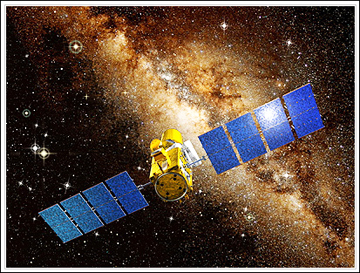
This Spacial Exoplation Is Courtesy Of ESA’s COROT
An exoplanet is a planet that is orbiting a star other than our solar system’s Sun, most having been detected by their gravitational influence on their star that causes a periodic shift in the spectral lines of the star. ESA‘s COROT mission has located two new exoplanets plus an unknown celestial object. The two new planets are gas giants of the hot Jupiter type. They orbit close to their parent star and have extensive atmospheres due to heat from the nearby star gives them energy to expand. These results were presented this week at the IAU symposium 253. Plus, an oddity that has been named “COROT-exo-3b” appears to be something between a brown dwarf, a sub-stellar object without nuclear fusion at its core, but with some stellar characteristics, and a planet. The oddity cannot be a super-planet, as its radius is too small. If it is a star, it will be among the smallest ever detected. Scientists suspect this oddity may well be the missing link between stars and planets. COROT has been operating for 510 days. The mission started observations of its sixth star field at the start of May this year. During this observation phase, which will last for five months, the spacecraft will simultaneously observe some 12,000 start.
