

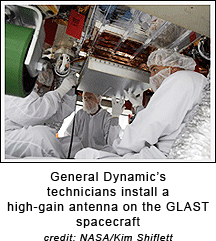
 The Gamma-ray Large Area Space Telescope (GLAST) has now been targeted by NASA for a launch on June 3rd from Pad 17-B at Cape Canaveral Air Force Station. The launch window extends from 11:45 a.m. to 1:40 p.m. EDT. That window will remain unchanged through August 7th. The GLAST launch date will be moved if the space shuttle Discovery‘s May 31st liftoff is somehow delayed. NASA‘s new gamma-ray observatory will open a wide window on the universe through the study of Gamma rays, the highest-energy form of light. GLAST data will enable scientists to answer persistent questions across a broad range of topics, including supermassive black-hole systems, pulsars, the origin of cosmic rays, and searches for signals of new physics—Cape Canaveral, Florida
A Blast For GLAST
The Gamma-ray Large Area Space Telescope (GLAST) has now been targeted by NASA for a launch on June 3rd from Pad 17-B at Cape Canaveral Air Force Station. The launch window extends from 11:45 a.m. to 1:40 p.m. EDT. That window will remain unchanged through August 7th. The GLAST launch date will be moved if the space shuttle Discovery‘s May 31st liftoff is somehow delayed. NASA‘s new gamma-ray observatory will open a wide window on the universe through the study of Gamma rays, the highest-energy form of light. GLAST data will enable scientists to answer persistent questions across a broad range of topics, including supermassive black-hole systems, pulsars, the origin of cosmic rays, and searches for signals of new physics—Cape Canaveral, Florida
