

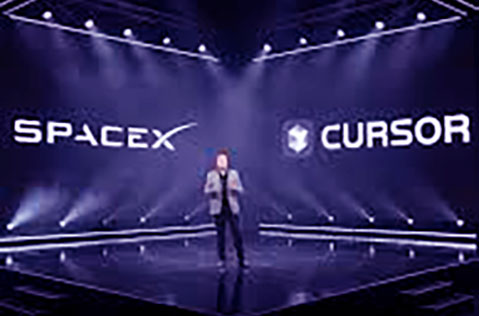
Following the formal execution of a definitive agreement and subsequent financial disclosures in early August 2026, space transport and satellite communications provider SpaceX is progressing toward the final closing of its $60 billion all-stock acquisition of Anysphere, the developer behind AI-powered coding assistant Cursor.
The acquisition represents one of the largest corporate technology transactions executed by a space enterprise, aligning with SpaceX’s broader strategy to expand its internal software development capabilities and enterprise artificial intelligence compute services.
The transaction utilizes SpaceX’s equity value to absorb Cursor’s machine learning development stack, integrating automated code generation directly into mission-critical aerospace
software pipelines.
Financial Disclosures and Corporate Restructuring
The acquisition of Cursor represents a core component of SpaceX’s evolving business model beyond launch services and satellite broadband. As first detailed in comprehensive analysis covering SpaceX’s S-1 regulatory registration filing, SpaceX structured its corporate operations into three main business units comprising Connectivity (Starlink), Space (Launch and Starship), and AI Compute. The S-1 disclosures revealed that SpaceX held a definitive option agreement to acquire Anysphere at a $60 billion valuation, supported by $10 billion in deferred service commitments.
Furthermore, in SpaceX’s second-quarter 2026 financial report released on August 4, 2026, the company confirmed that revenues reached $7.8 billion—a 92 percent year-over-year increase—with segment expansion driven by enterprise cloud agreements and Starlink subscriber growth. Incorporating Cursor into the corporate balance sheet expands SpaceX’s AI infrastructure, which already includes long-term compute hosting agreements with third-party generative AI developers.
System Architecture and Software Engineering Integration
Integrating Cursor’s automated software architecture is engineered to optimize code development across SpaceX’s engineering divisions. Primary operational integration targets across the company’s hardware and software ecosystem include:
- Flight Software and Avionics: Accelerating C++ and Rust code generation for flight computers, engine controller firmware, and active thrust-vectoring software operating on Falcon 9 and Starship launch vehicles.
- Starlink Constellation Routing: Automating real-time network management code to route optical inter-satellite links across more than 10,000 active Low Earth Orbit (LEO) broadband satellites.
- Ground Segment Integration: Streamlining backend database architecture for Starlink customer billing, network telemetry, and direct-to-cell (D2D) spectrum coordination tools.
- Payload Simulation Frameworks: Enhancing hardware-in-the-loop (HITL) simulation suites to test real-time re-entry and landing algorithms for Starship upper stages.
By deploying Cursor’s large language model (LLM) coding algorithms directly onto internal engineering servers, SpaceX aims to reduce software iteration cycles and accelerate testing timelines for upcoming launch programs.
“2026 has been a momentous year so far, and the second quarter demonstrated the true power of SpaceX,” noted SpaceX executive leadership in official earnings commentary following the Q2 results disclosure. “Revenue growth accelerated across all our business segments and we delivered strong operating leverage, with significant margin expansion led by our new AI compute agreements.”
As reported on August 7, 2026, regulatory reviews by Federal trade authorities are approaching completion, with final closing of the transaction anticipated before the end of August 2026. Upon final closing, Anysphere’s engineering team will integrate into SpaceX’s AI software division, with the existing Cursor developer platform continuing to serve enterprise softwa
