

KWAJALEIN ATOLL — The high-stakes orbital servicing flight intended to rescue NASA’s decaying Neil Gehrels Swift Observatory was postponed on Tuesday, June 30, 2026, due to unfavorable weather conditions over the Pacific launch range. The air-launched mission, originally scheduled to deploy during the morning window from Kwajalein Atoll in the Marshall Islands, has been moved to a tentative backup window opening no earlier than Wednesday, July 1, 2026.
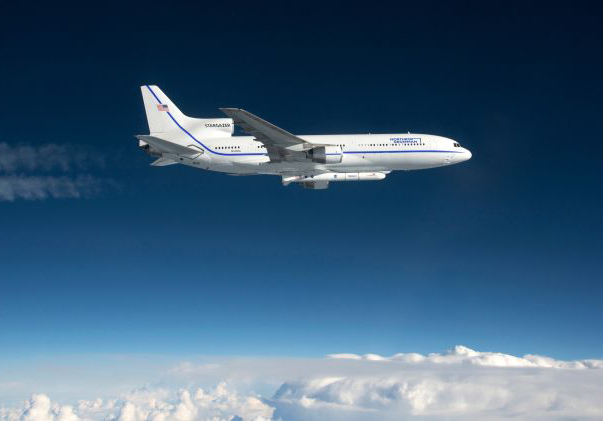
The launch operations team confirmed that the airborne launch platform, a modified Northrop Grumman Stargazer L-1011 carrier aircraft, remains on standby at the airfield. The aircraft is configured to carry a three-stage solid-fuel Pegasus XL rocket, which encapsulates Katalyst Space Technologies’ 425-kilogram LINK robotic servicing vehicle.
Mission Architecture and Technical Interventions
The delay introduces a brief pause into an accelerated, time-sensitive launch schedule dictated by the telescope’s thermodynamic decay curve. Swift, a $500 million triple-instrument astrophysical observatory launched in 2004 to identify cosmic gamma-ray bursts, has spent the last year rapidly losing altitude. Intense solar activity across the recent solar maximum expanded Earth’s thermosphere, creating severe aerodynamic drag that stripped away the propulsion-less satellite’s orbital energy, lowering its altitude toward a critical 224-mile threshold.
To preserve structural margins while Katalyst engineered the rescue payload under a compressed $30 million Small Business Innovation Research (SBIR) Phase III contract, NASA ground controllers enacted a strict drag-minimization profile on February 11, 2026. By powering down major science instruments and relaxing solar array orientation rules, operators reduced Swift’s average cross-sectional area by approximately 30%. This operational pause successfully extended the spacecraft’s “point of no return” into late October 2026, keeping it safely above the 186-mile limit where excessive atmospheric torque would prevent a stable mechanical capture.
Post-Launch Commissioning and Re-boosting Schedule
Once weather conditions clear and the Pegasus XL completes its mid-air drop and ignition sequence at an altitude of 40,000 feet, the mission will shift to a methodical operational track managed from Katalyst’s flight control center:
Timeline to Orbit Restoration
| Mission Phase | Core Operational Parameters | Estimated Duration |
| Phase 1: Commissioning | Initial signal acquisition, solar array deployment, and foundational subsystem checkouts in low Earth orbit. | 1 to 2 Weeks |
| Phase 2: Orbital Phasing | Autonomous navigation maneuvers to match Swift’s specialized 21-degree inclination and close the orbital distance. | ~1 Month |
| Phase 3: Proximity Operations | High-resolution close-up imaging and synchronization with non-cooperative grapple zones. | Flight Team Discretion |
| Phase 4: Mechanical Capture | Deployment of three robotic arms featuring finger-like grippers to secure a physical latch on the telescope structure. | Immediate Upon Docking |
| Phase 5: Propulsion Re-boost | Active firing of LINK’s integrated Hall-effect thrusters to elevate the assembly back to a stable altitude of 550 to 600 kilometers. | 2 to 3 Months |
Following completion of the multi-month propulsion campaign, the LINK vehicle will decouple from the telescope, utilizing its remaining xenon propellant reserves to lower its own perigee and speed up a destructive atmospheric reentry. NASA engineers will then initiate a systematic multi-wavelength recalibration process to return Swift to full active service as the primary alert trigger for global transient astrophysics monitoring networks.
