

The phenomenon of “Ghost Viewers” highlighted in Samsung Ads’ State of CTV report exposes a massive challenge in modern media consumption: extreme audience churn driven by specific, short-term content events.

While this behavior directly impacts streaming platforms and advertisers trying to measure ROI, it triggers a powerful secondary ripple effect on Satellite Communications (SatCom) infrastructure and maritime/aerospace data networks.
The breakdown below details exactly what ghost viewing means and how these massive, shifting audience spikes alter the math for satellite networks.
Understanding “Ghost Viewers”
A Ghost Viewer is a user who downloads, subscribes to, or aggressively streams a digital platform for a singular, high-profile event—such as the NFL season, a major tournament, or a viral series—and then completely vanishes once that content concludes.
- The Scale: According to the report, even the largest streaming applications lose or are “ghosted” by a user base equivalent to roughly half of their active quarterly audience.
- The Event Trigger: This behavior is highly volatile around live sports. When viewers migrated to major NFL streaming apps during the football season, 66% ghosted the applications immediately after the season ended—nearly double the normal user attrition rate.
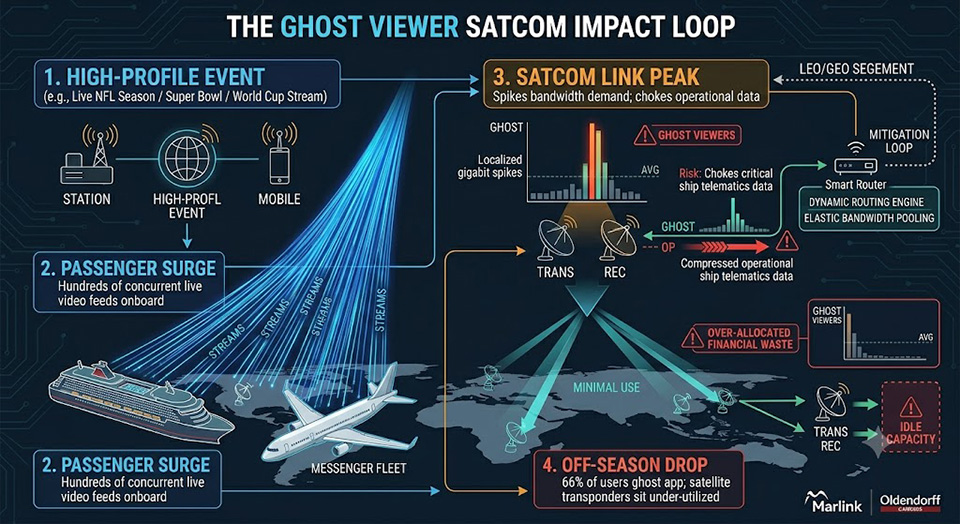
The Downstream Effects on SatCom and Hybrid Networks
When thousands of commercial airliners, cruise ships, cargo vessels, and remote base camps are factored in, “Ghost Viewers” cease to be just an advertising metric. They become a severe capacity management problem for maritime and aerospace satellite communication (SatCom) providers.
Extreme “Peak-to-Average” Bandwidth Strain
SatCom bandwidth over global oceans or flight corridors is finite, expensive, and historically provisioned based on predictable baseline averages. Ghost viewing fundamentally breaks this model.
- During peak event cycles (e.g., the NFL playoffs), thousands of passengers aboard aircraft or cruise ships simultaneously stream the exact same high-definition, live video feed.
- This creates sudden, localized megawatt/gigabit demand spikes over specific satellite transponders. If a SatCom network hasn’t engineered massive, elastic headroom, these spikes degrade network performance, slowing down business-critical operational data like cockpit communications or vessel telematics.
Financial Waste via Over-Allocation
Because operators cannot afford to let their connectivity fail during premium passenger events, they are frequently forced to buy expensive, fixed-capacity satellite beams to handle worst-case scenario peaks. However, when 66% of those viewers ghost the app at the end of the season, that streaming traffic drops off a cliff. The SatCom provider is left holding expensive, leased satellite capacity that sits completely under-utilized during the off-season.
The Shift to Managed Multi-Orbit Data Pools
To combat the financial and technical volatility caused by ghost viewers, the maritime and aviation SatCom sectors are migrating away from rigid, single-satellite bandwidth contracts. They are adopting Managed Multi-Orbit Platforms (combining LEO networks like Starlink with legacy GEO VSAT systems).
- Dynamic Software-Defined Allocation: Modern hybrid networks allow a maritime or aviation provider to dynamically route streaming traffic. During the football season, data-heavy live video streams can be pushed entirely onto low-cost, low-latency LEO networks, shielding the core GEO satellite channels for mission-critical ship operations.
- Elastic Fleet Pooling: Instead of dedicating fixed bandwidth to a single vessel or aircraft, SatCom managers use centralized data pools. If one cruise ship is packed with sports fans streaming a live game, bandwidth can be dynamically diverted to it from cargo vessels or empty aircraft in the same region, smoothing out the operational shockwaves caused by ghost viewers.
