

Driven by an intense geopolitical landscape and an absolute military necessity to overcome sophisticated electronic jamming and spoofing, the global military GPS receiver market is undergoing a highly lucrative modernization phase.
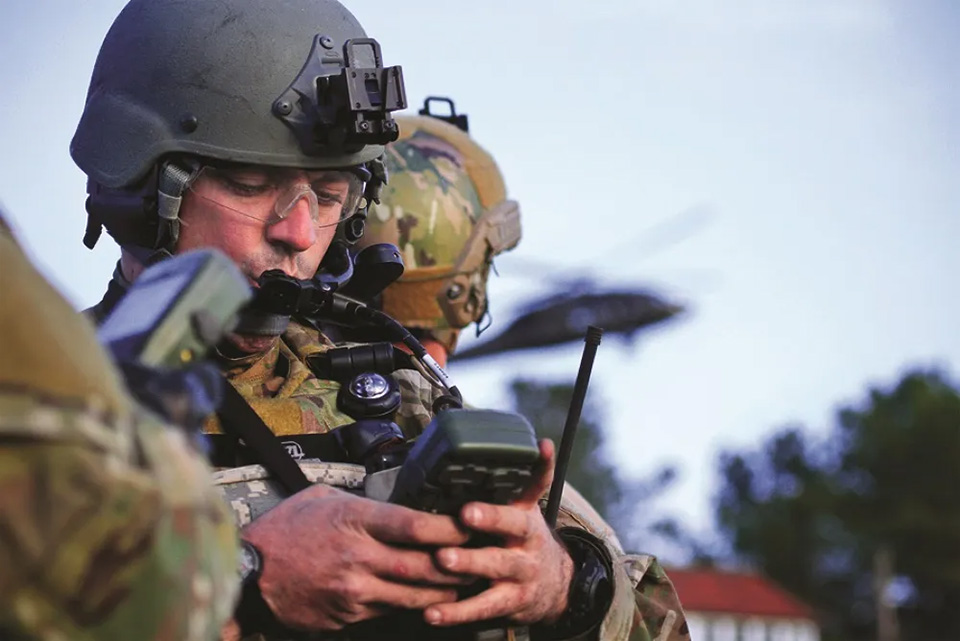
According to an operational market summary, the sector was valued at $1.962 billion and is on track to reach $2.862 billion by 2035. This represents a steady compound annual growth rate (CAGR) of 3.49%, as defense ministries phase out legacy positioning platforms in favor of highly resilient, cyber-hardened navigation hardware.
The Operational Reality: Hardening the PNT Network
In modern multi-domain operations, positioning, navigation, and timing (PNT) data is the operational anchor for everything from infantry situational awareness to the autonomous guidance systems of high-speed loitering munitions. However, the widespread proliferation of localized electronic jamming blankets has forced a structural shift away from commercial-grade tracking.
The primary catalyst for modern procurement cycles is the integration of M-Code (Military Code) capabilities. M-Code is an exclusive, highly secure military GPS signal designed to operate reliably in heavily contested electronic environments. Defense contractors are rapidly re-engineering receivers across frequencies—moving aggressively from the mature L1/L2 configurations to highly resilient multi-frequency L1/L2/L5 platforms—to deliver unprecedented anti-jamming protection to frontline warfighters.
                  MILITARY GPS RECEIVER MARKET PROFILE
+------------------------------------+------------------------------------+
| FINANCIAL METRICS                  | STRATEGIC DEMAND DRIVERS           |
+------------------------------------+------------------------------------+
| • 2024 Valuation: $1.962 Billion   | • Dense Adversarial Jamming        |
| • 2035 Projection: $2.862 Billion  | • Autonomous & Drone Fleet Surges  |
| • Industry CAGR: 3.49%             | • Multi-Domain System Integration  |
| • Largest Region: North America    | • Network-Centric Warfare Needs    |
+------------------------------------+------------------------------------+
Market Segmentation and Fast-Growing Horizons
While traditional, heavy hardware dominates the current landscape, the miniaturization of aerospace electronics is shaking up individual product lines.
- Technology: Stand-Alone vs. Integrated Modules: Stand-alone units remain the largest market segment due to their durability and proven performance during harsh ground operations. However, Integrated GPS Modules represent the fastest-growing technology segment. As defense strategies transition toward network-centric warfare, prime contractors require tiny, high-efficiency chips that can be nested directly inside radios, wearable computing kits, and smart munitions.
- Platform: Airborne Dominance vs. Space-Based Growth: The Airborne segment captures the vast majority of funding due to its vital role in aerial reconnaissance, strike coordination, and fighter jet navigation. In contrast, the Space-Based platform is expanding at the fastest clip, fueled by massive, ongoing military investments in low-Earth orbit (LEO) constellations and localized satellite-based positioning networks.
- Application: The Rise of Electronic Warfare: Standard navigation and guidance applications still command the baseline of global budgets. However, specialized Electronic Warfare (EW) sub-segments are seeing explosive growth. Rather than just receiving signals, modern military receivers are increasingly expected to actively identify spoofed data streams and coordinate with electronic countermeasures to suppress adversarial transmitters.
Regional Dynamics and Strategic Playbooks
The market remains heavily concentrated within established regional defense powers, though procurement strategies vary significantly by zone.
| Regional Market | Global Share | Primary Strategic Focus |
| North America | ~45% | Evolving next-generation M-Code assets, large-scale R&D funding, and extensive unmanned systems integration. |
| Europe | ~30% | Shifting from long-term strategic projects to immediate operational readiness, backed by collaborative EU defense initiatives. |
| Asia-Pacific | ~20% | Fastest-growing sector; heavy domestic engineering to reduce reliance on foreign technology amid escalating territorial disputes. |
| Middle East / Africa | ~5% | Targeted modernizations heavily reliant on international tech transfers and global defense partnerships. |
Frontline Industrial Movements
The competitive landscape is dominated by Tier-1 defense innovators who are actively securing multi-million-dollar government awards to validate these evolving market trends:
- Lockheed Martin: The aerospace giant recently secured a landmark $514 million Space Force contract to produce its 23rd and 24th next-generation GPS IIIF satellites. These spacecraft are built around an advanced Regional Military Protection architecture, delivering a 63-fold increase in anti-jamming signal strength to assets on the ground and in the air. This push is paired with a separate $105 million contract to modernize corresponding ground control stations.
- Raytheon (an RTX Business): Highlighting the push toward platform integration, Raytheon locked in a $206.2 million U.S. Navy contract to integrate M-Code GPS capabilities into the AN/USN-3(V)1 Joint Precision Approach and Landing System (JPALS). This initiative ensures aircraft can execute pinpoint maritime landings even under dense electronic interference. Concurrently, Raytheon continues high-rate production for the Air Force under its Miniaturized Airborne GPS Receiver (MAGR) program.
- Northrop Grumman: The company is executing a clear technological acquisition playbook, absorbing specialized, smaller AI-driven navigation firms to blend machine learning directly into its tactical receiver suites, optimizing signal sorting in highly cluttered electromagnetic environments.
